Education
What Children Learn When They Count on an Abacus
25 September 2026





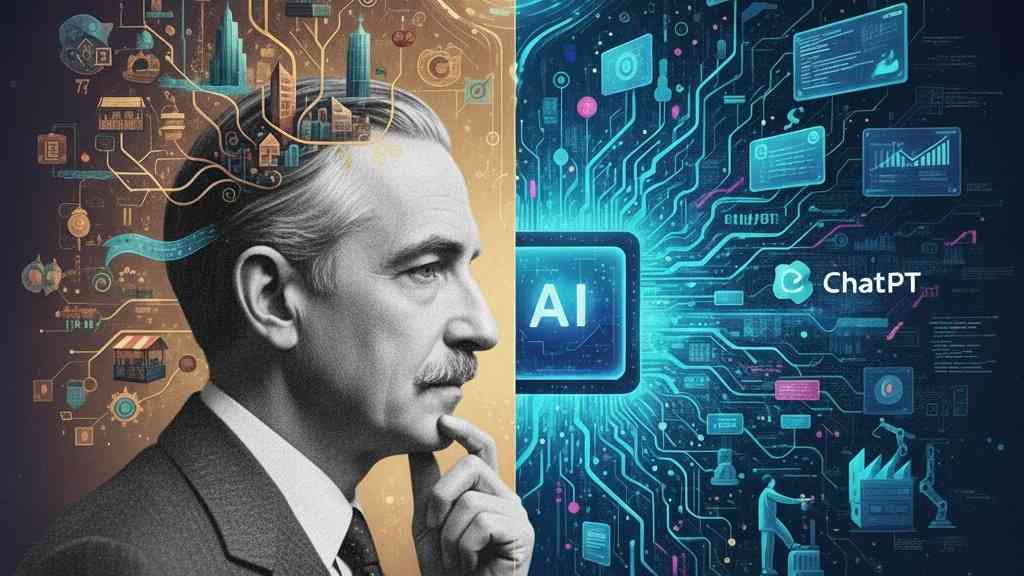
Millions in investments, labor automation, and algorithms entering daily life are not mere technological accidents. A Nobel Prize winner described their underlying mechanism long before the era of personal computers. Understanding Hayek’s AI legacy reveals that today’s digital shift follows a profound, pre-established logic.
Friedrich Hayek, the 1974 Nobel laureate, left us a key to understanding why AI is conquering the world right now. In 1952, when computers occupied entire rooms, Hayek published his groundbreaking work, The Sensory Order. In it, he described the human mind not as a central processor, but as a self-organizing classificatory network. He argued that knowledge and cognitive order emerge from the bottom up through trillions of neural connections.
This concept of spontaneous order proved prophetic. AI pioneers quickly recognized the value of Hayek’s AI legacy. Frank Rosenblatt directly cited The Sensory Order in his 1958 landmark paper on the perceptron, and Marvin Minsky included Hayek’s work in leading AI bibliographies around 1960.
Today’s Large Language Models (LLMs) operate on this exact principle. Their “reasoning” is not hard-coded; instead, it emerges spontaneously from data analysis. Hayek, an economist and philosopher, unknowingly described the architectural foundations of the most powerful technology of our time. While his historical contribution remained forgotten for decades, scholars today increasingly acknowledge his influence.
Though he is famous for economics, the same logic of spontaneous order Hayek discovered in perception formed the core of his revolutionary view of the market. To Hayek, the market is not a machine but a living, self-organizing communication system. Prices serve as information, carrying the dispersed knowledge of millions of participants. This deep understanding of complex systems allows us to see the AI boom not just as a tech breakthrough, but as the realization of fundamental economic principles.
The key to the AI boom lies in Hayek’s interpretation of the “Ricardo Effect.” Classically, this suggests that when wages rise, firms invest in machinery. Hayek saw a deeper dynamic involving time and capital availability.
Hayek explained that a sharp rise in consumer demand could lead to a paradox: instead of investing in long-term technologies, entrepreneurs might prefer increasing current production on existing lines. Why? Because when immediate profits are high, waiting for a return on long-term investment becomes unattractive.
Today, however, AI-driven automation has dismantled this classical dilemma. Companies no longer need years of investment in physical infrastructure; a subscription often suffices. As labor costs rise and the cost of digital tools plummets, the market responds instantly. This is an operational purchase of efficiency, rather than a capital investment in buildings or assembly lines.
The recent economic experience in Poland serves as a vivid illustration. A significant “wage miracle” created intense cost pressure. Following the logic of the Ricardo Effect, this forced a search for labor substitutes. In sectors where substitutes existed—such as IT, analytics, and law—a rapid shift toward automation occurred. In contrast, sectors relying on manual dexterity and relationships, like hairdressing, saw prices for consumers rise directly due to a lack of adaptable alternatives.
The market separates sectors susceptible to algorithms from those resistant to them with surgical precision. This reveals the purely economic mechanism behind the AI boom. We feel this not only through technology’s presence in our lives but also through inflationary price increases and the rising cost of living.
Hayek’s thought also offers a sharp warning regarding AI development. His concept of “The Pretence of Knowledge” takes on a dangerous new meaning today. Hayek argued that the knowledge required to manage a complex society is dispersed, local, and impossible to centralize.
Today, this illusion has two faces:
Did Hayek literally predict the AI boom? No. But through his analysis of spontaneous order, the Ricardo Effect, and dispersed knowledge, he provided the tools to understand it. He showed that fundamental economic forces—not just technological determinism—drive this revolution.
Hayek’s AI legacy serves as both a warning and a compass. The real threat does not stem from a machine rebellion, but from our own temptation to accept centralized, statistical models as a substitute for the living, diverse, and dispersed wisdom of human action. The future with AI should not consist of building a single, omniscient demiurge; instead, it must focus on strengthening an ecosystem of dispersed tools that help people utilize their unique, local, and indescribable knowledge.
AI can function as a tool serving this exchange—this constant process of coordinating dispersed knowledge. However, it will never replace it. And this is precisely the Hayek Effect. It serves as a reminder that true intelligence is not a collection of data, but the ability to act in a world that no one fully understands, yet which we all create together every single day. In this sense, the AI boom represents more than just a technological revolution. It stands as a triumph of the philosophy of spontaneous order, a concept prophesied by Friedrich Hayek long before the computer age.
Perhaps one more fundamental conclusion flows from this history. The world around us changes dynamically, but the rules governing these changes can remain permanent and independent of time. Thinkers and scientists from different eras may have held the keys to understanding them. It is worth reaching for those keys today.
Read this article in Polish: Efekt Hayeka. Jak noblista z lat 70. przewidział rewolucję AI


A graduate of Journalism and Social Communication at the University of Warsaw (UW), specializing in culture, literature, and education. Professionally, they work with words: reading, writing, translating, and editing. Occasionally, they also speak publicly. Personally, they are a family man/woman (head of the family). They have professional experience working in media, public administration, PR, and communication, where their focus included educational and cultural projects. In their free time, they enjoy good literature and loud music (strong sounds).


Zmień tryb na ciemny