Culture
A Life Spent Becoming Someone Else’s Ideal
12 October 2026





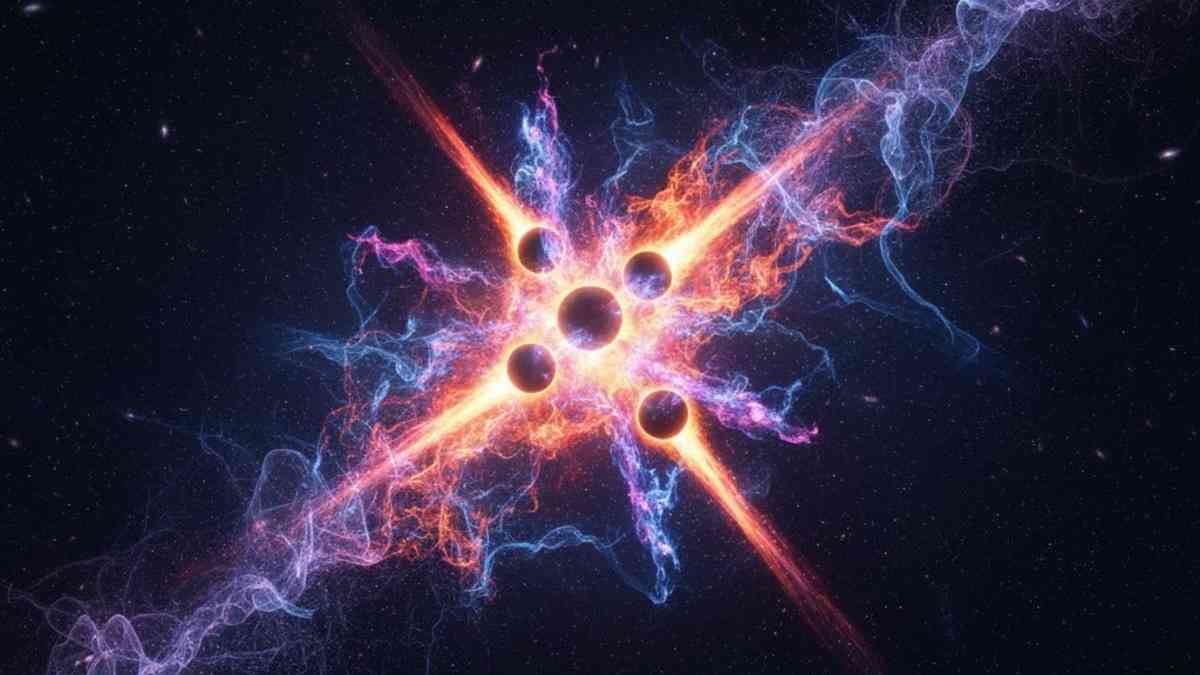
Two independent studies published in early 2026 offer a sophisticated perspective on the structural evolution of the universe. The first reveals an extraordinarily hot galaxy cluster from the cosmos's formative stages, while the second investigates the subtle interactions between dark matter and neutrinos. These findings address persistent cosmological tensions, providing a clearer view of the early universe and prompting researchers to refine the standard models of cosmic history.
While current cosmological models accurately describe many aspects of the universe, emerging discoveries often surprise scientists dedicated to studying its history. Recent, ultra-precise observations are beginning to indicate discrepancies between long-held assumptions and reality. Two independent studies published recently shed light on these gaps, both utilizing data from different cosmic epochs. Their results appeared in the prestigious journals Nature and Nature Astronomy.
An international team of astronomers, led by researchers from the University of British Columbia, focused their attention on a galaxy cluster designated as SPT2349-56. This object is incredibly remote; its light traveled approximately 12 billion years to reach Earth. Consequently, we observe the cluster as it existed just 1.4 billion years after the Big Bang—a mere fraction of time on a cosmic scale.
Using the high-resolution ALMA radio telescope array in Chile, the scientists measured the temperature of the so-called intracluster gas. This term describes the hot plasma that fills the space between galaxies within a cluster. They achieved this measurement by analyzing the Sunyaev-Zeldovich effect—subtle distortions in the Cosmic Microwave Background (CMB). These distortions occur when CMB photons pass through hot gas.
The results proved startling. The gas in this young cluster is at least five times hotter than basic simulations of cluster formation predict within the standard cosmological model. After months of verification, the researchers determined that the cluster did not only form rapidly but was also violently heated.
Investigators point to the most likely source of this energy: supermassive black holes. At least three such objects reside at the center of SPT2349-56. Their jets—powerful streams of matter and energy—could have functioned as immense “heaters.” It appears they injected energy and heated the surrounding gas on a massive scale much earlier than previously thought, as reported by Science Daily.
Simultaneously, a completely different team from the University of Sheffield published a paper analyzing one of the most serious inconsistencies in modern cosmology: the S8 tension. This problem stems from the fact that the contemporary universe appears slightly “thinner” or less dense than measurements from its earliest moments would suggest.
The source of this difference lies in the maps of the Cosmic Microwave Background—the afterglow of the Big Bang recorded by the Planck and ACT telescopes. These maps suggest exactly how much matter, primarily dark matter, should have condensed under the influence of gravity over the last 13 billion years. However, modern sky surveys like the Dark Energy Survey, which directly count and measure the distribution of galaxies, show a slightly lower concentration of matter than those predictions.
To resolve this puzzle, the Sheffield scientists considered a new possibility in their model: the interaction between dark matter and neutrinos. Neutrinos are incredibly light, nearly massless elementary particles that permeate the entire universe, passing through our bodies billions of times per second with virtually no interaction. The standard model of cosmology assumes they do not interact with dark matter either.
However, a new statistical analysis combining massive datasets from different cosmic epochs showed that a model allowing for even a weak interaction between these components fits the observations better. Why this conclusion? If dark matter “felt” the presence of neutrinos, their interaction would act as a cosmic “brake.” Neutrinos, moving at enormous speeds, would strip dark matter of some of its momentum, thereby slowing its accumulation under the force of gravity. This would explain why today’s universe is less “clumped” into clusters than previously anticipated.
Both research teams emphasize the preliminary nature of these findings and point to the need for further confirmation. In the case of the hot cluster, the key will be understanding how various violent processes—intense star formation, black hole activity, and the dynamics of hot gas—could coexist and interact within such a compact, young system.
As for the interaction between dark matter and neutrinos, it currently remains a compelling statistical possibility. However, if confirmed, it would represent a fundamental breakthrough, according to the researchers. Verification using data from even more sensitive observatories will be necessary.
These new findings may indicate where previously unconsidered physical processes might be hiding. They demonstrate how 21st-century precision cosmology, based on the synthesis of vast datasets, is entering a phase of testing the finest details of our cosmic history. Certainly, the final word on these cosmological tensions has not yet been written.
Read this article in Polish: Nowe odkrycia o początkach Wszechświata. Naukowcy zaskoczeni


A graduate of Journalism and Social Communication at the University of Warsaw (UW), specializing in culture, literature, and education. Professionally, they work with words: reading, writing, translating, and editing. Occasionally, they also speak publicly. Personally, they are a family man/woman (head of the family). They have professional experience working in media, public administration, PR, and communication, where their focus included educational and cultural projects. In their free time, they enjoy good literature and loud music (strong sounds).



Zmień tryb na ciemny