Education
What Children Learn When They Count on an Abacus
25 September 2026






More than 5 centuries after his death, Leonardo da Vinci is making headlines again—not for a lost painting, but for genetics. In a new study, researchers report trace Y-chromosome signals that may include Leonardo da Vinci’s DNA, recovered from a drawing known as Holy Child.
This could be the breakthrough of the century. Researchers from the Infectious Diseases and Genomic Medicine Group and The Jackson Laboratory for Genomic Medicine claim they report recovering trace DNA signals that may include a Leonardo da Vinci’s DNA. The key to this discovery? A meticulous analysis of his famous drawing, The Holy Child.
Leonardo da Vinci needs no introduction. A visionary inventor, mathematician, and musician, he remains best known as the world’s most influential painter and sculptor. From the Mona Lisa to The Lady with an Ermine, his Renaissance masterpieces have defined art for generations.
Now, his sketches—specifically The Holy Child—have provided something even more intimate: a biological code dating back over 500 years.
Leonardo died in 1519. While it may seem that every aspect of his life has been scrutinized, a revolutionary new technique is shedding light on his hidden history. Until recently, extracting viable genetic material from centuries-old paper was impossible.
American experts utilized a minimally invasive method to collect samples from sketches, drawings, and personal correspondence. This precision allowed them to isolate a previously unknown DNA sequence without damaging the priceless artifacts.
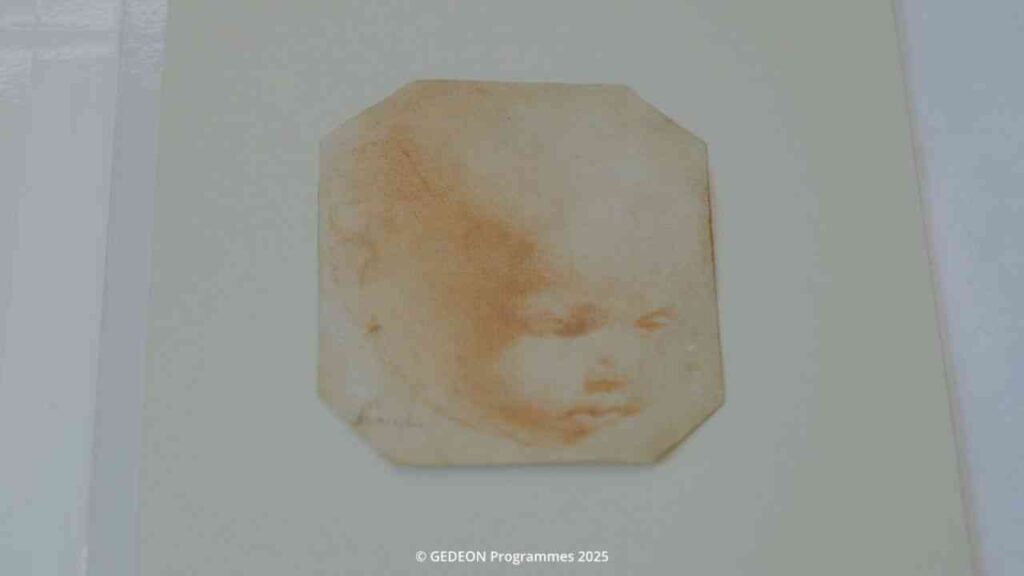
The study, titled Biological signatures of history: Examination of composite biomes and Y chromosome analysis from da Vinci-associated cultural artifacts, reports male Y-chromosome markers. The authors say the pattern is broadly consistent with Central and Southern Italy, including Tuscany—though it does not, on its own, prove identity.
Is it a definitive match? Not yet. While tests on other artifacts belonging to the Da Vinci family show striking similarities, scientists remain cautious. They now plan to test other works and collect DNA samples from Leonardo’s living descendants to confirm the link. If the results hold, it will mark a historic turning point.
In the past, tiny marks on artwork were dismissed as mere contamination. Today, we know these samples hold the keys to the past. This genetic “fingerprinting” can reveal an artist’s travel history, their environment, and even the conditions in which a masterpiece was kept.
This technology could rewrite the history of art conservation and the exchange of Renaissance objects. Beyond human DNA, this method can extract sequences from:
By analyzing wax seals and the absorbent fibers of old paper, we can learn more about creators than ever before. We are no longer just looking at the art; we are looking at the man who held the pen.
Read this article in Polish: Kod Da Vinci odnaleziony? To może być DNA geniusza


A graduate of journalism and social communication at the University of Rzeszów. She has been working in the media since 2019. She has collaborated with newsrooms and copywriting agencies. She has a strong background in psychology, especially cognitive psychology. She is also interested in social issues. She specializes in scientific discoveries and research that have a direct impact on human life.


Zmień tryb na ciemny