Education
What Children Learn When They Count on an Abacus
25 September 2026





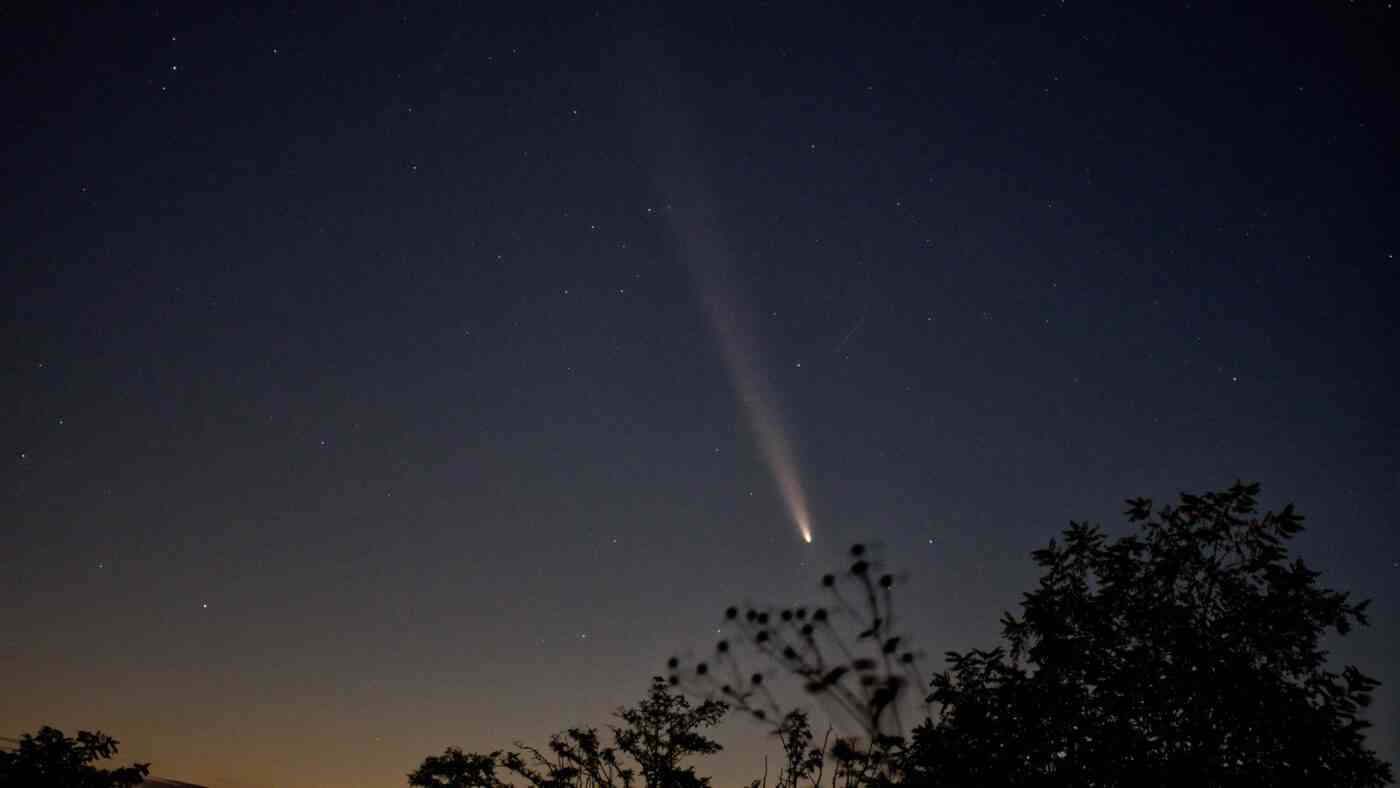
For three centuries, history books have credited Edmond Halley with realizing that the world’s most famous comet returns in a predictable cycle. However, provocative new research suggests a Benedictine monk may have beaten him to the punch by 600 years. Is the timeline of astronomical history due for a rewrite?
Halley’s Comet, officially designated 1P/Halley, remains the most celebrated periodic comet in our solar system. With an orbital period of roughly 76 years, it graces Earth’s skies approximately once every three generations. Its nucleus—a “dirty snowball” of ice, dust, and rock—ignites into a spectacular glowing tail as it nears the Sun, a sight that has captivated humanity since antiquity.
Chronicles from China dating back to 240 BCE, along with Babylonian and Greek records, document its ancient passages. Throughout the Middle Ages, Europeans viewed the comet as a grim harbinger of war or the death of kings. In 1066, it was famously stitched into the Bayeux Tapestry, depicted as a terrifying omen preceding the Battle of Hastings.
While the comet has been sighted for millennia, the world believes the understanding of its cyclical nature came much later. In 1705, British astronomer Edmond Halley analyzed sightings from 1531, 1607, and 1682. He concluded they were not separate events but the same object returning home. Based on this, he predicted its return in 1758. When the comet reappeared exactly as calculated, Halley’s name was etched into the annals of science forever.
According to NASA, Halley’s Comet is legendary because it provided the first proof that comets could be regular fixtures in our night sky rather than random, one-off events. Prior to this, civilizations treated each appearance as a unique divine message. While the name honors Halley’s mathematical brilliance, new evidence asks: was he truly the first to see the pattern?
A multidisciplinary team led by astrophysicist Professor Simon Portegies Zwart of Leiden University and historian Michael Lewis recently scrutinized medieval Latin and Anglo-Saxon chronicles. By cross-referencing these texts with computer-reconstructed orbital paths, they found a compelling candidate for the discovery: Eilmer of Malmesbury.
Eilmer, a Benedictine monk at Malmesbury Abbey in England, was already known to history as a daring (if ill-fated) pioneer of flight. However, researchers now believe he recognized the comet’s periodicity during his own lifetime. Their reconstruction shows that Eilmer would have been a young man during the comet’s 989 CE passage and an elderly monk when it returned in 1066 CE.
The smoking gun resides in the writings of the 12th-century chronicler William of Malmesbury. He records that upon seeing the brilliant comet in the spring of 1066, Eilmer spoke directly to the star:
You’ve come, have you?… It is long since I saw you; but as I see you now you are much more terrible, for I see you brandishing the downfall of my country.
This specific phrasing suggests that Eilmer wasn’t just seeing a comet—he was recognizing the comet he had seen in his youth. The researchers argue this wasn’t a mere literary device. Eilmer identifies a specific, recurring visitor. This realization represents a “seed form” of the very theory Halley would formalize centuries later, fundamentally changing our understanding of who discovered Halley’s Comet and its predictable nature.
While some scholars hint at a name change to reflect this earlier recognition, such a shift remains unlikely. “Halley’s Comet” is woven too tightly into the fabric of scientific culture and textbooks.
Instead, most experts suggest we simply expand the narrative. Rather than a solitary 18th-century genius, the story should include a lineage of observers, with Eilmer potentially being the first to bridge the gap between two sightings. This interdisciplinary approach—fusing astronomy, history, and philology—is revealing that many “modern” discoveries may have been understood by our ancestors.
We may find that other periodic phenomena were recognized long before the modern era,
– concludes Portegies Zwart.
As we look to the stars, it seems we are often just rediscovering what a monk in a drafty abbey already knew nearly a thousand years ago. And if this new work holds up, the question of who discovered Halley’s Comet may deserve a more nuanced answer—one that begins not with Edmond Halley, but with Eilmer’s memory of Halley’s Comet returning across a lifetime.
Read this article in Polish: Mnich z XI wieku wyprzedził astronomów? Kto odkrył Kometę Halleya


A Journalism and Social Communication graduate with 15 years of experience in the media industry. He has worked for titles such as "Dziennik Łódzki," "Super Express," and "Eska" radio. In parallel, he has collaborated with advertising agencies and worked as a film translator. A passionate fan of good cinema, fantasy literature, and sports. He credits his physical and mental well-being to his Samoyed, Jaskier.



Zmień tryb na ciemny