Culture
Between Dreams and Waking: The Mind’s Other Life
04 October 2026





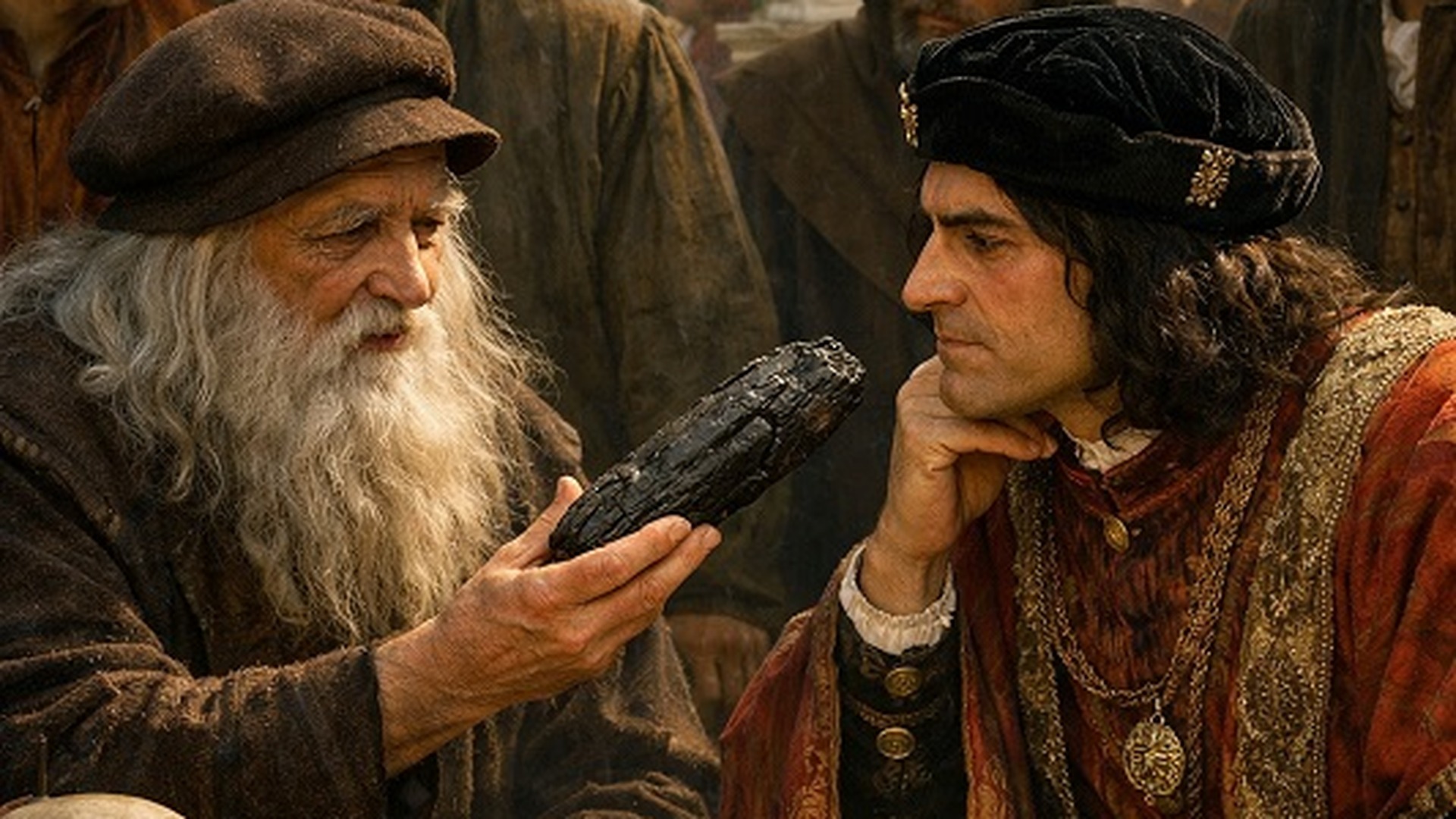
An invention does not always belong to the person who was first — more often to the person who could name it and popularize it. Brilliant ideas and progress often happen independently. Researchers in Italy discovered that there is a strong similarity between Leonardo da Vinci’s note on preserving wood and Japanese yakisugi, which emerged … 200 years later.
Italian researchers—Annalisa Di Maria, Andrea da Montefeltro, and Lucica Bianchi, members of the UNESCO Club of Florence—have pointed to a sentence in the notes of Leonardo da Vinci, written at the turn of the 15th and 16th centuries, which reads like a manual for wood preservation:
They will be better preserved if they are debarked and burned on the surface than in any other way.
(Madrid Codex II, folio 87r).
The surprise lies in the fact that a remarkably similar practice exists in Japan: the yakisugi technique (known in records since at least the 18th century) is based on the same concept of controlled carbonization of the outer wood layer. There is no possibility that the Japanese drew from the Italian polymath’s knowledge.
Researchers refer to this as an example of a convergent invention: a situation in which similar solutions appear independently in cultures that are not necessarily directly linked.
What is truly extraordinary here—the fact that two distant worlds responded to the same problem, or rather that the response proved to be so identical?
This is not an isolated case. The history of ideas is full of such “double births”: Newton and Leibniz independently developed differential and integral calculus; Bell and Gray entered a dispute over the telephone after filing competing documents at the U.S. Patent Office on February 14, 1876; and writing—as historians of script demonstrate—emerged independently across several civilizations.
Convergent invention challenges the myth of the “sole author of an era,” because it is often not a matter of a single flash of genius, but rather that certain needs mature simultaneously: the scale of exchange, administration, construction, warfare, and transport grows. At that point, similar ideas begin to fall “within reach”—because the tools, materials, and language required to even conceive them already exist.
However, this does not mean that creators are unimportant. Convergence simply shifts the emphasis: instead of asking “who was first?”, we begin to ask “why did this become possible just then?”. In this perspective, an invention is less like a meteorite and more like the intersection point of many lines: technology, economics, institutions, and imagination.
In the story of Leonardo and yakisugi, the most impressive aspect is not that “someone had an idea,” but that the ideas were nearly identical. This suggests that sometimes there are only a few sensible ways out of a given problem. Wood has the same weaknesses everywhere: moisture and biology destroy it in similar ways, and fire behaves according to the same laws. It is these “hard constraints” that can lead to similar answers in distant places.
On the other hand, convergence shows that the memory of inventions depends on who was able to describe, disseminate, and defend them. Therefore, the stories of Newton and Leibniz or Bell and Gray teach us not only about ideas but also about institutions: academies, patents, and the language of prestige. Sometimes, it is not the first idea that “wins,” but the one that received better framing and a superior distribution channel.
A similar mechanism can be observed today in Artificial Intelligence: different models, trained on different datasets, can arrive at similar answers because they are constrained by the same type of task and similar rules of inference. However, this is not always proof of truth—sometimes it is proof of shared assumptions or shared data biases. This is precisely why convergence is often more a hint of “what is possible” than a statement of “what is certainly true.”
In this sense, the note from Madrid Codex II is interesting not as “da Vinci’s instruction,” but as a testament to a certain attitude: material is not passive; it has its own rules that must be understood before one begins to improve it by force. Di Maria, da Montefeltro, and Bianchi read this as a precursor to a “culture of care for material”—a way of thinking that is returning today as we attempt to combine craftsmanship, science, and responsibility for durability.


Editor, publisher, and manager experienced in media and education.



Zmień tryb na ciemny