Education
What Does It Take to Keep a Child Curious?
28 September 2026





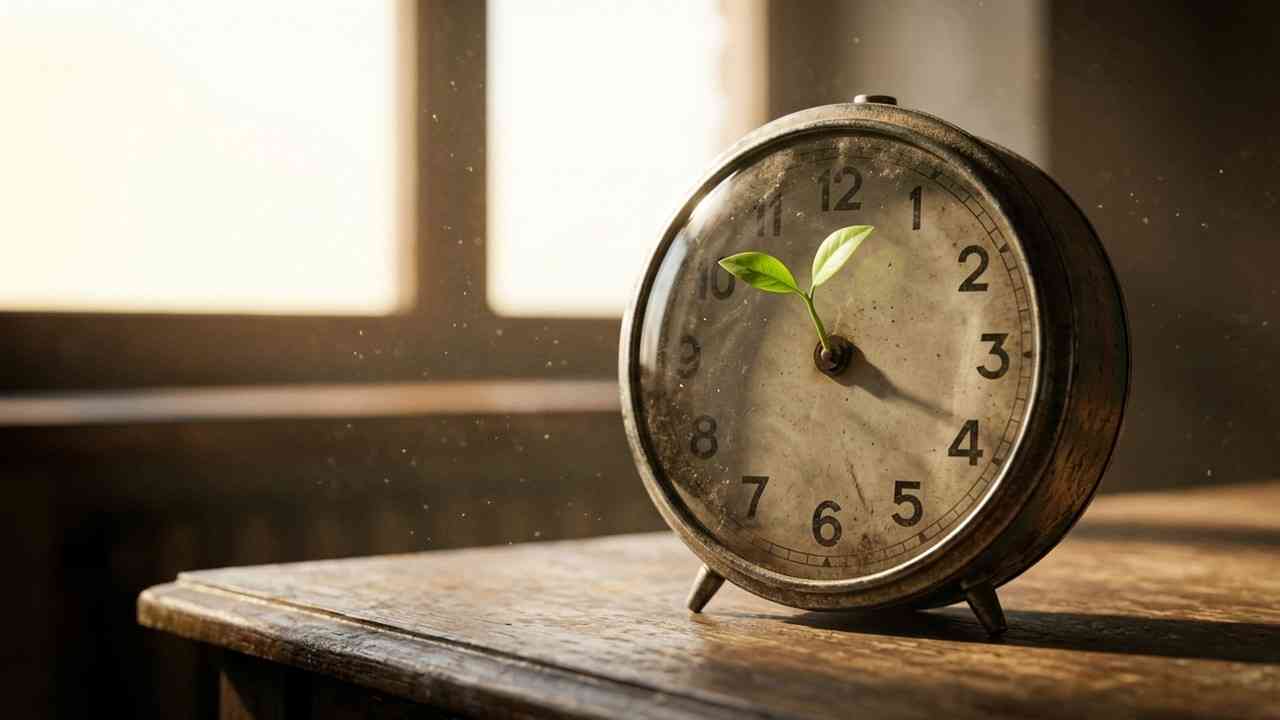
If you feel that every free moment must be useful, you may be draining your most precious inner resources without even noticing it. Toxic productivity can slip into every sphere of life, convincing you that every moment must serve a purpose.
When was the last time you did absolutely nothing? Not resting, not recovering, not “recharging your batteries” — but simply being, without function or purpose? Most of us need longer than we would like to answer that question.
Psychotherapist Piotr Fijewski addressed this in a broadcast devoted to our relationship with time, touching on the problem of toxic productivity. He began with a striking observation:
We either push the clock hands forward or try to hold them back. Both are forms of violating one’s own life.
The word violation lands with force because it describes harm done to something vulnerable — and to something that is our own. It points to the habit of treating our hours as raw material to be processed rather than as the very substance in which we live.
The mechanism is deeply perverse. We want life to feel richer, so we cram as much as possible into every unit of time: a weekend trip with a packed schedule, a podcast in the morning, an audiobook in traffic, a newsletter in the supermarket queue. At work and beyond it, we fall into the logic of toxic productivity. The intention seems noble: to experience more, to make life fuller, more colourful, more meaningful. And yet the opposite happens.
We stop truly experiencing and become collectors of events,
– Fijewski said. A person can visit 20 cities in a year and not remember a single scent. They can attend 100 concerts and never once feel a shiver. To experience something deeply takes time — not just calendar time, but attention, presence, and the ability to pause in the moment.
We focus easily on goals, and goals — as Fijewski notes — always belong to the future. They exist in a reality that has not yet arrived. For many hours a day, we live virtually: chasing what does not yet exist while passing by what is actually here.
Barry Schwartz, the American psychologist and author of The Paradox of Choice, once described a visit to a supermarket in a TED talk. In a single shop, he counted 175 kinds of salad dressing — not including oils and vinegars that customers could use to create their own.
Schwartz argues that this explosion of choice does not liberate us. It paralyses us. When there are too many options, we postpone the decision until tomorrow — and tomorrow never comes. But even when we do choose, and choose well, we often feel worse because we keep imagining all the alternatives we gave up. Opportunity cost eats away at satisfaction, even when the decision itself was sound. That is also how toxic productivity works: it whispers that every option must be considered, every outcome optimised, every choice made perfectly. But life does not work that way.
In a world of endless possibilities, excuses disappear. What remains is a growing sense of personal failure. The rise in clinical depression over the last generation, which Schwartz pointedly highlights, did not come out of nowhere. One cause, he suggests, lies in disappointment with our own decisions and in the tendency to blame ourselves when faced with too many choices.
Australian nurse Bronnie Ware spent years caring for people at the end of their lives and recorded their confessions in her book The Top Five Regrets of the Dying. Unsurprisingly, none of them said: “I wish I had worked more.” Their words sounded very different: “I wish I’d had the courage to live a life true to myself.” “I wish I’d stayed in touch with my friends.” “I wish I’d let myself be happier.”
These are not sentimental clichés. They are evidence that life keeps account not of goals, but of meaning. Not of achievements, but of presence. In everyday life, that difference may seem abstract. At the end of life, it becomes painfully clear. By then, toxic productivity is only a blurred memory — but the damage it has done remains real.
There is something quietly rebellious in what Fijewski proposes:
I have the right to waste time, and that right is sacred.
The culture we live in treats that sentence like heresy. Every free moment must be used well, filled up, made active and productive. Even rest becomes another task to complete.
And yet, Fijewski says, time slows down when we come into contact with natural processes. When we listen to our own breath. When we watch a fire. When we sit beside someone we love without an agenda. A morning coffee without a phone. A walk without a destination or headphones. Washing the dishes as a complete act in itself, not as background noise for a podcast.
Rituals are the parts of daily life that allow the soul — as Fijewski says, borrowing a Buddhist metaphor — to catch up with the body that has been racing ahead all day.
Schwartz ended his talk with the image of a fish in a bowl. At first glance, it is easy to think: poor creature, limited, deprived of possibilities. But the longer you look, the clearer it becomes that the fish understands something. Break the bowl, make everything possible, and you do not create freedom. You create paralysis.
We need frames, limits, and routines. Not because we are weak, but because real inhabitation is only possible within a defined space. Fulfilment does not come from the maximum number of options. It may sound paradoxical, but it is true: fulfilment comes from the depth with which we experience what we have chosen.
Every cup of coffee, every look into the eyes of someone we love, every conscious breath — these are not breaks between important things. They are the important things. If we want to live fully, we have to dismantle toxic productivity and stop treating life as a race that can never truly be won.
Read this article in Polish: Molestowanie własnego życia. Przestańmy popychać wskazówki zegara

Journalist and podcaster specializing in psychological, social, and religious topics. Creator of Dobry Podcast and the founder and editor-in-chief of the Siewca.pl portal. On a daily basis, he analyzes digital media and communication trends. He gained his professional experience at Polskie Radio Kielce, Tygodnik Niedziela, and the Aleteia portal. He combines journalistic integrity with the ability to conduct in-depth interviews and create engaging audio and online content. In his free time, he enjoys reading—from popular science to non-fiction—while cycling through Masovian trails and cheering for Korona Kielce, Liverpool, and Barcelona.

Zmień tryb na ciemny