Education
The Endless Scroll: How Short Videos Are Changing the Way We Pay Attention
19 September 2026






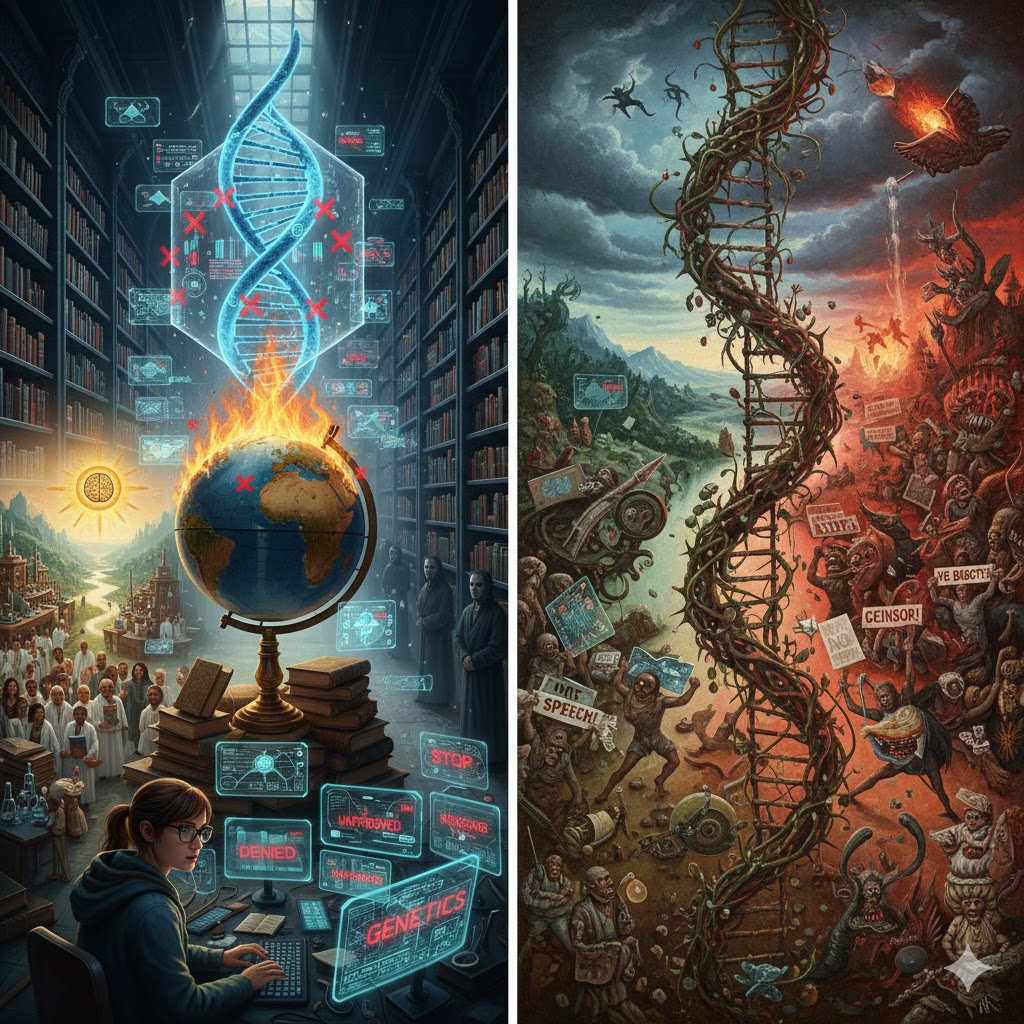
Can science still freely ask questions about the nature of man and the world? Increasingly, it appears that the boundaries of research are defined not only by facts but also by social sensitivity and the fear of consequences, raising urgent questions about academic freedom in science.
Science develops thanks to questions that are not always comfortable. These questions change our way of thinking and push the boundaries of knowledge. For years, it seemed obvious that one could ask about anything, provided the work was rigorous.
Today, however, doubts frequently arise as to whether this principle still holds in practice. Knowledge increasingly collides with emotions and social sensitivities. Consequently, the limits of debate are no longer as clear as they once were. One area where this tension is particularly evident is the study of differences in civilizational development.
Western civilization, centered in Europe, created advanced political, philosophical, and technological systems. Meanwhile, other regions developed under different environmental and cultural conditions for a long time. This led to varied paces of social progress. In the 16th century, Europeans were building ocean-going vessels and developing Enlightenment philosophy. At the same time, many communities in other parts of the world remained in tribal structures.
Popular explanations—geography, climate, or natural resources—seem insufficient to many researchers. In this context, a provocative question arises: could biology and genetics be part of this complex puzzle?
The most controversial field of this debate remains research into cognitive differences between populations. A key example is the work of Richard Lynn and Tatu Vanhanen (IQ and the Wealth of Nations, 2002). Their work triggered intense discussion. They suggested that average IQ in Sub-Saharan Africa is lower than in Europe and East Asia. The authors pointed to potential genetic factors that might explain this discrepancy. However, they also emphasized the significant impact of the environment, such as malnutrition or education levels.
Critics of this research point to serious methodological errors and potential racial bias. However, another question emerges: is the total rejection of these studies always based purely on merit? In science, the goal is not just to reach definitive conclusions. The goal is to be able to discuss them at all without the risk of ostracism.
The dispute over research results is only part of the problem. Increasingly, the discussion concerns whether certain questions should even be asked. In many institutions, researchers avoid “high-risk” topics. They fear media backlash, student protests, or the loss of their positions.
The 2017 protests at American universities regarding Charles Murray became symbolic of this trend. Some student circles found his theses on genetics and racial differences deeply controversial. As a result, many of his speeches were cancelled or disrupted. This sparked a broad debate on the limits of academic freedom.
Scientists who tackle controversial topics often face social exclusion. The University of Cambridge once withdrew an invitation for well-known psychologist Jordan Peterson following media criticism. Years later, the university reopened the doors to debate.
In 2019, Dr. Noah Carl, a sociologist at the University of Cambridge, lost his position. He had published an article suggesting that differences in academic performance between ethnic groups might have a partial genetic basis. His work was based on data, yet it was officially deemed “unacceptable” by prevailing standards of political correctness.
In the United States, schools and universities increasingly avoid publishing competency test results broken down by ethnic groups. For instance, in 2021, some California school districts stopped reporting SAT results by race. They argued that such data “unnecessarily highlights inequalities.”
When science becomes a hostage to ideology, we lose the chance to understand reality,
— stated James Watson, the Nobel laureate who co-discovered the structure of DNA, in 2007. Shortly after, he was excluded from academic circles for his comments on the link between genetics and race.
The genetic hypothesis is not the only explanation for historical differences in development. Geographical factors played a key role. These include access to domesticated animals, plants, and climate. The later history of colonialism was also vital. At the same time, the development of population genetics brings new data to this debate, further complicating it.
The work of scientists like David Reich of Harvard suggests that differences in gene pools may influence behavioral traits. However, Reich himself avoids open public discussions on this matter. He fears violent opposition and professional consequences.
In 2018, University College London withdrew an invitation for a group of genetics researchers. Planned presentations were to cover IQ differences between populations. The official reason given was the “risk of student protests.” This concerned a secret conference on eugenics and intelligence organized by honorary lecturer James Thompson.
The event, known as the London Conference on Intelligence, was exposed by the media, including The London Student and Private Eye. It sparked a major scientific and social scandal. The conference dealt with research into IQ differences between population groups, which was deemed highly controversial. This incident shows how certain pressures can take the form of preventive censorship. It makes it impossible to even initiate uncomfortable scientific discussions.
Ignoring the genetic component in human research carries real costs. First, it hinders a full understanding of complex social problems. These include persistent differences in educational outcomes or crime statistics. Second, it leads to wasting vast public funds on ineffective programs. These programs lack a key diagnostic element.
In the United States, programs aimed at equalizing educational opportunities cost billions of dollars annually. Meanwhile, the SAT score gap between major ethnic groups has remained virtually unchanged for decades. Third, systemic censorship and ostracism create an atmosphere of fear. Researchers instinctively avoid the most sensitive and crucial questions.
On the other hand, the risks associated with genetic research cannot be ignored. The history of eugenics provides a chilling example of how science can justify discrimination. This is why many contemporary scholars prefer to focus on environmental factors. These are less controversial and easier to change through direct intervention.
However, completely excluding genetics from the debate on human nature is like treating a disease while ignoring the patient’s genome. Such a perspective is inherently incomplete. It makes our actions partially blind and ineffective in the long run.
The scientific world accepts biological differences such as lactose tolerance. However, reflecting on possible differences in cognitive or behavioral areas remains a deep taboo.
Questions about the genetic basis of disparities are uncomfortable, but we cannot scientifically disqualify them. Biology is a significant factor in this complex puzzle, though certainly not the only one. Systemic censorship of scientists does not serve the truth. Instead, it leads to intellectual stagnation and a loss of trust in science as an institution.
A telling example of someone who criticizes these ideological limits is the renowned Black economist Thomas Sowell. He grew up in the 1940s in North Carolina in a deeply segregated environment. As a child, he did not even believe that naturally fair hair existed. Regarding modern discourse, Sowell said:
The word ‘racism’ is like ketchup. It can be put on practically anything—and to demand evidence makes you a ‘racist’.
Will science finally manage to break the barriers imposed by ideology and freely pursue knowledge about genetics and humanity? Ultimately, what is at stake is not just the freedom of research, but the ability to honestly seek the truth about man and the world. Science can only serve the common good when academic freedom in science is protected, while research remains rooted in responsibility and respect for human dignity.
Read this article in Polish: Czy dziś można szukać prawdy? Gdzie są granice wolności nauki


Television and press journalist, publicist. He published reports, investigative materials, and interviews in outlets such as Gazeta Wyborcza, Tygodnik DoRzeczy, Tygodnik Przegląd, and on the Onet portal. He collaborates with the Warsaw Enterprise Institute. Author of two editions of "Black Book" – a publication dedicated to the waste of public money, and the book "Myths and Spells of the 21st Century." Laureate of the Polish Chamber of Electronic Communication's Crystal Screen award for his report titled "Monsters," focusing on the issue of violence against children.
Education
19 September 2026



Zmień tryb na ciemny