Humanism
In the Mountains of Madness: Science Confronts the Legend of the Halny
28 March 2026





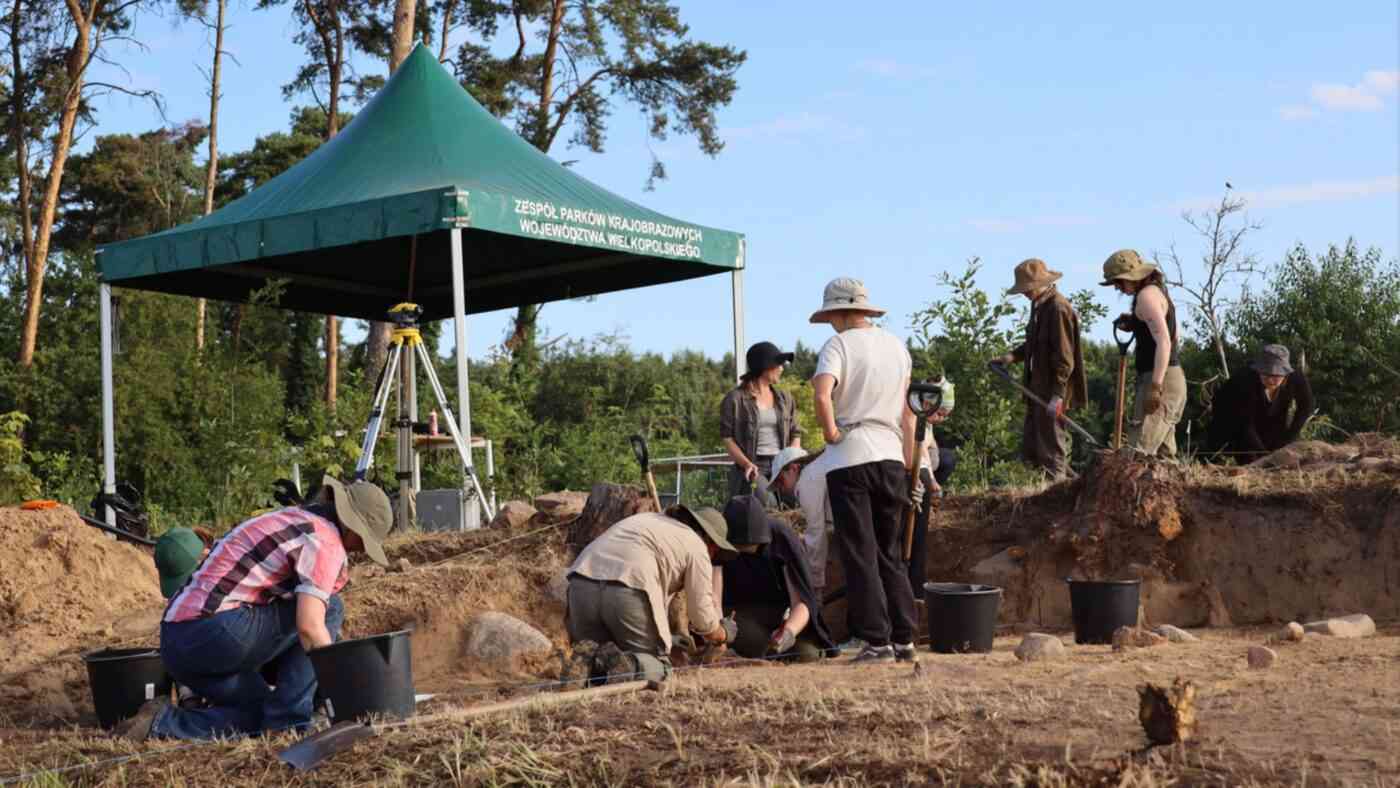
From Greater Poland to Egypt, archaeologists in 2025 uncovered sites and artifacts that are already being hailed as groundbreaking. Among them are finds that rewrite historical records and capture the world's attention. These archaeological discoveries 2025 offer a new perspective on our shared past.
In a landscape park in Greater Poland, Polish archaeologists discovered Kujavian-type tombs. Dating back approximately 5,500 years and featuring a characteristic triangular shape, they are often called the “Polish pyramids.” Their dimensions are staggering—reaching up to 200 meters in length and four meters in height. They were built by the Funnelbeaker culture at the end of the Stone Age.
These structures served as resting places for individuals of high social status, including shamans and leaders. The burial method is also extraordinary: the deceased were laid in a straight position, with their feet pointing toward the front of the tomb.
The “Polish pyramids” is a colloquial term for Kujavian-type megalithic tombs built around 5,500 years ago. They were constructed by people of the Funnelbeaker culture — a community of farmers and herders who were among the first in this region to adopt a settled lifestyle. Building such structures required remarkable organization and the coordinated effort of hundreds of people (some of the stones used in the construction weigh several tons). Unlike the Egyptian pyramids, the Polish pyramids are elongated earthen mounds shaped like triangles or trapezoids, reinforced with massive boulders.
A spectacular success for Polish archaeologists was the recovery of a spear dating back to the reign of the Piast dynasty. The artifact was pulled from Lake Lednica. Analysis revealed that the weapon was plated with precious metals—primarily gold and silver. It could not have belonged to an ordinary person. Some researchers speculate that it was wielded by Mieszko I himself, the first ruler of Poland.
“This season was supposed to be quiet, but it turned out to be one of the most exciting in recent years,”
– admit researchers from Toruń, as cited by the Archeologia Żywa.
On Polish soil, an excavation site was discovered dating much further back than the formation of the Polish state. It is a collective burial of four people from 8,000–9,000 years ago—a discovery of global significance. According to experts, the grave dates back to the Mesolithic era.
“Near a child’s skull, we found a microlithic flint tool characteristic of this period. It is also very important that the deceased were buried in a close, intimate, family-like relationship that emphasizes their emotional bonds. They are huddled together, embracing, which is a characteristic feature we know from other graves in Europe,”
– said Piotr Alagierski, an archaeologist quoted by TVP Bydgoszcz.
The collective grave was preserved almost in its entirety. The bodies were placed in a fetal position and most likely sprinkled with ochre—an earth pigment in shades of yellow or orange. There is no doubt today that this was one of the most significant archaeological discoveries 2025.
In the final quarter of 2025, Polish archaeologists in Egypt made a breakthrough in their research on the tomb of Pharaoh Shepseskaf. Our experts discovered that his burial site was used by a Byzantine monk for years after the Pharaoh’s death. Furthermore, they found ceramics hidden at the top of the tomb. This discovery has been widely covered by Holistic News.
Similar successes were recorded in the Bayuda Desert in Africa. Despite being one of the least explored places on the continent, six years of research by Polish experts led to the discovery of the remains of a middle-aged man from approximately 4,000 years ago.
Polish scientists also uncovered ceramics and charred animal and plant bones, which were likely part of a funeral rite. This is one of the latest archaeological discoveries 2025 made by our researchers.
Scientists from the Dominican Republic have found clues to Cleopatra’s tomb, bringing them significantly closer to solving the mystery of the ancient Egyptian queen’s resting place. The team discovered a lost port from her reign along with numerous valuable artifacts from that period, including:
A sensational discovery in Egypt was the location of the tomb of King Thutmose II. It was the last missing burial site of the rulers of ancient Egypt’s 18th Dynasty. British-Egyptian researchers came across it in February of this year—the first such significant breakthrough in 103 years, since the discovery of Tutankhamun’s resting place.
Among the latest and final archaeological discoveries 2025 are the findings of researchers in France. Archaeologists there revealed a monumental wall approximately 120 meters long. The structure weighs several tons and was built nearly seven thousand years ago. Its purpose remains a mystery.
Experts speculate that the wall might have served as protection against rising sea levels or as a fish trap. Despite harsh conditions and a long period underwater, the structure has remained in surprisingly good condition.
The finds of 2025 have shown one thing: history still has the power to surprise. Tombs from thousands of years ago, golden artifacts recovered from lakes, and traces of ancient civilizations found in the most unexpected places made this season exceptional, even for the researchers themselves. All signs indicate that this will not be the last year of such profound revelations.
Read this article in Polish: Od „polskich piramid” po Egipt. Odkrycia archeologiczne 2025 roku


A graduate of journalism and social communication at the University of Rzeszów. She has been working in the media since 2019. She has collaborated with newsrooms and copywriting agencies. She has a strong background in psychology, especially cognitive psychology. She is also interested in social issues. She specializes in scientific discoveries and research that have a direct impact on human life.



Zmień tryb na ciemny