Truth & Goodness
The Polar Silk Road: Can We Outsmart Geography?
26 March 2026





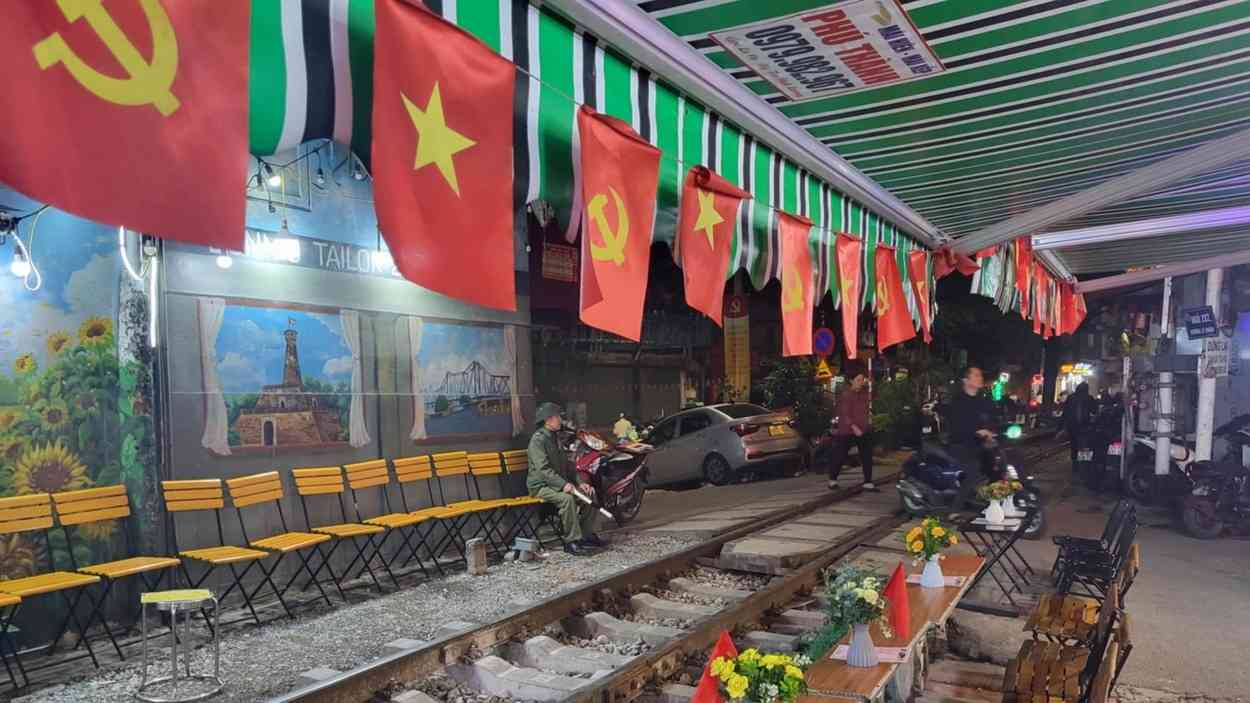
On the walls, slogans celebrate the working class; through the loudspeakers, patriotic hymns honor Hồ Chí Minh. Yet, beneath this scarlet surface lies a 7 percent growth rate and high-tech factories churning out products for Apple and Samsung. Today, the rise of capitalism in Vietnam stands as one of Asia's most captivating paradoxes.
In Vietnam, the hammer and sickle remain ubiquitous. They “decorate” small shops and restaurants, but their presence is most imposing in state institutions—railway stations, trains, and government offices. Hanoi, the nation’s capital, practically drowns in red. The city’s walls are covered in painted slogans praising the working class and the Communist Party.
In nearly every town, statues of Hồ Chí Minh stand adorned with flowers and communist iconography. As I drive through the streets of Hạ Long—a city perched on the edge of the breathtaking bay famous for its karst islands—communist propaganda assaults not only my eyes but also my ears.
My driver, Quang, a 40-year-old Grab pilot (the local equivalent of Uber), decides to treat his European passenger to a patriotic song. The chorus loops the words: “Việt Nam-Hồ Chí Minh, Việt Nam-Hồ Chí Minh…” This catchy tune, designed to build the legend of the “Red Vietnam” leader, dates back to the guerrilla days of the 1950s.
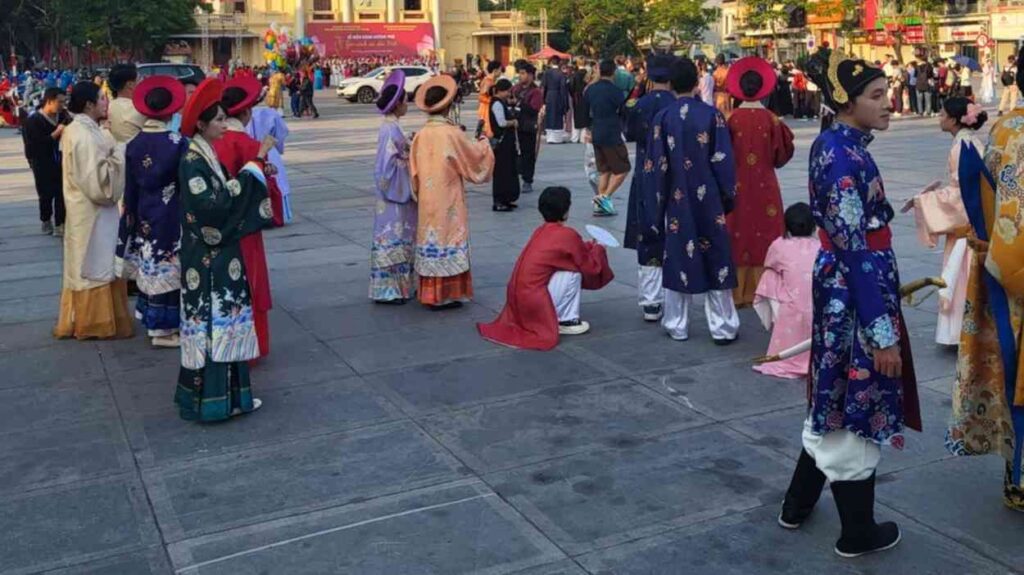
However, all of this is a façade—a form of political folklore that feels almost surreal when viewed against the backdrop of the country’s economic reality. According to every available statistic, this nation is a nightmare for Marxist dogmatists. Vietnam is steadily climbing the ranks of the world’s most business-friendly environments.
Here, the hammers and sickles carry little weight. While an authoritarian party still rules and prohibits free political activity (a path that leads straight to prison), the true sovereign is the U.S. dollar.
The “climate” for entrepreneurship is so favorable that the Economist Intelligence Unit—the research arm of The Economist—identified Vietnam as the country that improved its business conditions more than any other in the world between 2003 and 2023, even outpacing China. While Poland also ranked high, it ultimately lost to Vietnam in this race for reform.
The Economist has crowned Vietnam the “winner of the era of deglobalization.” This success stems largely from the China+1 strategy—a risk-diversification move employed by the world’s largest corporations.
Giants like Apple and Samsung are shifting significant portions of their production away from China to avoid “putting all their eggs in one basket” amid rising tensions between Washington and Beijing. Vietnam has emerged as the primary beneficiary of this exodus (Samsung, for instance, already manufactures approximately 40% of its phones here).
Singapore’s The Business Times echoes this sentiment: “The exodus of factories from China is turning Vietnam into the world’s factory,” the paper noted last year. It added that this transformation results from a broader trend: companies operating in China are moving south to escape American tariffs and shifts in global supply chains.
America? They have been our friends for many years. Our problem is China, not America,
– insists Minh, a young resident of Đà Nẵng who works in the tourism sector.
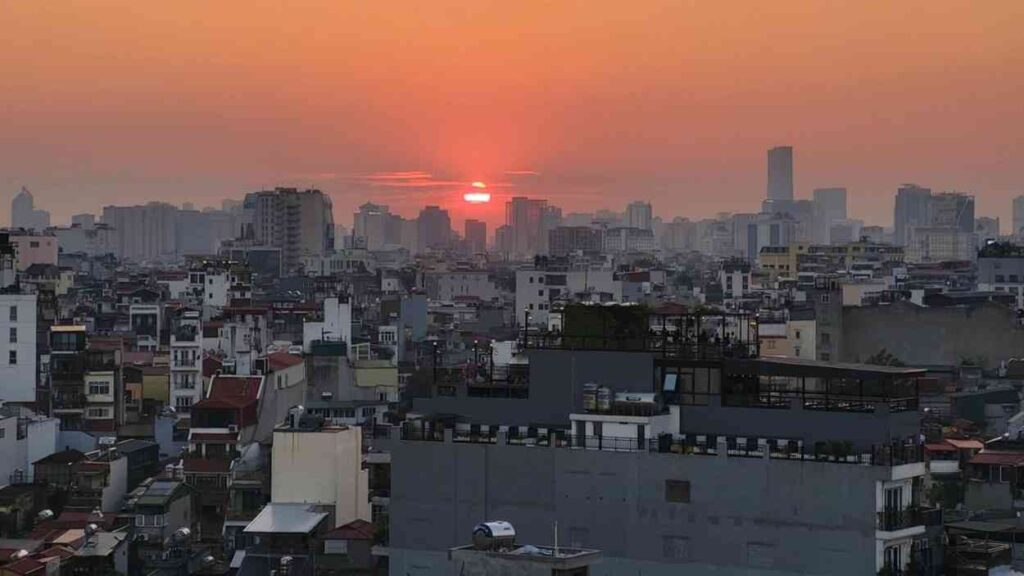
The main coastal boulevard of Đà Nẵng easily evokes images of Miami: wide, beautiful beaches lined with a forest of high-rise hotels. You don’t need to be an investor to see why capitalism in Vietnam is thriving; a simple tourist visit makes it clear.
A night in a four-star hotel costs just over 25 dollars, and a full dinner is only a few bucks. Services are almost absurdly cheap. For a handful of dollars, you can cross a massive city from end to end via ride-share.
The engine behind this is an exceptionally cheap and young labor force (the median age is 33, compared to China’s 40). When you combine this with the fact that Vietnamese workers are generally well-educated—unlike those in India—you have a perfect recipe for economic success.
Positive views of the U.S. are common here, despite everyone being painfully aware of how bloody the American intervention was (the U.S. dropped more bombs on Vietnam than were used in all of World War II). Today, the Vietnamese generally feel a strong affinity for Americans, seeing them as vital allies in the regional rivalry with China.
The tension isn’t just about the South China Sea or the disputed islands claimed by both Beijing and Hanoi. For decades, Hanoi has viewed its powerful northern neighbor as its primary threat. This danger is tangible.
The two countries fought a brief but brutal war in 1979. China attacked Vietnam as “punishment” for Vietnam’s invasion of Cambodia a year earlier to topple the Khmer Rouge regime. Pol Pot’s team had conducted such aggressive internal and external policies—including attacking Vietnamese border regions—that Hanoi decided to intervene and remove the extremist government.
The war ended in a stalemate, but the Vietnamese emphasize that despite the massive disparity in power, they managed to halt Beijing’s invasion. Since then, the two nations have looked at each other with deep suspicion.
Today, Hanoi is one of the United States’ most significant economic partners. Yet, until 1994, the U.S. maintained a trade embargo on the country, which kept other Western nations at bay. Currently, Vietnam ranks just behind Japan on the list of countries from which the U.S. imports the most goods. For Vietnamese exports, America is the absolute number one destination, accounting for about one-third of all outgoing goods.
Dr. Adam Fforde, a British economist and Vietnam expert at the University of Melbourne’s Asia Institute, doubts whether the country was ever truly “communist” in the full sense of the word.
When the main task of the top Vietnamese politicians, with the support of society, was to remove the French and then the Americans, it was useful to wear red shirts to secure foreign support—both military and economic. However, behind that façade, the reality was quite different,
– Dr. Fforde tells me.
He points out that capitalism began growing from the bottom up in Vietnam as early as the 1970s. By the mid-1980s, this process dominated the economy, and the remnants of “central planning” were limited to distributing aid from the Soviet bloc. When that support vanished in the late 80s, the “red façade” lost its value. The problem was that no one knew what to call the new system, so there was no choice but to keep up appearances. Consequently, those in power kept their seats.
Immediately following the war with the U.S., after the North “swallowed” the South in 1975, Vietnam was one of the poorest countries on earth. The ruling party quickly realized that classic Soviet and Maoist formulas were useless.
Hanoi decided to follow in the footsteps of Deng Xiaoping, adopting his famous pragmatic approach to growth: “It doesn’t matter if the cat is black or white, as long as it catches mice.” In other words: “If a capitalist economy is more efficient than a communist one, we won’t insist on the color red.”
In 1986, the Communist Party of Vietnam officially codified what was already happening on the ground. The Đổi Mới (Renovation) program decreed that while the hammers and sickles would stay and the Hồ Chí Minh Mausoleum would remain the capital’s focal point, the economy would be entirely insulated from communist ideology. Every citizen gained the right to operate in a private market, and Western investors were to be treated with the utmost care. These Đổi Mới reforms laid the groundwork for Vietnam’s long-term turn toward markets without abandoning one-party rule.
Since the introduction of Đổi Mới, the Vietnamese economy has grown at an average rate of 7% per year—one of the best results on the continent. This has propelled Vietnam into the ranks of the dynamic “Asian Tigers.” Over the last 50 years, Vietnam’s GDP per capita has surged from less than 100 dollars to nearly 5,000 dollars, according to UN data.
The Vietnamese take immense pride in recently overtaking the Philippines in total GDP. If they maintain their current growth (an impressive 8% last year), they will soon leapfrog Thailand.
Local engines of growth remain in private hands. One of the most significant is VinGroup, a high-tech conglomerate that produces electric vehicles. Its subsidiary, VinFast, founded just nine years ago, has flooded Vietnamese roads with its products and recently launched a successful global expansion.

Despite its meteoric rise in business-friendliness, Vietnam has not yet shaken its corruption problem. Dr. Fforde suggests that widespread corruption in Vietnam can be seen as a “non-standard form of ownership.” Officials who receive bribes from businessmen act as “silent investors.”
“This reveals something about the nature of the economy,” the expert emphasizes. Through corruption, the nomenclature effectively becomes a stakeholder in private enterprises. This naturally incentivizes Vietnamese officials to ensure that private entrepreneurs succeed in the market.
Power in Vietnam is not as concentrated as it is in China, where all threads lead to Xi Jinping. The Vietnamese have no desire to copy that model.
The current concentration of power in China is generally viewed here as excessive and dangerous,
– says Dr. Fforde.
He also highlights differences in social organization between the two nations. This is visible on the streets: Vietnamese cities feel much more chaotic, giving the impression that the Vietnamese are, in a sense, the “Latinos of Asia.”
This society is feisty and not particularly submissive. The relationship between the regime and the public is based on mutual concessions. Workers frequently threaten to strike, and they often follow through,
– the expert notes, adding that Vietnamese politics is more effective, open, and flexible than the Chinese model. It is clear that the unique brand of capitalism in Vietnam is dynamic and highly adaptable to the changing tides of history—and that the country’s rise is now tightly bound to global supply chain diversification.
Read the original article in Polish: Sierp, młot i dolary. Kapitalistyczny cud w „czerwonym” Wietnamie


Journalist with a degree in American studies, writing mainly about foreign policy and history. Author of numerous reports on international issues and interviews with leading experts in the field of economy, geopolitics and history. Since March 2023, editor-in-chief of the monthly "Historia Do Rzeczy".


Zmień tryb na ciemny