Humanism
In the Mountains of Madness: Science Confronts the Legend of the Halny
28 March 2026





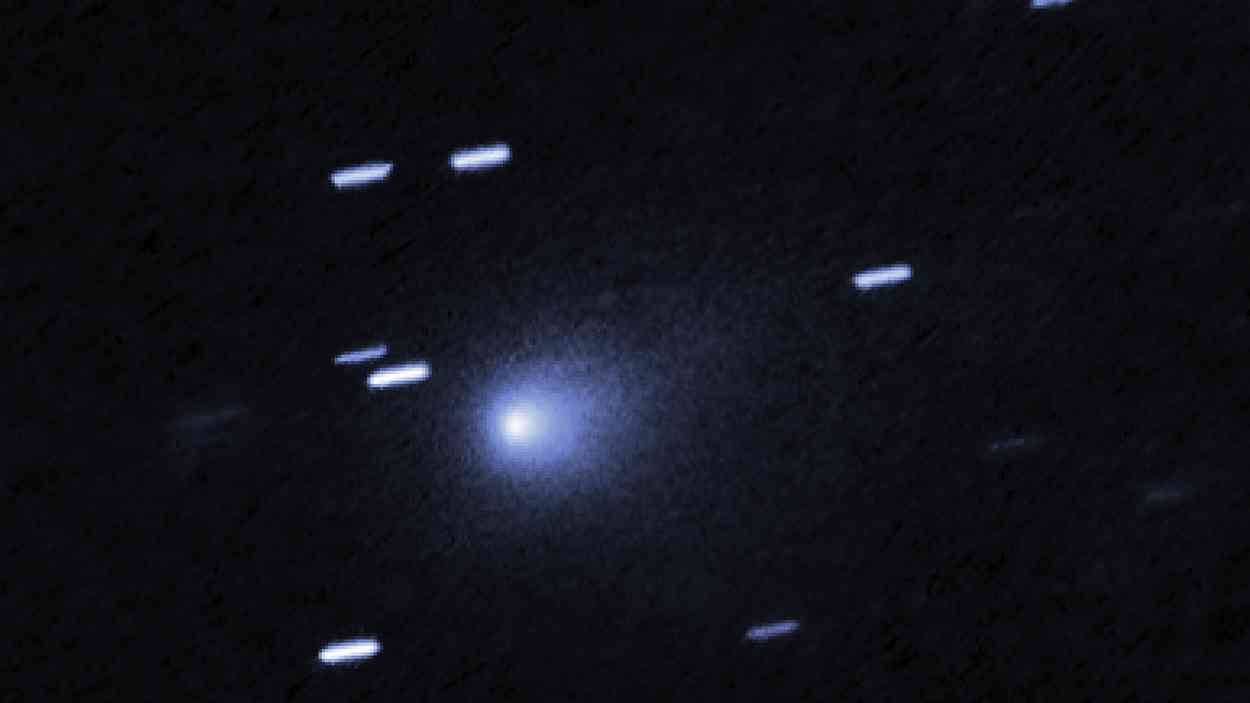
Comet 3I/ATLAS is a rare visitor from outside our Solar System—only the third such object ever observed. Likely ejected from a distant star system long ago, it passed Earth at a safe distance in December 2025. Scientists are enthralled by its potential to reveal secrets of distant stars, while it also sparks speculation: is it just ice and rock, or something more?
Comet 3I/ATLAS, officially designated as C/2025 N1 (ATLAS), is the third confirmed interstellar object to visit our Solar System. Discovered on July 1, 2025, by the ATLAS system in Chile, it initially appeared to be an ordinary comet. However, its hyperbolic orbit and velocity of approximately 221,000 km/h confirmed its alien origins.
This object, with a nucleus ranging from 440 meters to 5.6 km in size, consists mainly of ice, gases, and rock. While similar to local comets, it possesses unique features suggesting a composition from a different star system.
The origin of the comet remains a mystery, but scientists believe it was ejected from its parent system by gravitational interactions. It traveled through the galaxy for millions or even billions of years before entering our Solar System from the direction of Sagittarius, near the center of the Milky Way.
Its escape velocity, peaking at 246,000 km/h during perihelion on October 30, 2025, indicates it is not gravitationally bound to our Sun. After this visit, it will continue its journey back into deep space.
Scientific interest peaked during its close approach to Earth on December 19, 2025, at a distance of 1.8 AU (about 270 million km), allowing for unprecedented observations.
Telescopes such as Hubble, the James Webb Space Telescope, and XRISM revealed an X-ray halo around the comet. This resulted from interactions with the solar wind, with anomalies indicating charge exchange and the emission of gases like oxygen and carbon. Observations from XMM-Newton on December 3, 2025, confirmed this phenomenon, making Comet 3I/ATLAS the first interstellar object observed glowing in X-rays.
One of the most intriguing features is the comet’s green glow, caused by the emission of diatomic carbon (C2) or cyanogen (CN). This was observed by Gemini North on November 26, 2025, though December analyses indicate a higher nickel-to-iron ratio than in typical solar comets. The comet brightened four times more than predicted, reaching magnitude 11.
The lack of a typical ion tail was replaced by an “anti-tail”—a streak of dust pointing toward the Sun, extending over 500,000 km. This was caused by a geometric effect as Earth crossed the comet’s orbital plane. Observations from December 17–21, 2025, showed the anti-tail rotating and reversing direction, a rare purely geometric phenomenon.
What is this comet?
It is a mixture of ice, gas, and rock with a diameter ranging from about 440 meters to 5.6 km, resembling a dirty snowball.
It follows a curved, hyperbolic trajectory and does not orbit the Sun, which confirms its interstellar origin.
Where did it come from?
It was ejected from another star system millions of years ago. After traveling alone through vast regions of space,
it entered our Solar System from the direction of the constellation Sagittarius.
Why did it attract scientists’ attention?
Its close approach in December enabled observations with telescopes such as Hubble and XRISM.
Studies revealed X-ray emissions and a characteristic green glow of gases, including diatomic carbon.
Unusual discoveries
Images revealed a so-called anti-tail — a stream of dust pointing toward the Sun, caused by the observer’s viewing geometry.
The lack of clear water signatures suggests a relatively dry composition, while the X-rays result from interactions
between the comet and the solar wind.
This comet reminds us of how many mysteries the universe still holds. It poses no threat but serves as an inspiration—could it be carrying traces of life from afar? Science continues to analyze the data, and we can look at the sky with even greater curiosity.
Read this article in Polish: Zielony blask, anty-ogon i promieniowanie X. Ta kometa łamie reguły


Journalist. Born on the left bank of Warsaw. A graduate of the Faculty of Political Science and International Studies at the University of Warsaw. He began by writing about pop culture and current events, and today he specializes in geopolitics. Beyond journalism, he is interested in film and acts in an amateur dramatic theatre.



Zmień tryb na ciemny