Truth & Goodness
From Apollo to Artemis: Why Humans Are Returning to the Moon
04 April 2026





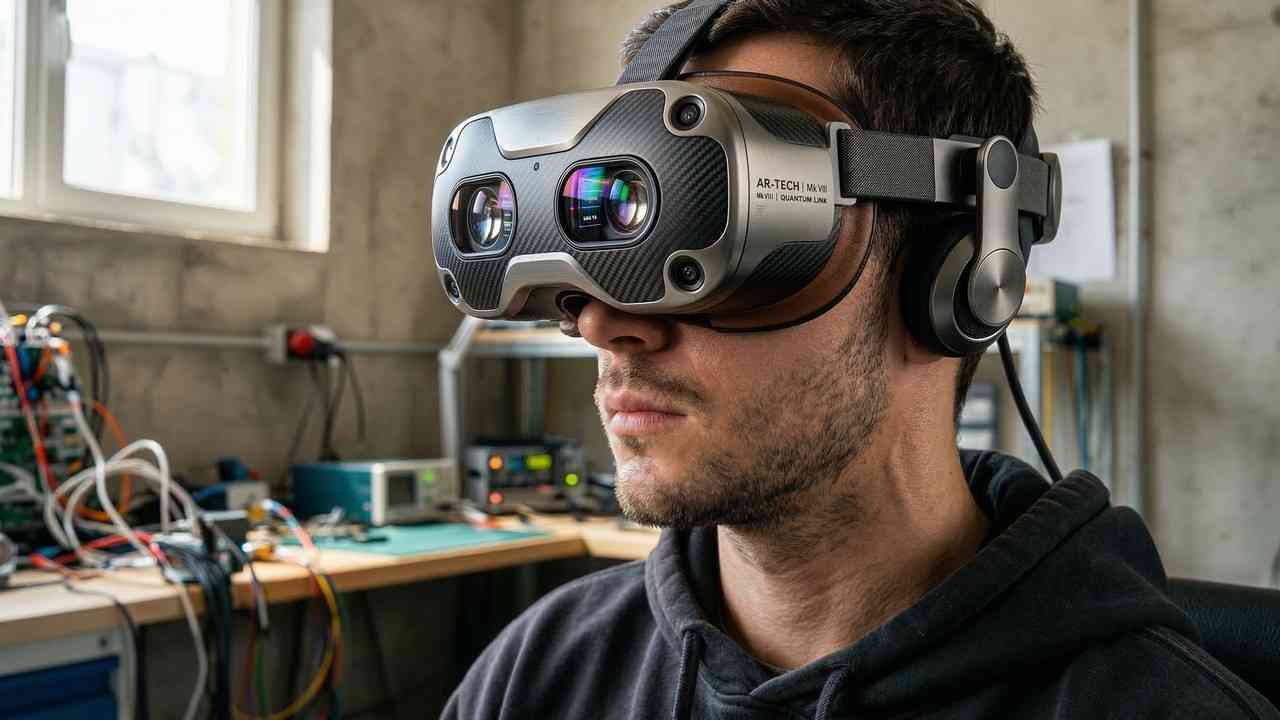
Tech giants dream of a virtual world that could replace reality. Yet the human body has its own safety switch. If a digital avatar falls behind by even the blink of an eye, your consciousness detects it at once and rejects the illusion. Understanding how to trick the brain helps explain why that dream will never fully come true.
Imagine sitting in an armchair wearing VR goggles while your virtual avatar mirrors your every move. You see a digital hand, you feel the vibration of the controller, and yet something feels wrong. Deep down, you know that this hand is not yours. A new study by scientists from Sweden’s Karolinska Institutet, published in the prestigious journal Proceedings of the National Academy of Sciences, explains why this internal “lie detector” is so precise. It also shows why even the most advanced technology will not truly master how to trick the brain in the long run.
A team led by Prof. Henrik Ehrsson and Renzo Lanfranco carried out experiments using the famous rubber hand illusion. In simple terms, participants saw an artificial hand placed in front of them in a position that imitated a real one, while their actual hand remained hidden from view. A robot then touched the real hand and the artificial hand with different delays, ranging from an almost imperceptible 18 milliseconds (0.018 seconds) to a clear 150 milliseconds.
The researchers found that below the 31-millisecond threshold, the brain treats both touches as a single event and “adopts” the artificial hand as its own. But when the robot touches the fake hand with a delay greater than 31 milliseconds in relation to the real hand, the brain does not fall for the illusion and immediately detects the mismatch.
Once that 30-millisecond barrier is crossed, our system of self-perception fully activates. The longer the delay, up to 150 milliseconds, the easier it becomes for participants to distinguish their own body from the artificial one.
This discovery has major implications for the entire immersive technology industry. Metaverse platforms, XR headsets, haptic suits—these devices all operate with delays of several dozen milliseconds, and network infrastructure adds even more. Tech giants dream of full immersion, of people living through digital avatars, and of moving work and relationships entirely into virtual space.
The Swedish study suggests something else. The brain is not a passive receiver in this equation. It acts more like a strict examiner with a biological pass mark. If the delay exceeds a tiny fraction of a second, the brain automatically rejects the digital body as foreign. The Metaverse, in other words, runs into a biological wall.
For years, science largely assumed that signals from the body—such as breathing or heartbeat—were processed mainly below the level of conscious awareness, somewhere in the background. The Swedish study overturns that picture.
The key finding is the stability of the so-called M-ratio. This index shows what share of objective information about the body actually reaches consciousness. The researchers found that this ratio remains constant. No matter how many stimuli reached the brain during the experiment, the way the brain passed that information to consciousness stayed steady and immediate.
That helps explain why our sense of owning a body feels so strong and so durable. Consciousness has direct, prioritized access to that stream of information. There is no subconscious “turbo mode” that technology can hijack and replace with a better version.
The brain prioritizes signals concerning its own body in conscious processing,
– explains Prof. Ehrsson.
That is why our sense of being “inside” our own body feels so immediate and so lasting.
How did the researchers know this was not just coincidence? They used an advanced mathematical framework known as the drift-diffusion model, which tracks how quickly the brain gathers sensory evidence before making a decision. The results showed that both processes unfold at the same pace.
This is a crucial finding because it suggests that recognizing your own body and consciously becoming aware of that fact do not rely on 2 separate mechanisms, one faster and one subconscious. They happen together, along the same pathway.
A control experiment with wooden blocks instead of rubber hands confirmed something equally important: this privileged access to consciousness applies only to the self. When the task no longer involved body ownership, the brain did not show the same heightened vigilance. So the question of how to trick the brain when it comes to signals from one’s own body remains unresolved.
The sense of body ownership is key to building and maintaining self-awareness. It is what allows us to distinguish ourselves from the outside world,
– explains Dr. Renzo Lanfranco, the study’s lead author. That single sentence reaches far beyond neurology.
Big Tech is building its future on the assumption that human beings can be persuaded to live inside a simulation. The study from Karolinska Institutet points in the opposite direction. The brain constantly listens for signals that no simulation can fully reproduce. The warmth of a palm, the subtle pressure of the floor under your feet, the pain of knocking your elbow against a desk—these signals reach consciousness ahead of almost everything else.
Evolution has spent millions of years training the brain never to miss information coming from its own body and never to mistake it lightly. The Metaverse may become a space for entertainment or work, but it will not replace reality, because reality has its own priority channel to consciousness, and no one can simply switch it off.
Creating the feeling that “this is my body” is a massive task for the brain. It must integrate vision, touch, temperature, and the position of the limbs all at once. That process recruits so many brain regions simultaneously that it triggers a kind of burst of consciousness. It is too complex and too demanding to happen quietly in the background of attention.
Depersonalization—a state in which a person begins to experience their own hands as foreign objects—is no longer just a term from psychiatry textbooks. The study from Karolinska Institutet makes it possible to almost measure that feeling of estrangement. These findings could lead to breakthroughs in treating schizophrenia, anorexia, or borderline personality disorder, where patients often struggle with a distorted sense of their own bodies.
One could say that in such cases the brain becomes vulnerable to deception, and the Swedish study may turn out to mark a life-saving breakthrough.
More than 100 years ago, the American philosopher and psychologist William James wrote that the sense of self is inseparably woven into bodily experience. He argued that the constant presence of the body in consciousness forms the foundation of all other experience. The Swedish study offers solid mathematical evidence for that insight.
We cannot simply switch off the sense of body ownership or push it into the subconscious. Evolution has ensured that signals from muscles and skin reach consciousness before almost anything else. They tell us where we end and where the outside world begins. They form the barrier against which attempts to answer how to trick the brain still fail.
Our physicality is not an optional add-on that technology will soon handle better than nature. It is the primary architecture of survival—and it will always have the final word.
Read this article in Polish: Technologia nie przejmie Twojej tożsamości. Ciało ma swój bezpiecznik


Journalist and podcaster specializing in psychological, social, and religious topics. Creator of Dobry Podcast and the founder and editor-in-chief of the Siewca.pl portal. On a daily basis, he analyzes digital media and communication trends. He gained his professional experience at Polskie Radio Kielce, Tygodnik Niedziela, and the Aleteia portal. He combines journalistic integrity with the ability to conduct in-depth interviews and create engaging audio and online content. In his free time, he enjoys reading—from popular science to non-fiction—while cycling through Masovian trails and cheering for Korona Kielce, Liverpool, and Barcelona.


Zmień tryb na ciemny