Humanism
The Moon Dweller: When Imagination Becomes a Disorder
30 March 2026





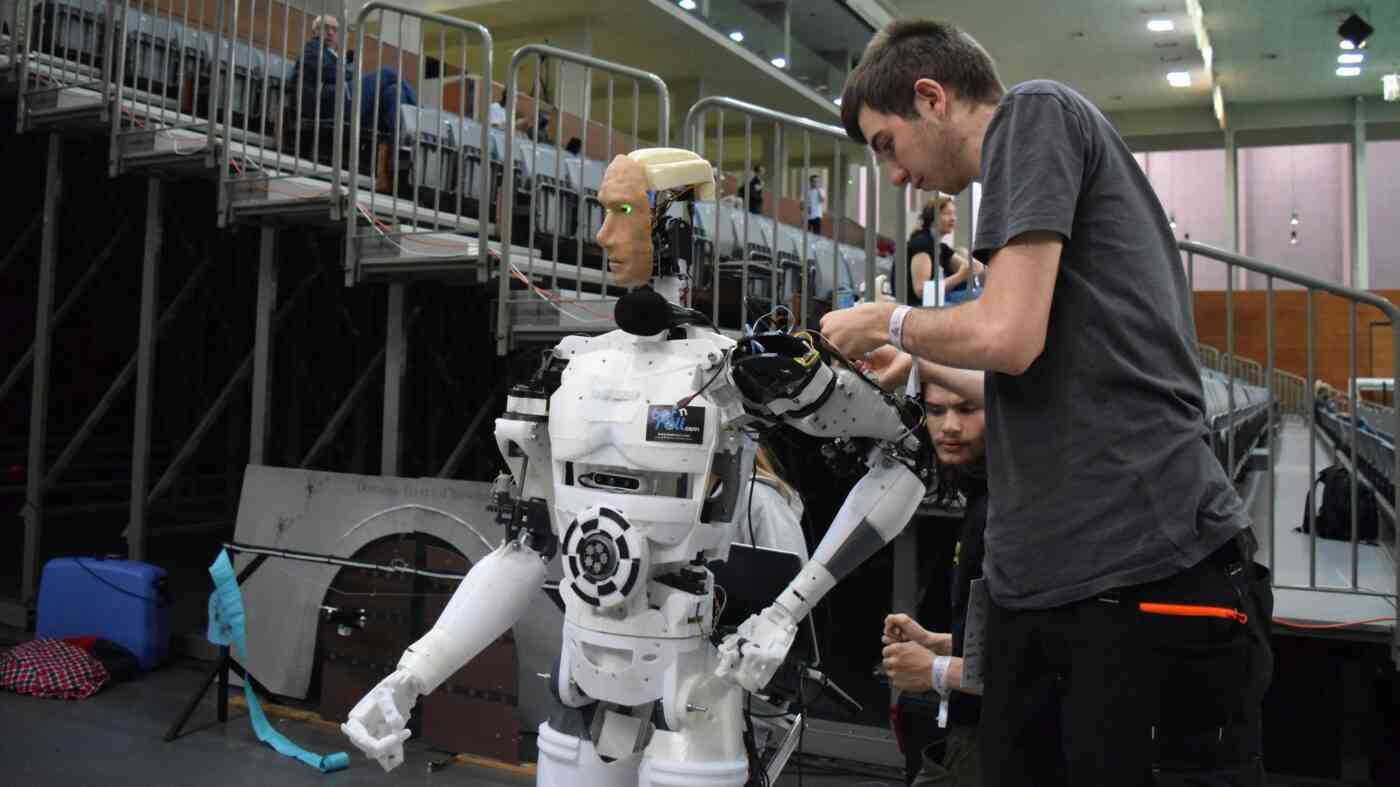
In centers across the country, young people spend hours folding towels, wiping tables, and opening microwave doors. They are not training for service jobs. They are teaching humanoid robots in China to navigate daily life. The goal is simple: give machines enough real-world practice to work in homes, shops, factories, and care facilities. The bigger question is harder: how fast will this shift hit jobs, safety rules, and privacy?
New training centers across China run like unusual classrooms. Young workers wear VR goggles and exoskeletons. They repeat the same motions for hours: folding clothes, opening and closing microwave doors, wiping tables, and stacking boxes.
Sensors capture each gesture with high precision. The systems track joint movement and hand rotation. Engineers convert these motions into massive datasets. Teams use this data to teach humanoid robots in China how to handle common tasks. They target homes, shops, factories, and care facilities.
The scale of this robot education is vast. One of the largest facilities sits in Beijing’s Shijingshan district. It spans over 107,000 square feet. Inside, researchers built scenes that mimic restaurants, warehouses, kitchens, and bedrooms.
Another center operates in Hubei province. Operators remotely control nearly a hundred humanoid robots there. Each day, the machines fold 300 pairs of shorts. They iron clothes 500 times, wipe tables 500 times, and pack 500 boxes of medicine. Dozens of such centers now operate across the country. Most work directly with companies building humanoid hardware and AI systems.
Chinese authorities built these centers to solve a critical shortage of training data. Unlike language models, robots need data that connects vision, movement, and task context. Text from the internet does not provide that link. Teams also cannot simply download this information from the web.
These “robot schools” aim to produce large, consistent datasets. AI systems that control humanoid robots in China need precisely labeled movement records. Standardized data from the centers can also spread across the industry. That raises the baseline for everyone, including smaller firms.
Experts say manual data creation moves slowly and costs a lot. China therefore develops digital simulations in parallel. Companies also collect “on-the-job” data in real workplaces. State-run centers give the industry an early boost. They do it through hundreds of thousands of well-labeled movement trajectories.
China has made AI and humanoid robotics a national priority. In a few years, more than 150 startups have emerged. Examples include AgiBot, Unitree Robotics, and Galaxy General Robot.
For the last decade, China led the world in industrial robot deployments. Chinese factories install nearly 300,000 industrial robots each year. That total often exceeds the rest of the world combined. Now the country wants to extend that advantage to humanoids. These machines promise a wider range of tasks. They could pack parcels, support warehouse work, assist customer service, and help with basic care duties.
“The goal is to build an entire industrial and research ecosystem,” one observer argues. The strategy mirrors earlier national pushes in solar power and electric vehicles.
Many forecasts place humanoids in factories and warehouses first. Some analysts expect wider use in the second half of the 2020s. A stronger surge could arrive around the turn of the decade.
Homes will take longer. Cost remains a barrier. Safety and social acceptance matter even more at home. Some experts expect “helper robots” in apartments only after mass industrial deployment. Several point to the mid-2030s as a realistic window.
Humanoid robots trigger excitement and worry. The biggest concerns involve safety, privacy, and the job market.
Safety: These machines often weigh between 110 and 175 pounds. They move in spaces shared with people. A malfunction can cause real harm, unlike a fenced-off industrial arm.
Privacy: Humanoids act like mobile sensor platforms. In homes, they can map routines and infer sensitive details. That includes habits, health signals, and spending patterns. Data leaks and profiling remain major fears.
The Job Market: Automation will hit routine manual roles hardest. Assembly line work, warehouse roles, retail back-stock jobs, and auxiliary hospital tasks face pressure. The World Economic Forum expects new jobs too, but the transition will still feel disruptive.
As the technology matures, deployments will expand. The presence of humanoid robots in China will likely reshape how the world thinks about work, data, and automation.
Read this article in Polish: W Chinach powstają „szkoły dla robotów”. Trenują przyszłych pracowników


A Journalism and Social Communication graduate with 15 years of experience in the media industry. He has worked for titles such as "Dziennik Łódzki," "Super Express," and "Eska" radio. In parallel, he has collaborated with advertising agencies and worked as a film translator. A passionate fan of good cinema, fantasy literature, and sports. He credits his physical and mental well-being to his Samoyed, Jaskier.



Zmień tryb na ciemny