Uncategorized
The Chokepoints That Move Fuel Prices
04 April 2026





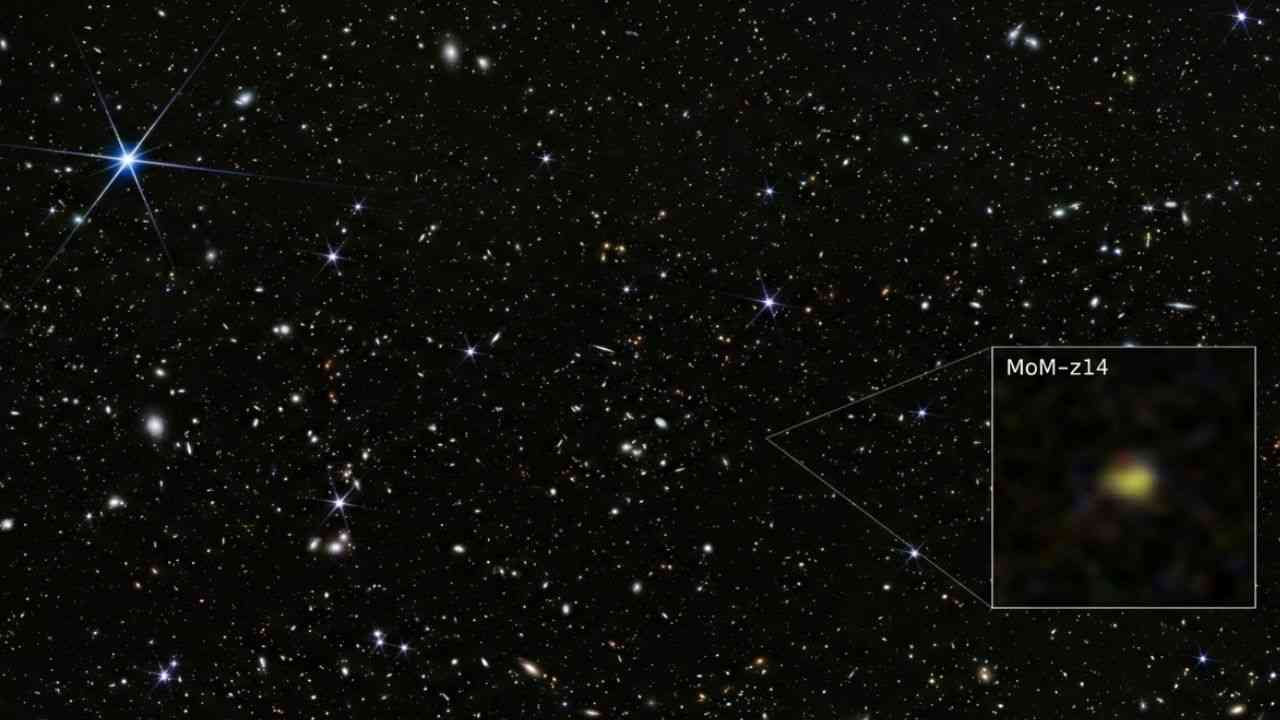
For more than 13 billion years, its light traveled across the cosmos before finally reaching Earth. The James Webb Space Telescope has now revealed a galaxy that already existed just 280 million years after the Big Bang. This discovery may represent the most distant galaxy ever observed—and it shines about 100 times brighter than cosmological models predicted.
This may become one of the most important cosmic discoveries of 2026. A team of astronomers has identified a new galaxy deep in space. Known as MoM-z14, it formed only 280 million years after the Big Bang—during the earliest stages of cosmic history.
That moment represents just 2 percent of the current age of the Universe. For billions of years the galaxy remained invisible to human instruments. Now the James Webb Space Telescope has finally brought it into view, revealing what may be the most distant galaxy detected so far.
Scientists from the Kavli Institute for Astrophysics and Space Research carried out the research. In their paper published in The Open Journal of Astrophysics, they explain that the galaxy’s light has traveled for about 13.5 billion years. The Universe itself is only slightly older, at roughly 13.8 billion years. Discovering such a distant object forces astronomers to rethink how quickly galaxies formed in the early cosmos.
One of the most surprising aspects of MoM-z14 is its extreme brightness. Observations show that its luminosity exceeds theoretical predictions by roughly a factor of 100.
There is a growing gap between theory and observation regarding the early Universe, which raises fascinating questions for further study,
– said Dr. Jacob Shen, one of the study’s authors, as quoted by Science.nasa.gov.
This unexpected brightness suggests that the first galaxies may have formed and evolved much faster than scientists once believed.
Astronomers may find clues by studying the oldest stars in our own galaxy. Some of them show unusually high concentrations of nitrogen—similar to what researchers observe in galaxies like MoM-z14.
Scientists suspect that the dense environment of the early Universe allowed supermassive stars to form more easily. These stars could have produced unusually large amounts of nitrogen compared with stars in the modern Universe.
We can take a cue from archaeology and look at these ancient stars in our Galaxy as fossils from the early Universe. Except in astronomy we are lucky that Webb sees so far that we also have direct information about galaxies from that time.
– explained Dr. Rohan Naidu, also quoted by Science.nasa.gov.
MoM-z14 also shows signs that it helped clear the dense hydrogen fog that filled the young Universe. During this period—known as cosmic reionization—young stars generated extremely energetic light. That radiation gradually pierced the thick hydrogen surrounding early galaxies.
The James Webb Space Telescope was designed precisely to study this era. By observing distant objects whose light began its journey billions of years ago, Webb can trace how the first stars and galaxies transformed the cosmos. The light from MoM-z14 managed to escape this early cosmic fog and eventually reached Webb’s instruments—and, through them, astronomers on Earth.
Yet Webb’s discoveries did not emerge in isolation. Earlier telescopes had already hinted that something unusual might be happening in the early Universe.
Before Webb, the Hubble Space Telescope detected one of the earliest signs that galaxies may have appeared sooner and shone brighter than expected. Using Hubble, astronomers identified the galaxy GN-z11, which existed about 400 million years after the Big Bang.
Later observations with Webb confirmed its distance and properties. At the time, GN-z11 became the most distant galaxy ever observed. Today, discoveries like MoM-z14 push those limits even further.
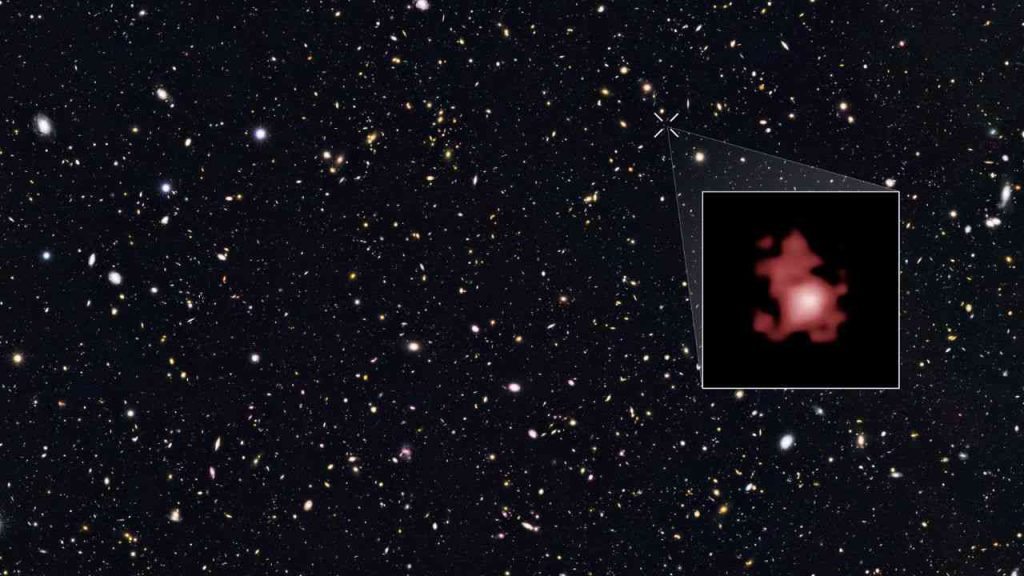
Since Webb began operating, it has repeatedly uncovered extremely bright galaxies at astonishing distances. Some of them appear far earlier in cosmic history than theoretical models predicted.
In January this year, astronomers also observed one of the most distant galaxy collisions ever recorded. Five small but highly active galaxies merged only 800 million years after the Big Bang. That violent encounter scattered heavy elements across enormous distances, enriching intergalactic space far earlier than scientists expected.
These discoveries point toward one striking conclusion. The early Universe was not a quiet, slowly evolving place. Instead, it was dense, turbulent, and extraordinarily efficient at forming new structures.
Galaxies appeared rapidly. Collisions occurred frequently. Heavy elements spread through space much earlier than models once suggested. Each new observation adds another piece to the puzzle of how the cosmos evolved—and each newly detected most distant galaxy brings scientists closer to understanding the Universe’s earliest chapters.
Read this article in Polish: Odkryto galaktykę sprzed 13,5 mld lat. Nie powinna być tak jasna


A graduate of journalism and social communication at the University of Rzeszów. She has been working in the media since 2019. She has collaborated with newsrooms and copywriting agencies. She has a strong background in psychology, especially cognitive psychology. She is also interested in social issues. She specializes in scientific discoveries and research that have a direct impact on human life.

Zmień tryb na ciemny