Humanism
The Moon Dweller: When Imagination Becomes a Disorder
30 March 2026





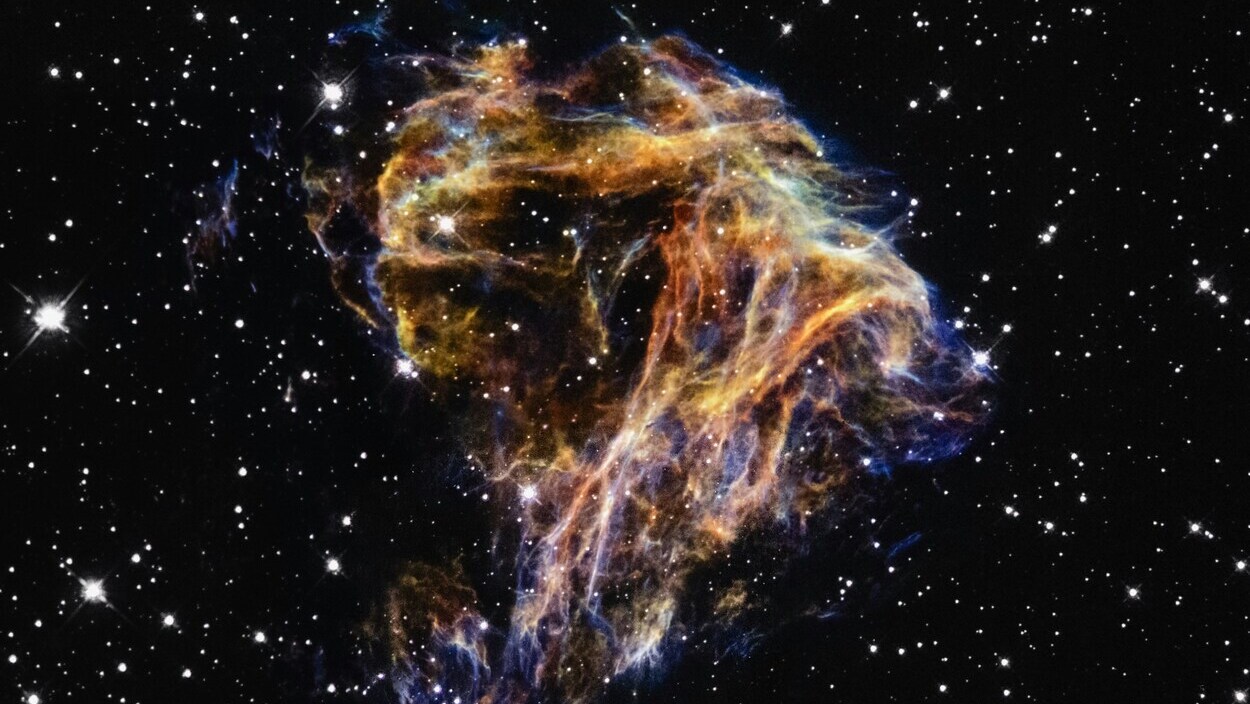
The James Webb Space Telescope (JWST) has discovered the oldest known supernova. According to scientists, the stellar explosion occurred 13 billion years ago, when the universe was only 730 million years old. This discovery, announced in December 2025, could significantly impact our understanding of stellar evolution.
The discovery of the oldest known supernova, designated as GRB 250314, began with the detection of a short, intense burst of gamma radiation. In March 2025, ground-based and orbital telescopes recorded this signal, indicating a distant, high-energy event.
Intrigued, scientists pointed the James Webb Space Telescope at this region of the sky. By July, the telescope confirmed that the source of the flash was indeed a supernova. Thanks to the precise data provided by the Webb telescope, it was determined that the star’s explosion took place 13 billion years ago, when the universe was just 730 million years old.
The supernova discovered by scientists, although it formed at the beginning of the Universe’s existence, closely resembles modern supernovae. This is surprising, given that early stars had fewer heavy elements than modern stars and were also far more massive. According to researchers, this discovery could contribute to a better understanding of the secrets of the Big Bang.
The discovery indicates that massive first-generation stars may have evolved faster than previously assumed. Until now, a longer lifespan was assumed for stars containing fewer heavy elements, but the similarity of this event to modern explosions suggests more efficient mechanisms of nuclear fusion and collapse. This, in turn, points to shorter stellar life cycles and more frequent supernovae.
A supernova is a spectacular cosmic phenomenon consisting of the violent explosion of a massive star at the end of its life. When a star exhausts the nuclear fuel in its core, it collapses and then explodes, releasing enormous amounts of energy. As a result, a supernova can briefly shine brighter than an entire galaxy. The explosion disperses heavy elements throughout the universe, which later form new stars and planets, while the core becomes a black hole or a neutron star.
The James Webb Space Telescope was launched in December 2021. The telescope observes the universe primarily in the infrared, enabling the study of the oldest galaxies and star formation.
Since 2022, the Webb telescope has provided highly intriguing data, including images from the most distant known galaxy, and has studied the atmospheres of exoplanets—detecting water vapor on WASP-96b and methane on others. Within our own Solar System, it has photographed Jupiter’s rings and numerous asteroids.
In April 2025, the telescope discovered a supermassive black hole in the M83 galaxy. However, it made its most significant discovery to date in December 2025, allowing for the detection of the oldest known supernova, GRB 250314A.
Read this article in Polish: Najstarsza supernowa we Wszechświecie. Przełomowe odkrycie Webba


A Journalism and Social Communication graduate with 15 years of experience in the media industry. He has worked for titles such as "Dziennik Łódzki," "Super Express," and "Eska" radio. In parallel, he has collaborated with advertising agencies and worked as a film translator. A passionate fan of good cinema, fantasy literature, and sports. He credits his physical and mental well-being to his Samoyed, Jaskier.



Zmień tryb na ciemny