Culture
Culture Is Losing Its Voice—And the Cost Will Be Staggering
01 April 2026





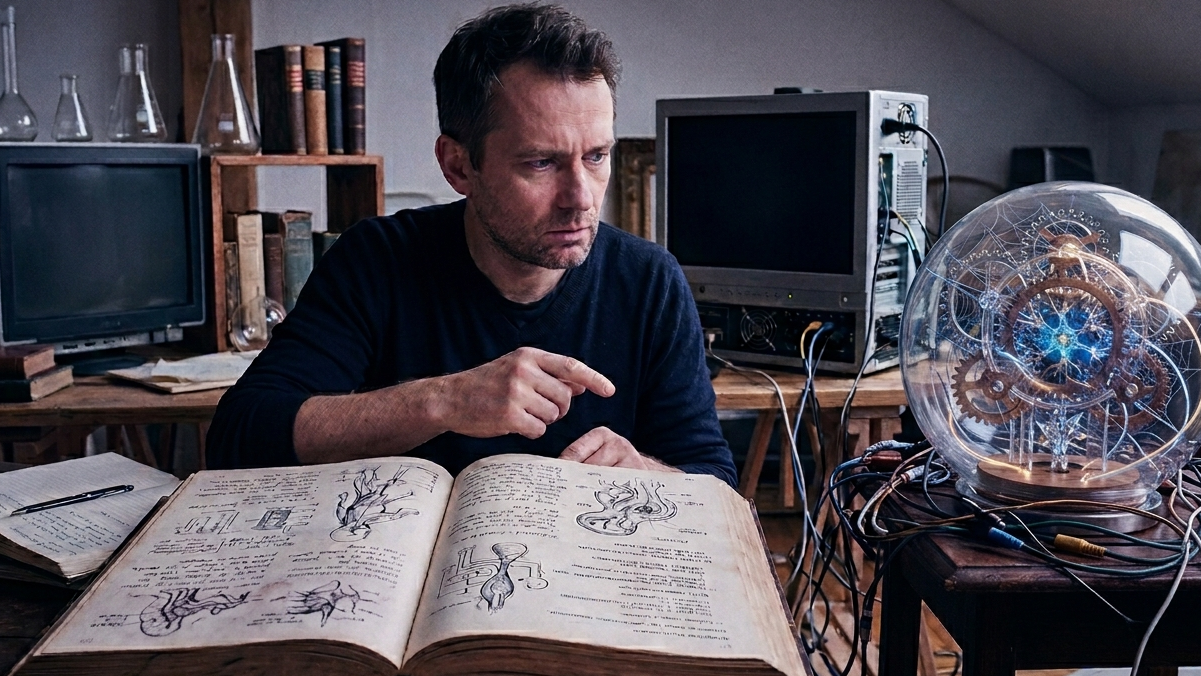
Technology in literature is usually associated with science fiction. Yet from the very beginning, it also pointed to something else: responsibility for discovery and its consequences. Artificial intelligence, algorithms and biotechnology are now outpacing our ability to understand what they do. That is why technology in literature still refuses to leave science in peace.
In 1984, Thomas Pynchon published an essay in The New York Times titled Is It O.K. to Be a Luddite? He used as his starting point C. P. Snow’s famous lecture from 1959 on the “two cultures” of literary and scientific thought. Snow argued that those 2 worlds barely understood one another. Pynchon responded that such a dividing line no longer held. Specialists could once hide behind jargon and remain unintelligible to everyone else. That strategy no longer works. Knowledge is everywhere now.
Pynchon recalls the figure of Ned Ludd, the worker who, according to legend, smashed 2 knitting frames in 1779. He presents him not as a simple enemy of technology, but as someone reacting to injustice. In that sense, a Luddite is not a foe of progress. A Luddite is someone who asks about the price. That is exactly why, in the face of the convergence of artificial intelligence, biotechnology and robotics, Pynchon argues that we need a technological mythology. We need stories that help us understand what we are doing. Engineers and corporations can deliver machines. They cannot deliver the narratives that let us ask a simple question: is this really what we wanted?
Pynchon also offered a thesis that now sounds prophetic:
If our world survives, the next great challenge — you heard it here first — will be the convergence of the research and development curves of artificial intelligence, molecular biology and robotics. It will be amazing, and unpredictable. Even the biggest of the big — God willing — will be caught by surprise.
Pynchon immediately pointed to where literature had already anticipated this. He named Frankenstein — a novel that warns us what happens when technology escapes control. And he added that if there is such a thing as a Luddite novel, then Frankenstein is its first and finest representative. Because the point is not the monster, but the creator who flees from responsibility.
Mary Shelley published Frankenstein in 1818. She was only 20 years old. The novel did not try to predict artificial intelligence. It asked something simpler and more frightening. Victor Frankenstein creates a being and then abandons it. He never asks what becomes of it. Nor does he want to know. Instead, he flees. When his creation begins to kill, he acts shocked. At that moment, literature asks a question that science long preferred to avoid: is the creator responsible for what he has made, even if he failed to foresee the consequences? Scholars and engineers still turn to Shelley’s novel as a way of thinking through creativity and responsibility.
Today, that question returns with far greater force. Artificial intelligence helps decide who receives a loan, who gets a job and who does not. Algorithms shape what we see online. Biotechnology pushes against the boundaries of what we call human. All of these things are our own creations. But who answers for them? The engineers who wrote the code? The corporations that deployed it? Or each of us, every time we click “I agree” under terms we never read?
Science asks: how can this be done? Literature asks: should you do it? The more effective the answer to the first question becomes, the more uncomfortable the second one feels.
In Mr. Sammler’s Planet, published in 1970, Saul Bellow showed what happens when science stops being a tool and becomes an ideology. His protagonist, Artur Sammler, a Holocaust survivor, moves through New York like an anthropologist in a foreign civilisation. That civilisation speaks the language of behavioural psychology, sociology and evolutionary biology. It uses that language to describe love, crime, freedom and dignity. At one point, Sammler hears a lecture in which a human being is described as an “error in the reproductive chain,” and something inside him recoils. The novel stages a conflict between scientific reduction and moral seriousness.
In Sammler’s world, no one asks whether reducing the human being to a biological mechanism is ethically acceptable. They ask only whether it is true. Bellow does not force a choice between science and the humanities. He forces us to see that no science exempts us from responsibility for who we are.
Stanisław Lem, who knew and valued Bellow’s novel, went further. In His Master’s Voice, first published in 1968, he describes a group of scientists who receive a mysterious signal from space. The signal may prove the existence of alien intelligence. It may also be only the trace of something long extinct. The scientists try at all costs to prove that it is contact. Lem uses that premise to explore the limits of knowledge, the risks of projection and the ethical burden of discovery. Commentators still identify responsibility for invention and the misuse of research as one of the novel’s central themes.
Lem shows something people rarely say outright: science can bend facts toward its own theories instead of admitting ignorance. This is not a rejection of science as such. It is a critique of institutional vanity, of the urge to prove oneself right at any cost. Lem did not write science fiction as an escape from reality. He wrote novels that pointed toward responsibility for what science was already doing, even when it still refused to name that responsibility openly.
Cormac McCarthy spent decades around the Santa Fe Institute, where he built close ties with physicists and mathematicians. In his final novels, The Passenger and Stella Maris, he returned to that world. Bobby Western, the protagonist of The Passenger, carries the legacy of a father who helped build the atomic bomb. The emotional centre of the paired novels, however, is his sister Alicia, a mathematical genius in psychiatric care. Together, the books revisit the moral burden left by Los Alamos and the Manhattan Project. McCarthy’s long relationship with the Santa Fe Institute makes that engagement even more telling.
The question that echoes through Alicia’s reflections is devastatingly simple: if we can calculate something, does that mean we should? Does the mathematical description of the world release us from thinking about what we do with that knowledge? In Los Alamos in 1945, only a few people asked that question aloud. McCarthy turns it into part of our shared inheritance.
In each of these writers, science crosses a line. It creates something it cannot control, and then it flees. Frankenstein flees from his creature. The engineers of the Manhattan Project hid behind bureaucracy and behind the formula, “I did not know.” Today, the programmers of artificial intelligence retreat into algorithms they no longer fully understand. Lem adds one more layer: science also flees into itself, into models, assumptions and the belief that if something can be described mathematically, then it has already become Truth.
Technology in literature is not a separate issue reserved for science fiction. It remains the same question that literature has asked science for 2 centuries. The point is not to replace laboratories with libraries. The point is to remember that some questions cannot be evaded. Behind every invention stands a human being who should ask: should I? And that question does not disappear once the invention leaves the lab.
Read this article in Polish: Frankenstein wrócił. Czego nauka nie chce wiedzieć


A graduate of Journalism and Social Communication at the University of Warsaw (UW), specializing in culture, literature, and education. Professionally, they work with words: reading, writing, translating, and editing. Occasionally, they also speak publicly. Personally, they are a family man/woman (head of the family). They have professional experience working in media, public administration, PR, and communication, where their focus included educational and cultural projects. In their free time, they enjoy good literature and loud music (strong sounds).


Zmień tryb na ciemny