Humanism
In the Mountains of Madness: Science Confronts the Legend of the Halny
28 March 2026





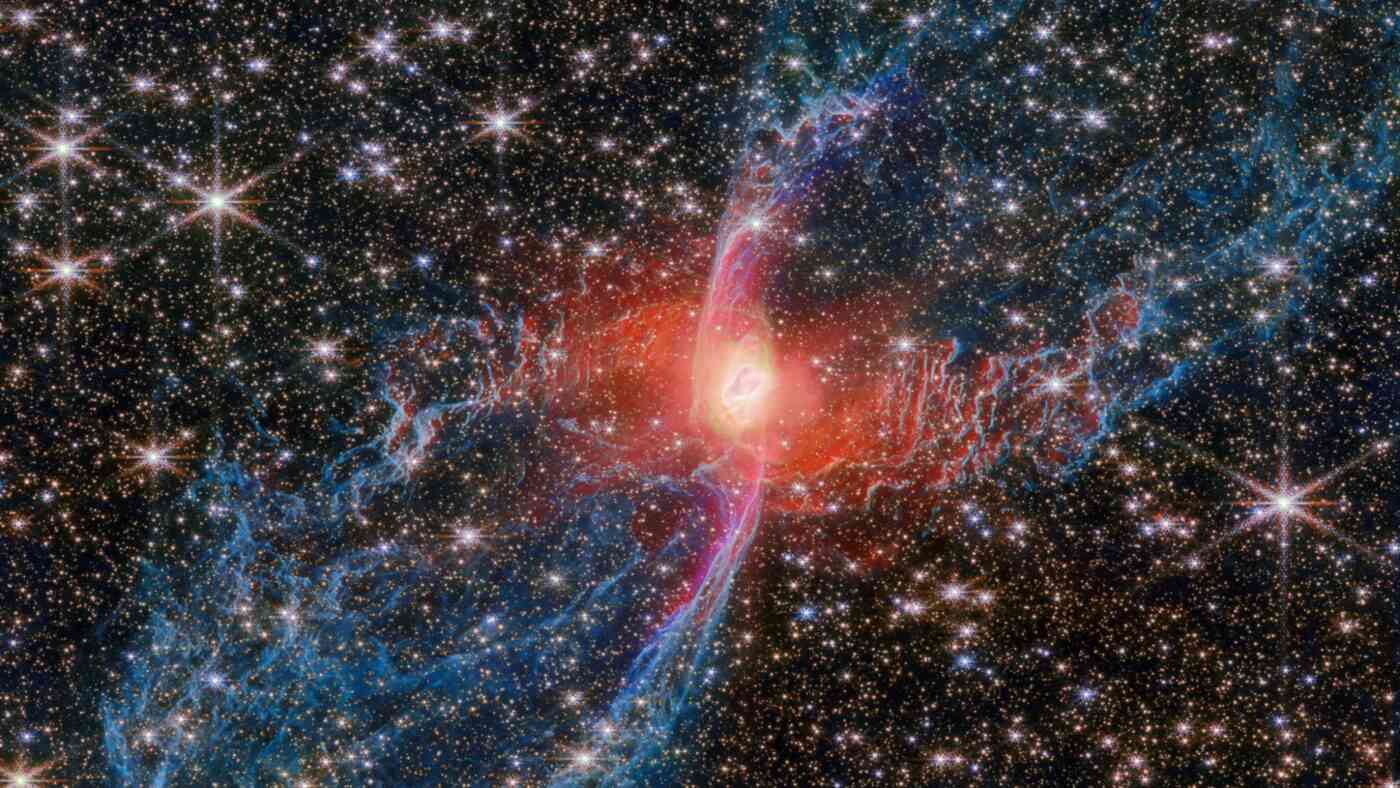
It looks like a scene from a science fiction movie, but it is reality. The James Webb Space Telescope has captured a nebula that serves as a preview for the future of the Sun and similar stars.
While it resembles a digital painting from a sci-fi blockbuster, this image is remarkably real. The James Webb Space Telescope recently transmitted an extraordinary photo of the Red Spider Nebula. It is difficult to ignore; the image is simultaneously unsettling and hypnotically beautiful. It depicts a tangled web of gas and dust that may represent a vision of the future of the Sun billions of years from now.
The new image reveals the finest details, which remained hidden until now. Long, twisted structures—resembling the legs of a giant spider—spread from the center of the nebula. According to scientists, these resulted from a violent ejection of matter caused by a dying star. In this way, the star ended its life in a spectacular celestial display.
When researchers analyzed the image published in The Astrophysical Journal, they noticed a specific detail. The characteristic “legs” of the Red Spider Nebula are not merely a visual effect—they glow. As the study’s authors explain, this is the result of molecular hydrogen emissions escaping from a dense ring of matter surrounding the dying star.
Even the researchers involved in the project remain puzzled as to why the image appears so “hairy”:
“It is still not clear why these outflows look ‘hairy.’ One possibility is that the ejection from the host star was not continuous, perhaps because mass transfer from a companion star affected the timing of the ejection,”
– wrote Mikako Matsuura, an astrophysicist at Cardiff University, as quoted by Live Science.
Astronomers refer to this object as NGC 6537, a so-called planetary nebula. The name is misleading, as it has nothing to do with planets. These objects form when a star similar to our Sun reaches the end of its life. For billions of years, it burns hydrogen; once that fuel runs out, it begins burning helium. At this point, energy production increases dramatically.
Consequently, the star swells into a red giant, becoming thousands of times larger than its original size. But how exactly does this happen? During this stage, the star begins to shed its outer layers. Its core heats up and shrinks until it transforms into a very hot, white core. The ultraviolet radiation it emits ionizes the ejected gas and dust, causing the nebula to glow like a cosmic neon sign. For astronomers, this represents a natural stage of stellar evolution that, in the distant future, will mark the end of the Solar System in its current form.
The dying process of a star and the uniqueness of the image are significant, but there is a deeper takeaway. The photo—captured by the James Webb Telescope—literally shows us our own fate. In about 5 billion years, the Sun will also become a red giant. Its size will become so impressive that it will swallow Mercury and Venus. Researchers predict that a similar fate may await Earth and perhaps even Mars.
Even if our planet escapes total destruction, it may face a fate similar to what the Red Spider Nebula currently experiences—drifting among glowing filaments of gas in the shadow of a dying star.
This is why the James Webb Telescope image is more than just a picture; it is a chilling reminder that even the Sun is not eternal. One day, its end will come.
While many questions remain, one thing is certain: the telescope has once again proven that the cosmos can be both breathtaking and ruthless regarding the future of humanity and our planet.
Read this article in Polish: Słońce czeka zagłada. Teleskop Webba pokazał wyjątkowy obraz


A graduate of journalism and social communication at the University of Rzeszów. She has been working in the media since 2019. She has collaborated with newsrooms and copywriting agencies. She has a strong background in psychology, especially cognitive psychology. She is also interested in social issues. She specializes in scientific discoveries and research that have a direct impact on human life.



Zmień tryb na ciemny