Science
Earth as an Ice Ball: We Finally Know What Blocked the Thaw
20 March 2026





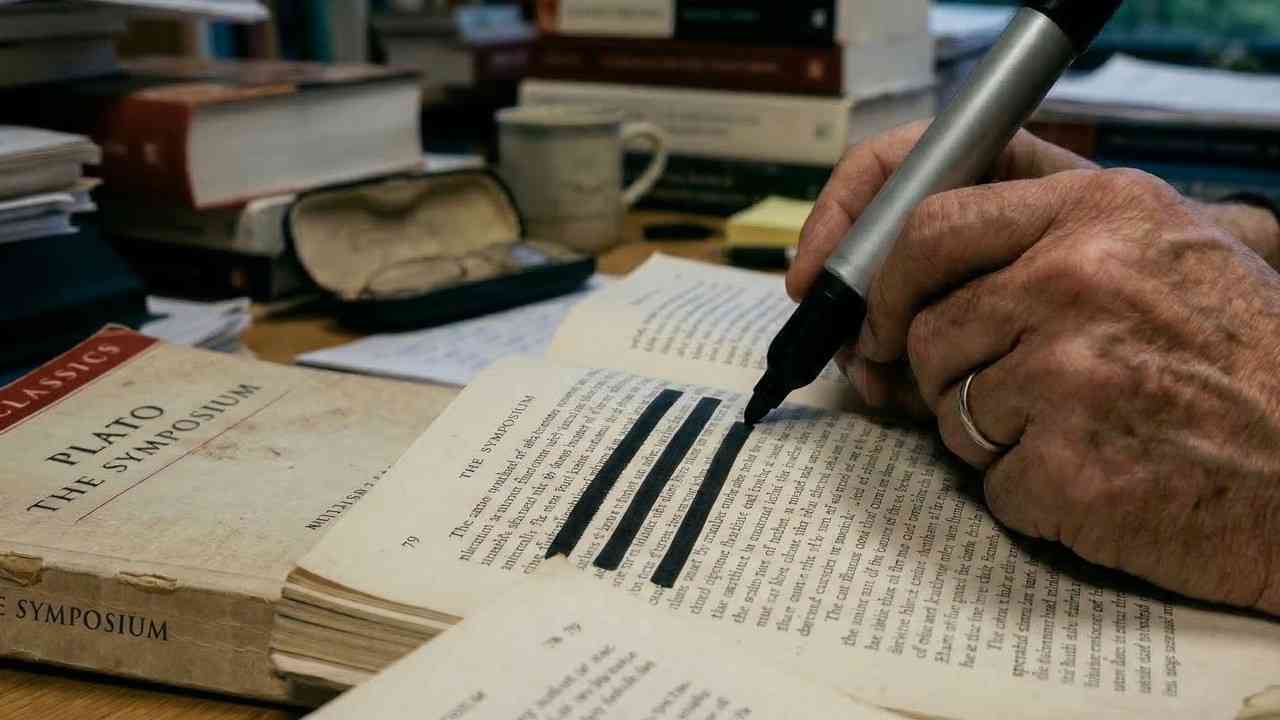
The culture wars and ideological polarisation have reached higher education. Today, university censorship is hitting the very foundations of the humanities, with even ancient philosophy becoming a target. The question is whether banning thought has ever truly worked.
When Professor Martin Peterson of Texas A&M University opened his inbox in early January 2026, he did not expect to become a central figure in a global debate about academic freedom. The message from department head Dr. Kristi Sweet was blunt: he had to remove 2 modules on “racial and gender ideology” from the syllabus of his ethics course or face reassignment to other classes. Peterson, a philosopher with more than 20 years of experience, was left with a choice: comply or lose a course he had taught for years.
The removed passages came from Plato’s Symposium. More specifically, the directive targeted the famous myth of the androgynes, told by the playwright Aristophanes. In that story, Plato suggests that humanity once consisted of 3 sexes rather than 2, and that same-sex attraction is entirely natural. As Peterson later said in an interview with a public radio station:
We will not make universities great again by censoring the classics.
At first glance, the situation seems almost lifted from Plato’s own work. The philosopher who, in The Republic, outlined a vision of a polis ruled by philosopher-kings and had no illusions about democracy has now been deemed politically dangerous. Jonathan Friedman of PEN America, commenting on the case for University World News, noted that university censorship in such cases depends on “flattening” complex texts into their simplest components, the ones easiest to classify as incompatible with regulations.
The fact that we can have a balanced discussion about Plato ceases to matter,
– he added.
For scholars of antiquity, however, the decision at Texas A&M was not entirely surprising. James Romm, professor of classics at Bard College, pointed out to University World News that many ancient texts could fall victim to similar rules: Euripides’ The Bacchae, with its androgynous Dionysus; Aristophanes’ Thesmophoriazusae, where women disguise themselves as men; or the myths of the warrior Amazons. All of them complicate any simple image of stable gender roles.
Philosophy has existed in tension with power from the very beginning. When an Athenian court sentenced Socrates to death in 399 BCE, it was not because he was merely a troublemaker. It was because his activity carried a deeply political meaning, even if it was not political in the ordinary sense. Socrates mattered politically because his presence suggested that no belief should remain beyond criticism.
In the Apology, Plato presents a philosopher who refuses to capitulate even when facing a death sentence. When his friends suggest escape, he declines. He does not do so because he agrees with the verdict, but because fleeing would amount to claiming that the law no longer applied to him. This was a paradoxical tribute to the political community: Socrates submitted to its judgment, but only after defending, to the very end, the right to question it.
2 and a half millennia after the death of Socrates, fascist Italy produced another confrontation between philosophy and authoritarian power. Benedetto Croce, the most eminent Italian thinker of the first half of the 20th century, did not initially grasp the true nature of fascism. At first, he saw Mussolini as a force capable of halting the Left. But once the regime showed its true face, Croce’s resistance became unwavering.
For the regime, Croce was more dangerous than any conventional political opponent. His authority reached far beyond the academy. The fascists did not even dare arrest him, fearing international backlash.
In time, the Duce had to acknowledge his own impotence. An anecdote from fascist circles captures the point. Pressed to deal decisively with the philosopher, Mussolini reportedly replied: “I do not want to give hemlock to a philosopher.” It was more than an allusion to Socrates. It was an admission that philosophy, when it remains free, critical, and uncorrupted, possesses a kind of power that even dictatorship cannot openly crush. Hemlock for the thinker could prove more dangerous to the regime than the thinker himself.
To connect those historical examples with present-day Texas, it is worth recalling a distinction proposed by Deepak Sarma, professor of Indian philosophy at Case Western Reserve University. Sarma contrasts “epistemic humility” with “epistemic hubris”.
Epistemic humility lies at the core of philosophical inquiry. It is the stance of Socrates, who knows that he knows nothing and who, through relentless questioning, forces others to justify their assumptions. It assumes that human knowledge is partial and that truth demands constant searching, testing, and confrontation with other points of view.
Epistemic hubris, by contrast, is the conviction that one already possesses certainty and a monopoly on truth. Sarma recalls Donald Trump’s remark that only “his own morality” limits his power. That is the essence of hubris: I am the sole judge in my own case. And according to Sarma, that same mindset drives the current wave of university censorship visible in places like Texas.
There is, however, a deeper irony here. If one looks for the intellectual patrons of today’s struggle over the canon and traditional values, it is impossible to ignore 2 thinkers who helped shape the US conservative elite: Leo Strauss and Allan Bloom.
Strauss was a German Jewish philosopher who emigrated to the United States in 1938. He devoted his life to restoring political philosophy to its Socratic and Platonic roots. He opposed relativism, historicism, and positivism, all the tendencies that, in his view, undermined the possibility of speaking seriously about truth and the good. His lectures at the University of Chicago shaped generations of conservative intellectuals, and his thought became one of the foundations of neoconservatism.
The most famous of Strauss’s students was Allan Bloom, author of the influential book The Closing of the American Mind. Bloom defended the Western canon against what he saw as its destruction by relativism and counterculture. In his view, universities had betrayed their mission by abandoning great books in favour of ideological fashions.
And this is where the irony becomes impossible to miss. Strauss and Bloom, both deeply shaped by Plato, called for a return to the classics precisely because they believed great books teach people how to think: independently, critically, and beyond the reach of simple ideology. Yet in Texas today, under the banner of defending traditional values, authorities ban Plato. Those who claim to protect the Western canon are censoring one of its central pillars simply because one of his texts clashes with a current political line.
The lesson from Texas is stark: are students still allowed to think for themselves? It is as though the heirs of a thinker who spent his life restoring Plato now believe students cannot be trusted to read the Symposium on their own. It is as though Strauss’s lesson about the need for slow, careful reading of great books has been replaced by the lesson that some books are better left unopened. In that sense, today’s university censorship is not only an attack on Plato. It is also, and perhaps above all, a betrayal of the intellectual inheritance of those who helped bring Plato back to America.
History shows that philosophy repeatedly becomes a thorn in the side of power, whether in Athenian democracy, fascist Italy, or a modern university in Texas. The texts change. The bans change. But the mechanism remains the same. Power always prefers simple answers to difficult questions.
Read this article in Polish: Platon zakazany na uniwersytecie. Cenzura sięga po filozofię

A graduate of Journalism and Social Communication at the University of Warsaw (UW), specializing in culture, literature, and education. Professionally, they work with words: reading, writing, translating, and editing. Occasionally, they also speak publicly. Personally, they are a family man/woman (head of the family). They have professional experience working in media, public administration, PR, and communication, where their focus included educational and cultural projects. In their free time, they enjoy good literature and loud music (strong sounds).

Truth & Goodness
19 March 2026


Zmień tryb na ciemny