Humanism
When Goodness Becomes Procedure. How Generosity and Solidarity Fade
07 April 2026





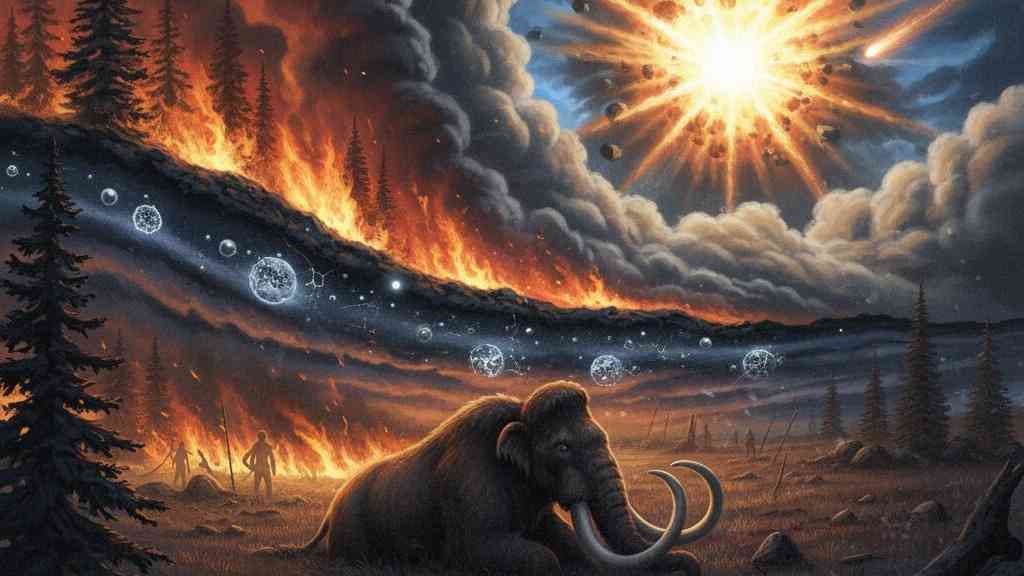
The sky over North America ignited, followed by fire and a deep chill. New evidence supporting the Younger Dryas impact hypothesis suggests that this event from millennia ago may have altered the destiny of the entire planet.
A new study published in the journal PLOS One by a team led by Professor Emeritus James Kennett of the University of California, Santa Barbara, strengthens the controversial theory that a cosmic impact contributed to the demise of prehistoric giants. According to Science Daily, the research provides evidence that an explosion of comet fragments supports the Younger Dryas impact hypothesis.
The key evidence cited by the authors is the discovery of “shocked quartz”—sand grains with an internal structure marked by characteristic fractures that can only form under extreme heat and pressure.
As described in the publication, scientists examined three key archaeological sites belonging to the Clovis culture in Arizona, New Mexico, and the Channel Islands in California. In all these locations, within a sediment layer dating back approximately 12,800 years, they found deformed quartz grains. According to the researchers, this cannot be explained by volcanic activity or human actions of that era.
“These sites were classic locations for discovering and documenting the megafauna extinction in North America and the disappearance of the Clovis culture,”
– Professor Kennett said in a statement summarizing the study.
The presence of this mineral is particularly significant because no impact crater from this period has been discovered. This lack of a crater is precisely what supports the “airburst” theory within the mammoth comet hypothesis.
The hypothesis suggests a detonation of comet fragments within the atmosphere. Such an explosion could cause immense destruction on the surface without leaving a permanent crater. This is the exact scenario suggested by the team’s simulations.
According to the scenario emerging from the analysis in PLOS One, an explosion of this scale was not a single isolated event. In reality, it was only the beginning of a chain of catastrophes. This cataclysm may have triggered a cascade of events leading to a global ecological crisis.
The first immediate consequence was a devastating heatwave. The energy released during the atmospheric explosion could have swept across the continent, igniting everything in its path and triggering massive, continent-wide wildfires.
Next came the “impact winter.” Vast amounts of smoke, dust, and soot from these fires, combined with material ejected by the explosion itself, rose into the atmosphere. This dense veil could have effectively blocked sunlight for many years, causing a rapid and drastic drop in average global temperatures.
This effect directly aligns with a well-documented geological phenomenon: a sudden cooling known as the Younger Dryas. Proponents of the Younger Dryas impact hypothesis argue that this “impact winter” served as the direct mechanism that triggered such a dramatic and sudden climatic shift.
This combination of immediate destruction and catastrophic climate change created what the study’s authors call a deadly trap for the megafauna of the time. Mammoths, mastodons, giant sloths, and other large animals failed to adapt to the new, extremely harsh conditions. This resulted in their rapid extinction across North America.
Simultaneously, the Clovis culture—an advanced hunter-gatherer society—vanished. Their characteristic projectile points have been found across the continent, but their sudden disappearance from the archaeological record suggests that human populations also struggled to survive the cosmic cataclysm and its aftermath.
The discovery of “shocked quartz” is, as the scientists emphasize, the latest piece of a puzzle that researchers supporting the Younger Dryas impact hypothesis have been assembling for over two decades. The research team points to several other crucial indicators that align with this cosmic event, including:
While this new data brings us closer to understanding one of prehistory’s greatest mysteries, the theory continues to spark debate within the scientific community. However, the discovery of shocked quartz provides a compelling new argument for the Younger Dryas impact hypothesis, potentially explaining what exactly brought an end to the world of the mammoths and its first human inhabitants.
Read this article in Polish: Katastrofa sprzed 13 tys. lat. Ślady kosmicznego wybuchu


A graduate of Journalism and Social Communication at the University of Warsaw (UW), specializing in culture, literature, and education. Professionally, they work with words: reading, writing, translating, and editing. Occasionally, they also speak publicly. Personally, they are a family man/woman (head of the family). They have professional experience working in media, public administration, PR, and communication, where their focus included educational and cultural projects. In their free time, they enjoy good literature and loud music (strong sounds).



Zmień tryb na ciemny