Science
Before There Are Planets, There Is Dust
16 October 2026





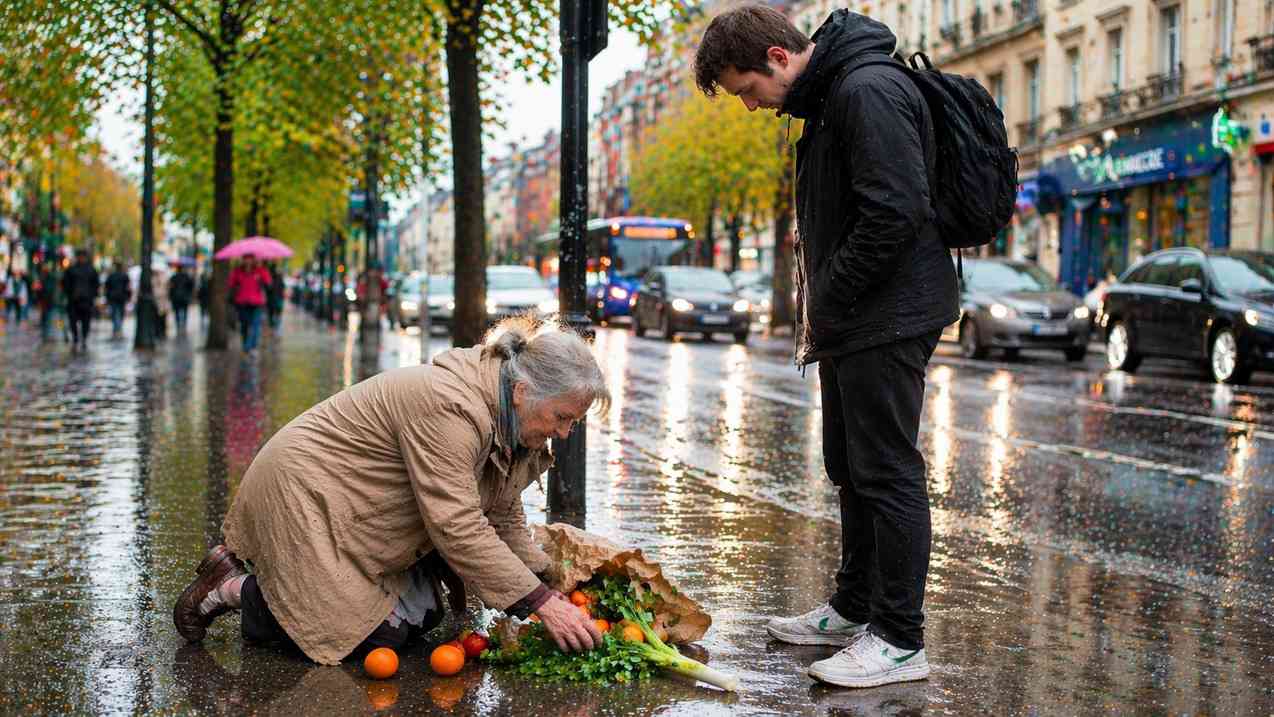
Imagine standing at a bus stop on a cold, rainy evening. A man next to you drops his groceries; a jar shatters on the pavement. You hesitate for a moment — and then decide. In those few seconds, you see how empathy works when no one is watching.
We live in an age that loves extremes. For good to “count,” it must be spectacular — ideally shared and liked. Evil, in turn, must be monstrous, so we can condemn it without hesitation and forget our own small omissions.
Hannah Arendt showed that evil poses a problem: what is most dangerous rarely looks like a beast. Much more often, it takes the form of an ordinary official.
In 1961, Arendt travelled to Jerusalem expecting to encounter a monster — the man who had coordinated the logistics of the Holocaust with the precision of a watchmaker. She expected to see fanaticism or hatred in his eyes. Instead, behind the glass of a bulletproof booth sat Adolf Eichmann: a man in a suit, with a face so ordinary it was almost forgettable.
In Eichmann in Jerusalem, Arendt described him as someone utterly incapable of independent thought. He was not a sadist in the usual sense, but a bureaucrat who had surrendered conscience to instructions. What drove his crimes was not burning hatred, but thoughtlessness — what Arendt called “the banality of evil.”
The idea caused outrage. Critics accused her of minimising guilt. But Arendt was not excusing Eichmann. She was describing a mechanism — showing how systems, hierarchies, language, and the suspension of reflection can turn an ordinary person into a cog in a machinery of destruction.
If evil can be quiet and ordinary, perhaps good can be as well.
Psychologist Philip Zimbardo offers an answer. After years of studying the “Lucifer effect” — how ordinary people become capable of cruelty — he turned the question around. If the tendency toward evil is banal, then the capacity for heroism must be equally common.
His concept of the “banality of heroism” carries a simple message: each of us is a potential hero waiting for a moment. Heroism does not require extraordinary character or destiny. It requires a decision made here and now.
The conclusion is uncomfortable and hopeful at once. Evil cannot be reserved for monsters — but neither can good be reserved for saints. Both are democratic. Both are available to anyone, at any moment.
A striking example is Giorgio Perlasca, an Italian businessman who, posing as a diplomat, saved thousands of Jews in Budapest. Journalist Enrico Deaglio called his actions the “banality of good.” Perlasca had once believed in fascist ideas. One day, he simply said enough — and quietly began repairing the world around him.
The problem today is that such quiet goodness has become almost invisible. Scandal, catastrophe, and hatred generate attention. A helping hand at a bus stop does not. We begin to believe that good is rare, when in fact it is simply not newsworthy.
Marek Edelman, the last leader of the Warsaw Ghetto Uprising, disliked the word “hero.” When asked about 1943, he would shrug and say they simply “did not let themselves be killed.” For him, decency was almost technical. After the war, he became a cardiologist and saw his work as a continuation of the same task: shielding the fragile flame of life from the wind.
When Edelman said, “This is not heroism, this is decency,” he was not being modest. He understood that in extreme situations, simple human reflexes matter most. Decency meant reliability — being “in order” toward one’s work and toward another person, regardless of circumstances.
This attitude resembles that of Dr Bernard Rieux in Albert Camus’s The Plague. Rieux fights the epidemic not because of grand ideals, but because he is a doctor and his task is to heal. This “working humanism” is the most effective barrier against the banality of evil.
Perlasca’s story belongs here as well. His life shows that goodness does not require a spotless past. What matters is the choice made when it counts. As Deaglio observed, this is the “banality of good” — goodness without fanfare or declarations. Goodness that does not seek witnesses, but simply exists.
You will likely encounter news today about war, scandal, or disaster. You may hear again that the world is falling apart. That is the information diet of our time. In such noise, it is easy to conclude that small acts of decency are irrelevant — that only systems, politics, and structures matter. In reality, the opposite is true.
Social psychology describes the bystander effect: when many people are present, each individual becomes less likely to act. Responsibility dissolves. The more witnesses, the greater the passivity.
Zimbardo showed something else: the bystander effect can be reversed. It takes only one person to act. One person who does not look away can prompt others to do the same. Decency is contagious — just as indifference is.
Everyday micro-acts of decency hold society together. Not manifestos, not hashtags, but gestures: opening a door, giving up a seat, apologising, listening to someone we disagree with. Zimbardo argued that small daily actions improve the world — from family and school to the level of society. Edelman put it more simply: “This is not heroism, this is decency.”
Both were right. This convergence between a Stanford psychologist and a cardiologist from Łódź is not accidental. Studying evil, both discovered on the other side not a monument of goodness, but something quieter — a small, everyday, almost invisible gesture.
Let us return to the bus stop. The man drops his groceries. The jar breaks. It is cold, it is late, and you have your own concerns. Three seconds.
Arendt might say: be careful — passivity is also a choice. Indifference is never neutral. The moment you look away, you take part in a process larger than yourself.
Edelman would say: this is not heroism. Just crouch down and help.
Zimbardo would add: if you do, others will likely follow.
And suddenly, around that broken jar, it might feel a little warmer.
Perhaps that is precisely where we see how empathy works most clearly.
This is the banality of good. Not spectacle. Not declarations. Not grand words. Just a few seconds. A movement of the hand. A decision no one records.
And yet, it is in such moments that we reveal who we truly are.
Read this article in Polish: Te 3 sekundy mówią wszystko. Czy stać nas na zwykłe dobro?


Content marketing specialist with his heart in journalism and English translations. An active writer for 20 years. Majored in economy. He has authored several non-fiction books, one of which won an award at the Ladek Mountain Festival. Sports, hard rock, and Italian cuisine afficionado.


Zmień tryb na ciemny