Science
Before There Are Planets, There Is Dust
16 October 2026





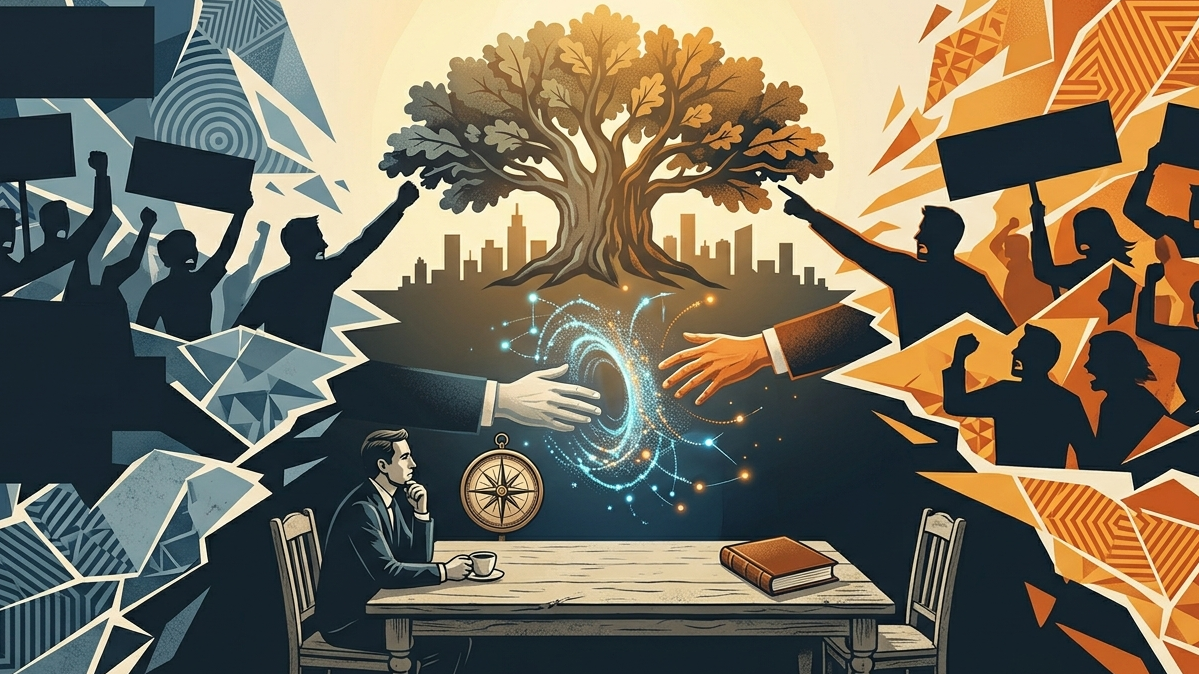
Do you avoid talking about politics at the family table, with neighbours or at work? That is not necessarily a lack of conviction. It may be the effect of political polarization. Why does democracy, which was supposed to be the art of compromise and the search for the common good, produce conflict instead? The answer is uncomfortable.
Social media was supposed to connect us. It did — but into bubbles. The algorithms of social platforms are designed to maximise the time we spend in front of a screen. They do this by serving us content that provokes emotion, and nothing engages us as powerfully as outrage, fear and anger. As a result, every day we feed on what divides us, not on what connects us.
Poles feel this. According to a CBOS survey conducted for the Polish Press Agency at the end of March, 46 percent of Poles see political conflict and polarization as the greatest threat to Poland’s stability over the next 5 years — more often than the international situation, named by 42 percent, or the quality of public services, named by 31 percent.
Yet the source of polarization lies deeper than algorithms or our temperaments. It reaches into the very nature of democracy as a system of competition for power. It is a game in which we often take part without noticing.
Anthony de Jasay, the Hungarian economist and political philosopher, offered in his 1980s book The State a way of thinking about democracy that explains polarization better than any conspiracy theory. In his view, politicians do not fight for ideas. They fight for votes. And votes, like goods on a market, have a price. Parties prepare offers: they promise benefits to some groups and tax increases to others. Whoever makes the better offer wins.
De Jasay illustrates this with a simple, though ironic, model. Imagine 3 groups: the rich, the poor and those in the middle — the decisive electorate. The “party of the rich” may propose taxing the poor and giving those resources to its own voters and to that crucial middle group. The “party of the poor” acts symmetrically: it taxes the rich and transfers resources to the poor and the middle. Which offer wins? The one that gives more to the middle group.
Here the key mechanism appears. De Jasay notes that the “party of the rich” will quickly realise that it can get more money to bribe the middle by taxing not the poor, who have little to take, but its own rich voters. It must therefore, as he puts it, “steal the poor’s idea” and turn against its own electorate.
As a result, both parties offer the middle group something similar, and the differences between them begin to blur. But to preserve the loyalty of their core voters, they must at the same time speak to them in the language of conflict: point to an enemy, frighten them with what the other side will do. Polarization, then, is not an accidental side effect. It is a tool.
De Jasay also uses the term “addictive redistribution.” Once the system starts, it cannot stop. Parties must keep bribing voters, because otherwise their rivals will do it for them. Any party that tried to halt the mechanism would lose the election.
The more deeply the state involves itself in redistribution, the more it reshapes society in its own image. It creates interest groups that then demand further transfers. This addiction is precisely what makes democracy unable to stop polarizing. Polarization becomes a condition of staying in power.
In this world, politicians do not govern in order to carry out a specific programme. They govern simply in order to remain in power. De Jasay calls this “profitless power” — power without profit, which nevertheless becomes an end in itself. Keeping it requires the constant fuelling of conflict.
What does this look like in practice? Parties speak one language to the centre and another to their hard-line electorate. To the centre, they say: we are pragmatic, we want stability, prosperity and security. To their own supporters, they say: they are a threat, no compromise with them is possible, they must be defeated. This duality becomes necessary in order to hold 2 groups at once: a loyal, mobilised base and an unstable but decisive centre.
As a result, democracy, which in theory was supposed to be a system of negotiation and the search for solutions, becomes a machine for producing conflict. Not because politicians are “evil.” Because this is the logic of the system.
Polarization did not come from nowhere. It is built into the very logic of democratic competition. But the fact that the system produces conflict does not mean that everyone has to participate on its terms. Quite the opposite: the more people stop supplying fuel, the more the mechanism will have to slow down.
A click on an outrageous headline is fuel for algorithms. Without clicks, the machine slows. The same principle works in politics. Someone votes differently because they have different data and different experiences. Labels simplify. “Them,” “the woke left,” “the hard right” — every such word shuts down conversation.
One of the simplest ways to step out of this loop is to recognise that we do not need to have an opinion on everything. The world is too complicated to judge every bill, every move, every politician. Ignorance and hesitation are not weaknesses. They are forms of honesty. They also save energy that would otherwise be spent on yet another wave of emotional agitation.
Finally, in real conversation — over coffee, on a walk, in the kitchen — conflict tends to be less sharp than it is online. Algorithms intensify tension. Anonymity loosens restraint. Away from the screen, it becomes easier to see that the person on the other side has a face. If the medium changes the rules of the game, changing the medium may be a good move.
Politicians will not walk away from political polarization, because it fuels them. Change has to begin with a private decision: not to play the game on the terms it sets.
Read this article in Polish: Polityka dzieli, bo musi. Z tej gry można wyjść

A graduate of Journalism and Social Communication at the University of Warsaw (UW), specializing in culture, literature, and education. Professionally, they work with words: reading, writing, translating, and editing. Occasionally, they also speak publicly. Personally, they are a family man/woman (head of the family). They have professional experience working in media, public administration, PR, and communication, where their focus included educational and cultural projects. In their free time, they enjoy good literature and loud music (strong sounds).


Zmień tryb na ciemny