Truth & Goodness
States, Scarcity, and the Future Under Construction
10 September 2026





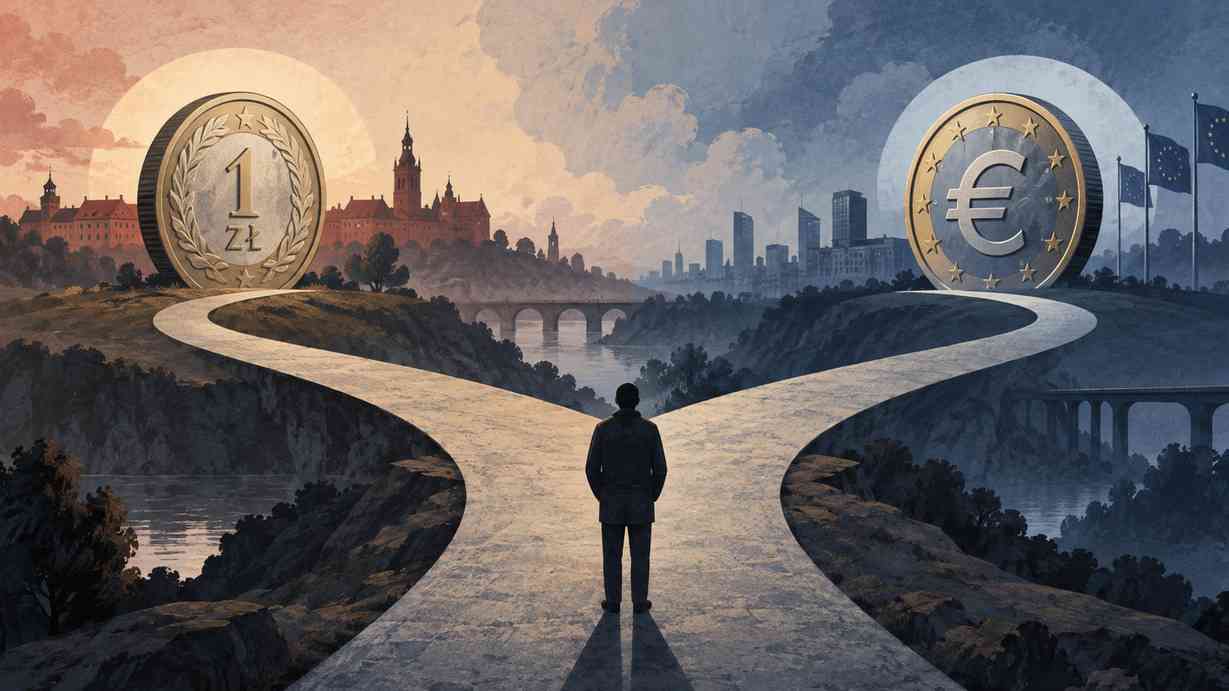
Poland is supposed to adopt the euro. No one, however, wrote down when. For more than 20 years, Sweden has shown that such a state of suspension can last a very long time. And this is where the real dispute over Poland and the euro begins: over who has the right to decide, and when, that the zloty will cease to be Polish money — writes Dariusz Lipiński, former vice-president of the Parliamentary Assembly of the Council of Europe.
Everyone who speaks about Poland’s possible adoption of the euro — supporters, opponents, and, because they exist too, all manner of both-sidesists — uses the vocabulary of economics. But they do so only to express a political position, and sometimes even an ideological profession of faith. The introduction, or non-introduction, of the European currency in Poland — or in any other country — is not an economic problem. It is a political one.
Its origins were political when, at the Hanover summit in June 1988, the European Council asked the European Commission led by Jacques Delors to examine how the Community might move toward Economic and Monetary Union, or EMU.
The decision taken a year later in Madrid by the European Council on the first stage of the plan leading to EMU was also political. And every subsequent step toward the introduction of the euro, without exception, was political as well. So were the steps toward not introducing it, as in Denmark, where a referendum rejecting the Maastricht Treaty at the first attempt ultimately led to that country’s treaty-based exemption from adopting the European currency.
Being in favour of, or opposed to, introducing the euro is not an expression of economic knowledge. It is an expression of political conviction. Were it otherwise, economists would all have to hold roughly the same view on the matter. They do not.
The choice between monetary sovereignty and surrendering it is purely political. Among Polish voters, it corresponds fairly closely to the division between those who declare an attachment to the homeland and those who make no such declaration, or who might be willing to make one only with various reservations — one of the more important being a desire to distance themselves from the very use of the word “homeland.”
I will not attempt to summarise precisely the views of various economists on the euro, but the spectrum is full. Supporters point to matters such as the absence of exchange-rate risk, lower transaction costs, greater macroeconomic credibility, greater credibility in the eyes of investors, and even easier travel.
Opponents stress the importance of the cushioning mechanism that comes with the ability to devalue one’s own currency in times of crisis. They point to concrete figures showing how much better countries outside the eurozone — the United Kingdom, Poland, or Iceland — coped with the post-2008 crisis than Mediterranean eurozone countries, and even Germany.
Among the radical opponents of the euro are Nobel laureates in economics: Maurice Allais, who received the Nobel Prize in 1988, Joseph E. Stiglitz, who received it in 2001, and Paul Krugman, who received it in 2008. Stiglitz wrote that
“Europe’s stagnation stems in part from the common currency, which was flawed at birth.” Krugman believes that “the euro was a mistake; it was meant to be a symbol of unification, but in the end it delayed European integration.”
In Poland, Stefan Kawalec, one of the co-authors of the so-called Balcerowicz Plan and a former deputy finance minister in the governments of Hanna Suchocka and Waldemar Pawlak, co-authored a book whose title speaks for itself: The Euro Paradox: How to Escape the Trap of the Common Currency? The other author is Ernest Pytlarczyk, chief economist at Bank Pekao SA.
I do not know how many Nobel laureates support the euro. In Poland, among professors of economics, there are probably quite a few. But since — let us repeat — the problem is political rather than economic, we need not enter into the details.
The Danish referendum of 1992 mentioned earlier — a political act — produced a situation in which Denmark is, after Brexit, the only member state of the European Union that has a treaty-based exemption from the obligation to introduce the European currency.
The Treaty on European Union, signed in 1992 and known as the Maastricht Treaty, obliged member states to introduce it. The Danes, however, rejected the treaty in a vote. Only after securing, under the so-called Edinburgh Agreement, the privilege of keeping their own currency, along with 3 other opt-out clauses, did they agree in a second referendum to ratify it.
One might say that their legal status is such that they do not have to adopt the euro until the end of the world — or, more precisely, until the end of the European Union’s existence — unless they themselves change their minds. As we can see, the reasons for this state of affairs — both the referendum and its result, as well as the negotiated concessions in the Edinburgh Agreement — were par excellence political events, not economic ones.
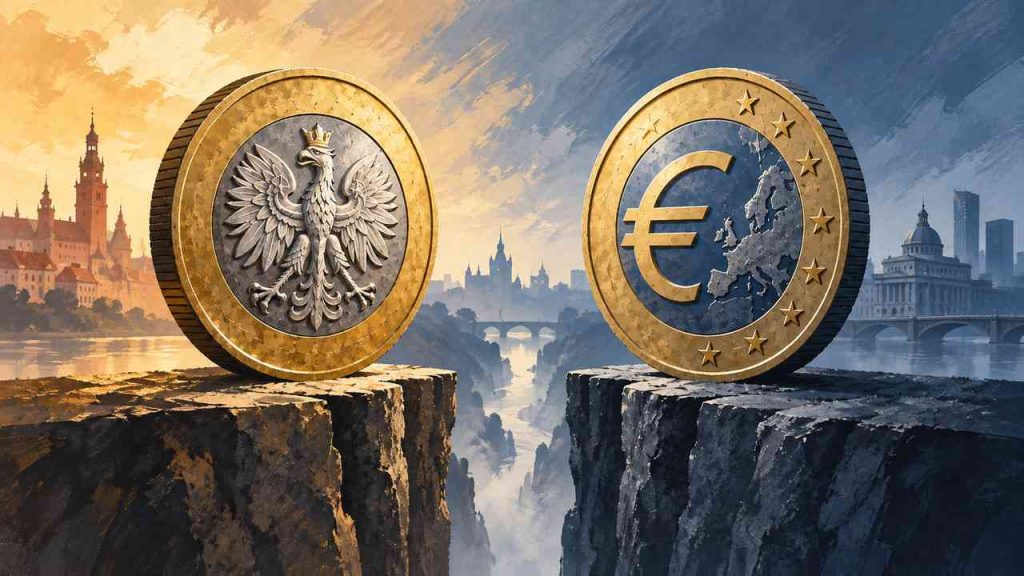
Sweden’s case is even more interesting. When it joined the Union after the Maastricht Treaty, the country committed itself to membership in the eurozone. Despite this, 8 years later, in 2003, the Swedish government called a referendum on the matter. At the time, a majority of Swedes, 56.2 percent, voted against, and the result binds the country’s authorities.
Since then, every Swedish government, whatever its composition, has been bound at once to adopt the euro, because the treaty says so, and not to adopt it, because a binding referendum says so. For more than 20 years, the Swedes have handled this split through creative accounting. They simply make sure that they never meet at least 1 of the convergence criteria required for joining the eurozone.
Specifically, they avoid meeting the exchange-rate criterion by remaining outside the Exchange Rate Mechanism, ERM II. Avoiding this condition is a conscious political decision. A ratified treaty that requires euro adoption, a binding referendum result that requires non-adoption, and the Solomonic care shown by all Swedish governments to ensure that they do not accidentally meet the convergence criteria — all these are political factors, not economic ones.
In Poland, the approach of successive governments toward introducing the euro has seemed to resemble the Swedish model. Formally, we are obliged to adopt the currency under the accession treaty. Yet for 20 years, no one worried about this. And rightly so, because the treaty sets no deadline. During the years of global crises after 2008, our own currency carried us through them relatively painlessly.
In serious discussions, the subject appeared rarely and usually in narrow circles. When it did surface more broadly, it tended to do so as a slip, a blunder, or a public-relations manoeuvre — as in 2008, when at the Economic Forum in Krynica Prime Minister Donald Tusk unexpectedly announced, to the astonishment of everyone, including his closest collaborators, that his government’s goal was to adopt the euro in 2011.
Even leaving constitutional considerations aside — introducing the euro in Poland would require an amendment to the Constitution of the Republic of Poland — replacing the zloty with the euro is difficult to imagine today, because most Poles remain consistently negative toward the European currency.
According to Eurobarometer, based on a survey conducted at the turn of April and May 2026, and whose figures are in any case inflated compared with data from domestic polling centres, 43 percent of Poles support introducing the euro. According to IBRiS polling from the turn of 2025 and 2026, the figure is 28.5 percent, while according to the Pollster Research Institute in January 2026, it is only 21 percent.
Only the Czechs show slightly less “enthusiasm” than we do, at 42 percent. Among the Swedes, who earlier rejected the euro in a referendum, the figure is 51 percent. In Romania it is 65 percent, and in Hungary as much as 80 percent. It is therefore difficult to expect this currency to displace the zloty in the near future, although it is worth remembering that few things can change as quickly as political moods.
Everywhere, not only in Poland, everyone — supporters, opponents, and both-sidesists — agrees on 1 thing: adopting the euro is irreversible. Once it has been adopted, leaving it becomes unimaginable, even if, as in Italy for example, doing so would be advisable. It hardly needs saying that this universal agreement is the strongest argument against introducing the euro. That is why the argument over Poland and the euro is ultimately not about banknotes or exchange rates, but about who gets to decide when a political promise becomes a point of no return.
Read this article in Polish: Między złotym a euro. Czy Polska musi przyjąć wspólną walutę?


A columnist and former member of parliament specializing in European affairs. He served as Vice-President of the Parliamentary Assembly of the Council of Europe. In his writing, he analyzes the future of European integration, relations between member states and EU institutions, and the challenges facing European democracy.



Zmień tryb na ciemny