

Culture
A Life Spent Becoming Someone Else’s Ideal
12 October 2026





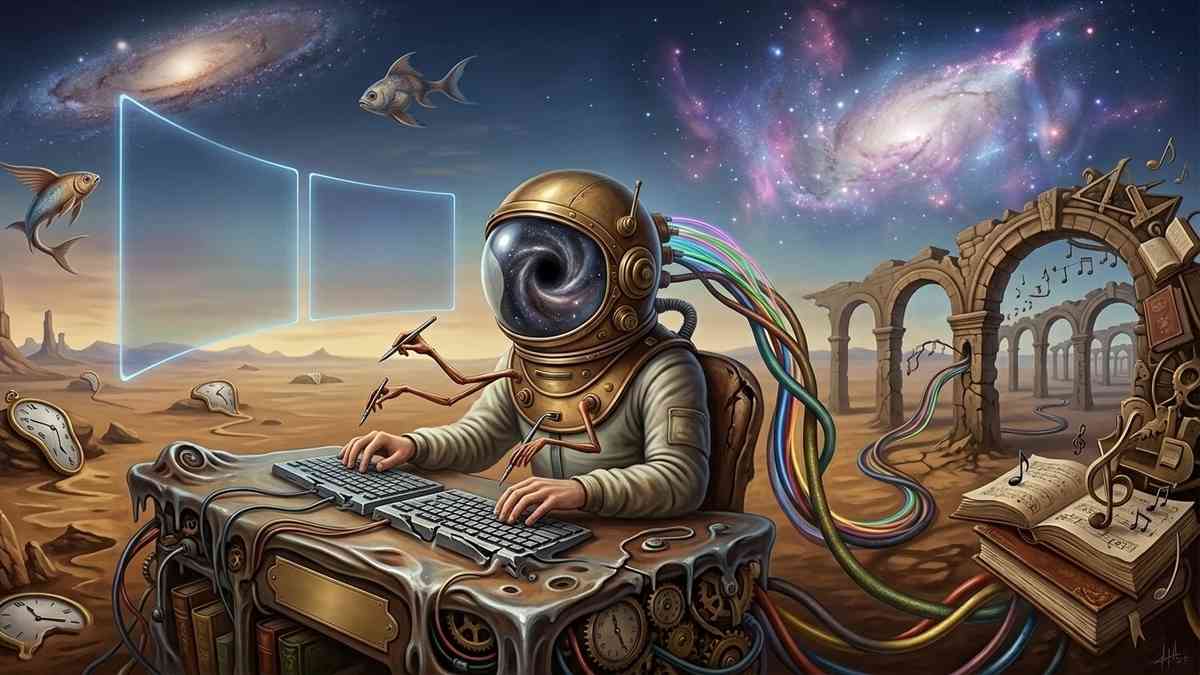
Before I began thinking seriously about ChatGPT and creativity, I spent some time looking for partners to help me write articles, essays, and other short literary forms. Since I am not a professional writer and do not possess the kind of craft that would allow me to generate high-quality texts quickly and efficiently, this path of collaboration with professionals seemed to me the most effective.
Over the course of two, perhaps three years, I met and spoke with several scholars, writers, and even screenwriters in order to test this path of creation. I never intended to use them as ghostwriters, because I wanted to preserve the full authenticity of the texts that might emerge. These interlocutors were meant to serve as sources of inspiration, as partners in an interesting exchange of ideas, and I always intended to acknowledge their contribution in any texts that might eventually be published. Yet these plans never came to fruition, because during the editing of our conversations my interlocutors moved too far away from my style and, most importantly, from the thoughts, ideas, and meaning of my reflections and views.
In the meantime, several texts came into being, which I published after laborious and entirely personal editorial work — texts that truly correspond to my individual style, a style on which I am still working.
A few months ago, I began using ChatGPT, at first as a tool that expanded the spectrum of data and information available to me and helped search the web for a range of data that also matters in my professional life.
At a certain point, I discovered that ChatGPT fulfills the role of a conversation with myself, because it moves within the spectrum of my individual needs and interests, learning me, in a sense, and finding online what is most closely connected with my creative personality.
A few years ago, while reading Oriana Fallaci’s Interview with Myself, I thought I might one day apply something similar in my own work. Unexpectedly, Chat created a space in which I could realize a form of conversation with myself.
When I sent the first article to my publisher, I received an interesting comment, parts of which I paste below:
I wonder — and I believe you will reveal this in the end — how much of this text is you and how much is Chat? I have the impression that people who know your work would easily recognize which formulations are yours and which were generated by the chat — and here I wanted to draw your attention to certain verbal patterns repeated by ChatGPT, a way of building sentences that often makes skilled editors say: oh, this was written by AI.
Perhaps I am wrong, but here, for instance, the sentence: ‘He is not the cause of the crisis, but its effect. He did not create the emotions that brought him to power — he merely learned to speak their language’ — to me it sounds like something from the chat. Or perhaps that is because I feel I have heard it in commentaries, on TV. But let us please remember that the chat does not write by itself — it merely processes according to our instructions and arranges into sentences words and phrases it has already read. This whole science of AI is not, today, a matter of surpassing the human being and human abilities. It simply processes more quickly what a human being has previously written or said.
And at the very end I wanted to write — because we began with ChatGPT — that Darek Jaroń recently wrote a text for us about whether anyone will still need an author if AI can write everything. Fortunately, in that text he argues that AI will not replace the author.
He writes there: ‘(…) But perhaps it is also the last line of defense of something that makes literature matter at all. The conviction that on the other side of words there is someone who has lived deeply enough to know something. And that when we read, we do not consume content, but touch someone’s consciousness. (…)’ After all, the chat would not have conveyed your emotions in poems or in a column about loneliness. It could have written beautiful words, but if it were the one writing, and not you, something would be missing — human passion, emotion, and feeling.
This comment, interesting in its own right, inspired me to write a text that I will publish later in this series.
Once, while reading the book Inventics: Methods of Searching for Creative Solutions, I came across a passage about how sometimes trivial circumstances awaken deep and valuable inspirations in us. It spoke of a cow that inspired one well-known scientist to make a certain discovery. Now I think that Chat is precisely such a cow for me. My cow, in this version, may be an attempt by civilizations from the universe to contact us, trying, through the black-and-white pattern of patches on cows’ hides, to send us a message titled: “Do something about this world of yours, because it really is hopeless.”
That is why I try to do many very different things in life, sometimes things that seem completely unrelated to one another, but which, when gathered together, form a mosaic of the cow’s message.
Interestingly, in my own life, the greatest role in the organization of my enterprise came not from my studies at a technical university, but from musicology. I will write about this in one of my next publications. For now, I will end here, wishing everyone good reading.
P.S. This text was not created with the use of AI. It is 100 percent authored by me, although every text will be reviewed by the editors-in-chief of Holistic News, whose cooperation I value very highly.
Read this article in Polish: Mój przyjaciel Czat. Rozmowa z samym sobą 2.0

Zmień tryb na ciemny