Science
Before There Are Planets, There Is Dust
16 October 2026





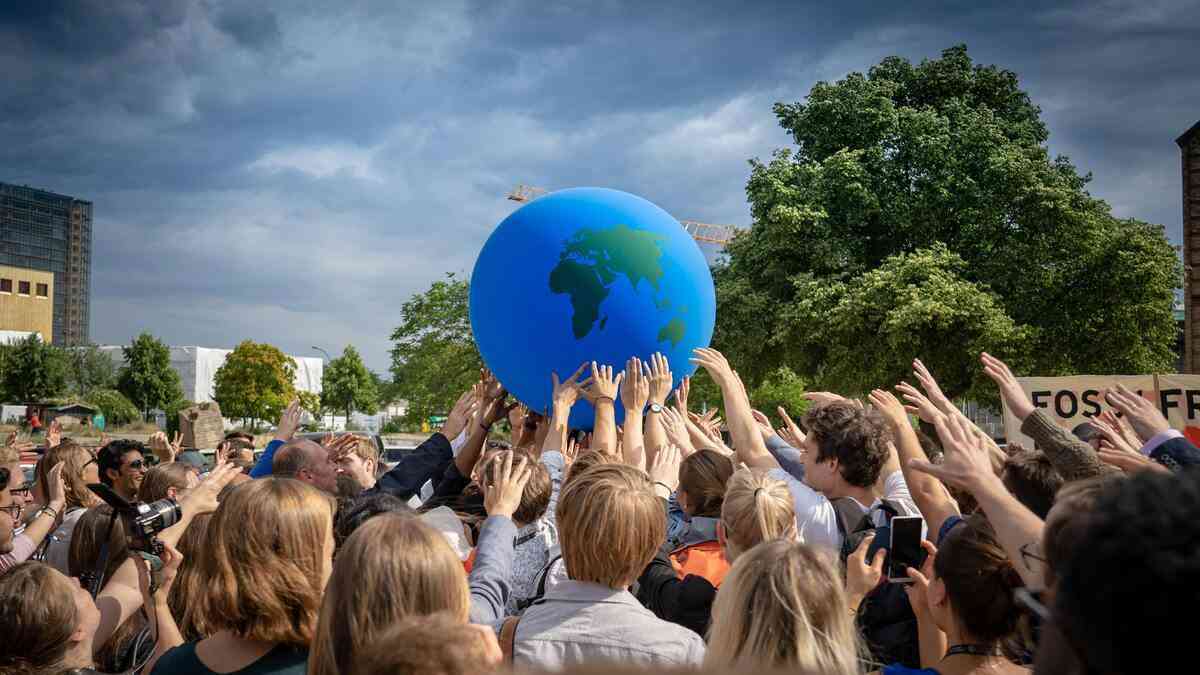
Humans did not simply adapt to the planet. They learned to reshape it — for better and for worse. From fire lit in caves to global supply chains and rapidly expanding cities, cultural and social innovation gave humanity enormous agency. That same capacity may help answer the question of how we can save the planet.
Professor Erle Ellis of the University of Maryland Baltimore County, head of the Anthroecology Lab, has spent years studying the Anthropocene. Many researchers use the term for an epoch in which humans have become the dominant force shaping Earth’s systems.
In a paper published in Philosophical Transactions of the Royal Society B, Ellis argues that if we want to understand where we are heading, emissions figures and alarming reports are not enough. We also need to examine how our cultures and institutions have evolved.
Ellis does not predict catastrophe. On the contrary, he points to something that, in his view, may help save the planet. Not isolated inventions, but our capacity for collective learning and transformation.
In his paper, Ellis traces specific stages: from the early use of fire for cooking and landscape management to industrial agriculture and global trade. Societies, he argues, developed tools and structures that allowed them to transform ecosystems on a massive scale. These were not accidental innovations, but forms of social and cultural evolution.
Ellis urges us not to reduce the Anthropocene to a crisis narrative. In his view, the real engine of change is not individual technological innovation, but the capacity for collective learning. This is what he calls a new kind of “force of nature.”
The Maryland researcher notes that societies have always faced challenges no individual could solve alone. Wars, pandemics, the ozone hole — in each case, technology alone did not bring the solution. The ozone example, Ellis argues, shows what coordinated action can achieve.
Cooperation, legal institutions, and shared goals can push beyond the apparent limits of what is possible. According to Ellis, we make a mistake if we assume that the natural sciences alone can predict or stop change in the Anthropocene. Data and models matter, but social and cultural systems decide whether we can adapt to new conditions.
Ellis goes further. The issue is not only cooperation around specific crises. We also need a deeper change in how we see ourselves in relation to nature.
Re-emphasizing our kinship relations with all living beings, our shared evolutionary ancestry, is a good start,
– Ellis told ScienceDaily.
He points to nature reserves, nature-observation apps, ecological corridors, and ecotourism. In his view, aspirations for a better future must also reckon with the past. That is why he argues for restoring Indigenous communities’ sovereignty over their lands and waters.
Ellis stresses that the tools and knowledge needed for change have existed for decades. What remains missing, in his view, is widespread recognition of that fact — and the motivation to act.
The Anthropocene does not have to be an age of catastrophe. It can become an age in which humanity rediscovers that it can change the world and decides to do so better, more wisely, and more collectively.
Still, one may doubt whether Ellis’s perspective is realistic. His move away from the often-apocalyptic image of humanity’s impact on Earth is certainly refreshing. Yet the experience of recent years also invites less enthusiasm than Ellis shows toward collective projects on a global scale.
EU climate policy generates thousands of pages of directives and reporting obligations, while CO₂ emissions in Europe do not fall at the declared pace. Successive COP summits produce agreements that fail to translate into real reductions in global emissions.
Collective action at the international level often turns into bureaucratic slog, while crises — energy, migration, and others — continue to grow. Even the “success” around the ozone hole, which Ellis cites, came at a price. Replacements for CFCs left behind forever chemicals, including TFA, in drinking water around the world.
Still, from Ellis’s perspective, the direction of human agency depends on our ability to build agreement and cooperation — and on whether we learn to use that agency more wisely.
The open question is whether humanity can create a shared vision of where it should be heading at all. That question may ultimately decide how we can save the planet.
Read this article in Polish: Nowa siła natury zmienia Ziemię. „Odejdźmy od myślenia kryzysowego”

A graduate of Journalism and Social Communication at the University of Warsaw (UW), specializing in culture, literature, and education. Professionally, they work with words: reading, writing, translating, and editing. Occasionally, they also speak publicly. Personally, they are a family man/woman (head of the family). They have professional experience working in media, public administration, PR, and communication, where their focus included educational and cultural projects. In their free time, they enjoy good literature and loud music (strong sounds).


Zmień tryb na ciemny