Science
Before There Are Planets, There Is Dust
16 October 2026





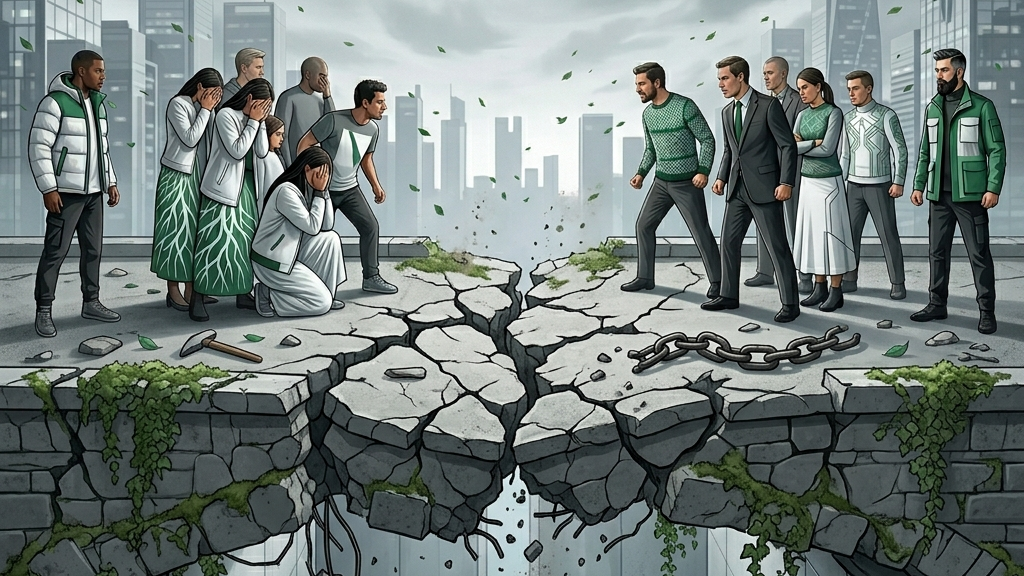
The effects of social polarization run deeper than we imagine. The problem is no longer just that we dislike one another more and more. Increasingly, we regard the active harming of “them” as morally right. Even when it brings us no benefit.
In the world we inhabit, the effects of social polarization do not end with sharper headlines or family arguments around the dinner table. Recent studies point to something far more serious. Increasingly, it seems, we regard harming “them” as morally right, even desirable.
In one experiment conducted in the United States in 2026, participants had to divide real money they had received from an anonymous person with a defined political identity: an ally, an opponent, or someone whose views remained unknown. The results showed that people were much more willing to actively harm a political opponent than anyone else. They did so even when it brought them no financial benefit. More than that, they judged this as the behavior one “ought” to choose.
Global reports, such as the World Economic Forum’s “Global Risks Report,” list social polarization — alongside disinformation and extreme weather events — as one of the most serious short-term threats facing the world. International analyses of trends in so-called affective polarization add another layer to this picture. They show that, in many countries, people have grown more willing over the decades to see their opponents not merely as people with different views, but as enemies unworthy of trust. Against this background, the effects of social polarization become something more than a conflict over a party platform.
Humanism, in its minimalist sense, says that there is a certain “minimum of good” owed to every person simply because that person is human. Not because they think as we do. Not because they support “our” party. But because they share with us the fate of a fragile, mortal being, vulnerable to suffering.
Yet the findings cited above suggest that, in practice, we increasingly follow a different code. “The good” belongs to our own people. Toward “them,” one may be unjust. One is even expected to be.
This is no longer simply a dispute over values, but the selective application of them. Toward those close to us, we speak of dignity, respect, and human rights. Toward political opponents, those same words seem to lose their force. The effects of social polarization appear in a quiet permission: if “they” lose their job, if they are cut off from resources, if they become the target of aggression — well, they brought it on themselves. In this way, humanism begins to apply only within the tribe.
In a classical democracy, a political opponent is someone with whom one argues, but to whom one does not deny a place at the table. We may regard that person’s views as mistaken, even dangerous, but we assume that they remain a person whom we may not simply harm as a means to an end. In the logic of rising polarization, the opponent becomes morally suspect. They are not merely wrong. They are “bad.”
From there, it takes only one more step to believe that harming them does not violate the good, but defends it. In experiments in which people voluntarily take money away from political opponents, the issue is not ordinary dislike. Something deeper is at work: the feeling that harm inflicted on an enemy is morally justified, perhaps even necessary.
Once such thinking becomes normalized, the effects of social polarization also become visible in everyday life: in the language of the media, in political campaigns, and in the ordinary way people speak about “them.”
A political community is not only a shared territory and a tax system. It is also — perhaps above all — the conviction that we bear some responsibility for one another’s fate. If half of society stops seeing the other half as people “worthy” of fairness and compassion, something fundamental disappears. The sense that anything still truly binds us together begins to vanish.
Reports warn that where polarization fuses with disinformation and economic crises, violence becomes easier to ignite. So does the temptation to turn away from democracy as a “theater of hypocritical community.” People can then live beside one another, but they find it increasingly difficult to live together.
The effects of social polarization are visible on a small scale: in broken family relationships, in silence around the holiday table, in the decision to hide one’s views “for the sake of peace.” These are not only psychological costs. They mark the erosion of the space in which any genuine conversation might still take place.
In an age in which studies and global reports leave little doubt that polarization is real, growing, and morally costly, the most important decisions do not take place at the level of statistics. Their real stage is the small, ordinary situation in which each of us decides whether another person’s political identity deprives them of the right to minimal justice.
The issue is no longer only agreement or disagreement. It is the willingness, despite our differences, to continue recognizing one another as human beings who must not be stripped of basic respect. Humanism in the age of social polarization does not require universal affection. It requires a conscious refusal to use the supposed right to harm others with impunity. Where that restraint disappears, political conflict gradually becomes another form of war — one waged without any formal declaration.
Read this article in Polish: Kiedy „tamci” przestają być ludźmi. Ukryte koszty podziałów


A Journalism and Social Communication graduate with 15 years of experience in the media industry. He has worked for titles such as "Dziennik Łódzki," "Super Express," and "Eska" radio. In parallel, he has collaborated with advertising agencies and worked as a film translator. A passionate fan of good cinema, fantasy literature, and sports. He credits his physical and mental well-being to his Samoyed, Jaskier.


Zmień tryb na ciemny