Culture
A Life Spent Becoming Someone Else’s Ideal
12 October 2026





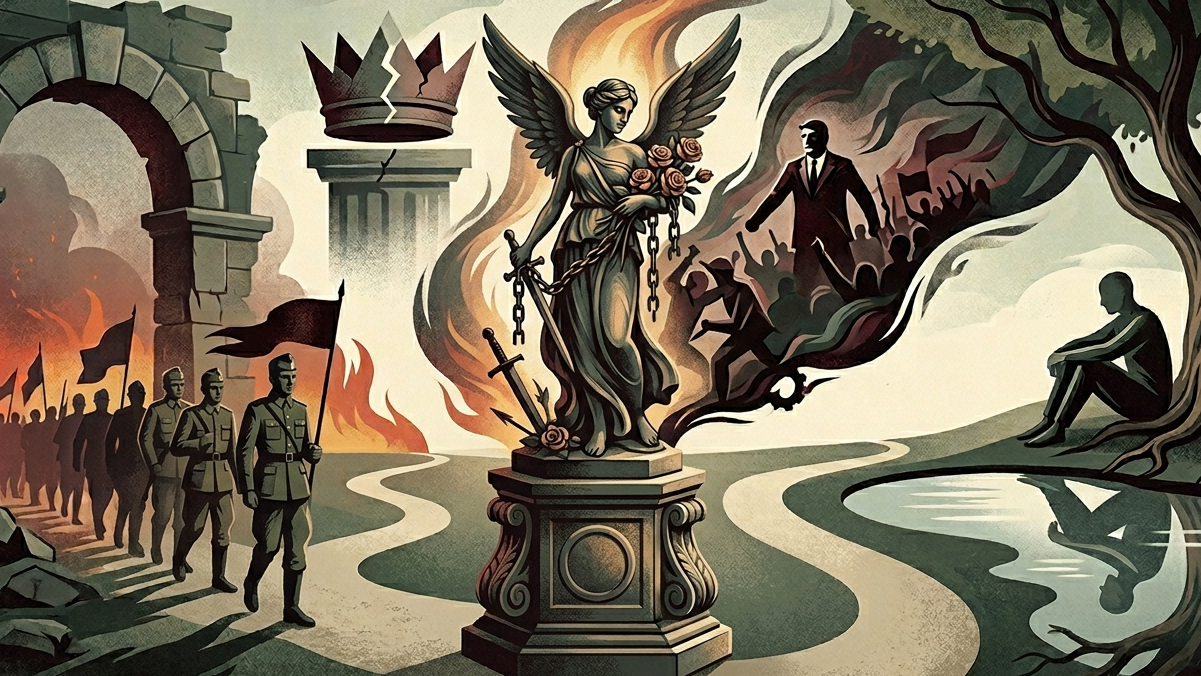
Although humanity has experienced the horrific consequences of wars throughout history, conflicts continue to erupt. Is it possible that we are driven by a love of war?
The First World War, the Second World War, the Cold War, the war in Ukraine, wars in the Middle East. There are also gang wars, drug cartel wars, corporate conflicts, and even backyard disputes. Many wars in history have erupted suddenly over issues that could have been mitigated through mediation or economic agreements just moments earlier.
Does humanity have a love of war encoded in its genes? Not necessarily, as there is no evidence for that. But the facts show one thing: humans cannot live without war.
For humans to ever stop waging wars, they would first need to pause for a moment. To realize that they think in terms of war, feel that they are in a state of conflict with themselves, and believe that an endless struggle between opposing forces constitutes the fundamental rules governing all existence.
Erich Fromm sheds some light on understanding the madness of war in The Anatomy of Human Destructiveness, arguing that much of war is about people clinging to strong leaders. Even if it is an illusion, far too many of us desperately need others in whom we can entrust our fate.
Illusions emerge wherever we try to reclaim something lost forever. Resentment thus becomes fuel for populist leaders, who are able to mobilize masses of humiliated, excluded individuals yearning for “the good old days” or believing that “with him, we will be safe.”
We know from the media that a calm leader rarely makes a career. Rational argument and a voice devoid of populist promises often result in being the “nice uncle” rather than the commander people will follow. Aggressive leadership, similar to dominance in animals, commands respect and attention. It can even unify large groups, as the leader imposes authority that is then accepted.
It is true that among lower primates, a leader’s authority often relies on the fear they instill in others. Among great apes, like chimpanzees, it is not revenge-based power but the ability to lead the group that establishes authority. A dominant animal must continually assert its role, showing superior physical strength, wisdom, energy, or traits that made it a leader. In human history, once dominance became institutionalized rather than based on personal skill, a leader no longer needs to constantly display exceptional qualities. In fact, it isn’t necessary for them to possess them. Our social system conditions people to perceive symbols—titles, uniforms, or other signs—as proof of competence. As long as these symbols exist, supported by the system, the average person won’t even question whether the king is naked.
— Erich Fromm
War is inhuman, states James Hillman in The Love of War. Every moment of combat exerts such pressure that soldiers inevitably break down sooner or later. Mental crises in war are as inevitable as gunshot or shrapnel wounds, according to the U.S. report Combat Exhaustion.
Studies of World War II participants showed that after sixty days in front-line combat, 98 percent of surviving soldiers exhibited psychological symptoms. Among the remaining 2 percent who maintained relatively stable mental health, a common trait was a predisposition toward aggressive psychopathic personality traits.
Hillman argues that even labeling human suffering as “stress syndrome” is inhumane, reducing humans to tiny cogs in the machinery of war. For this machine to function, it must be kicked into action—soldiers are metaphorically “rebooted” and sometimes literally struck to restore order.
There is another side: war is also normal. It concerns people; people instigate it, participate eagerly, and accept it—even without direct involvement. Film chronicles show cheering crowds of civilians—mothers, fathers, children—bidding soldiers farewell as they march to the front.
Consider a scene from Patton (dir. Franklin J. Schaffner, 1970). General Patton walks across a battlefield just after combat. The earth is scarred by shells, tanks smolder, soldiers’ bodies lie scattered. He kneels by a wounded officer, lifts his head, kisses his forehead, surveys the battlefield, and says:
I love this. By God, I love this. I love it more than my own life.
Hillman contends that we will never prevent wars or reasonably speak of peace and disarmament without first understanding the love of war. It requires immersing ourselves in the psychological state of humans in conflict to grasp the powerful force driving it.
War is, after all, the father of everything. We think in terms of war, feel at odds with ourselves, and believe that predation, territorial defense, conquest, and endless struggles between opposing forces are fundamental rules of existence.
In both Eastern and Western cultures, even meditation can symbolize struggle, as Pema Chödrön, an American-born Buddhist nun, points out in The Wisdom of No Escape:
When people practice meditation or other spiritual work, they often believe it will change them or make them better. This implies a subtle aggression against who they truly are. It’s like saying, ‘If I jog, I will be better,’ or ‘If I had a nicer house, I would be better,’ or ‘If I could meditate, I would calm down and become better.’ The pattern continues: we seek blame in others, saying, for example, ‘If it weren’t for my husband, my marriage would be perfect,’ or ‘My job would be wonderful if not for my boss,’ or ‘Meditation would be amazing if my mind weren’t in this state.’
In contrast, loving-kindness (maitri) toward oneself does not require denying or rejecting anything within. Maitri means accepting your madness, anger, inhibitions, jealousy, and low self-worth. Meditation isn’t about forcing self-change to become better; it’s about befriending oneself as one is.
It seems General Patton was right: we wage wars outwardly because wars persist within us. Recognizing this inner war is the first step to breaking free from it.
The love of war does not vanish because war also exists internally. It is not only a political or historical phenomenon—it is a force that fuels our fears, ambitions, and desires. Understanding it is the first step to no longer being its slave.
Read this article in Polish: Nie polityka, nie ideologia. Co ciągnie ludzi do wojny


A journalist, writer, playwright, painter, and therapist working towards certification. The author of 9 books, including Jak odzyskać duszę, Gdy nadwrażliwość wystawia rachunki. Czterdzieści dwa listy o miłości, życiu i śmierci, co-written with philosopher Professor Lech Witkowski, and Miłość w Ejlacie, published by PIW. A graduate in Political Science from Nicolaus Copernicus University in Toruń, she also completed the European Journalism Programme at the Natolin European Centre and the Academy of Transpersonal Therapy in Warsaw. Her work has appeared in Twórczość, Odra, Czas Literatury, Helikopter, and Dialog.

Zmień tryb na ciemny