Science
Before There Are Planets, There Is Dust
16 October 2026





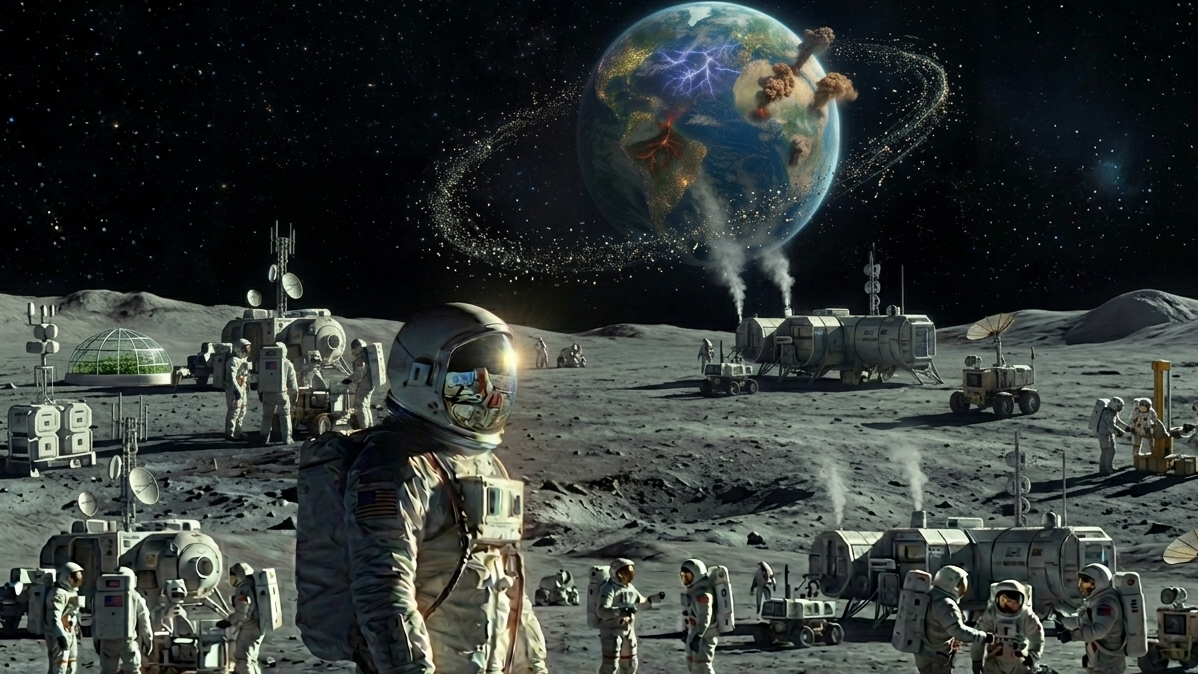
Humanity is returning to the Moon, but this time the story is not only about the great dream of astronauts. Behind NASA’s missions, China’s plans and private companies lies a new game for influence, resources and the rules of the future. Space colonization may turn the cosmos into yet another place where we carry Earth’s conflicts.
In April 2026, NASA’s Artemis II mission ended in historic success. For the first time since the Apollo programme, astronauts circled the Moon on a crewed flight. The 4 members of the crew travelled farther from Earth than anyone in history. This success was presented as a step toward a permanent human presence on the Moon and, at the same time, another step on the road to Mars. In this way, space colonization is no longer merely a science-fiction fantasy. It is becoming a concrete political and technological project.
At the same time, experts warn that we may soon face a “space traffic jam” near the Moon. The growing number of missions — Artemis, China’s Chang’e programme, commercial landers and plans for bases — could lead to congestion in cislunar orbits. This, in turn, forces us to ask whether, by colonizing space, we will truly begin a new, more mature era of humanity. Or whether we will simply repeat the old mistakes that led to so many political and ecological crises on our own planet.
Do we have the right to colonize space? The exploration and conquest of outer space carries the risk that we will transfer to other celestial bodies precisely the same mechanisms we observe on Earth. In Solaris, Stanisław Lem suggests that a journey into space is not an encounter with “the other,” but a confrontation with our own reflection:
We have no need of other worlds. We need mirrors.
In this sense, space colonization is a psychological experiment. Wherever we fly, we will take with us our ego, traumas, fears and hunger for possession. We will carry beyond Earth our systems of power, our mechanisms of denial and rationalisation. Everything suggests that we will take to the Moon or Mars not only our knowledge and technologies, but also our corporate interests, national ambitions and short-sightedness.
Experts already speak of the militarisation of space. Orbits around the Moon, Lagrange points — stable gravitational “corners” between Earth and the Moon — and lunar resources are becoming objects of geopolitical competition. The United States, China, Russia and private corporations look at them as if they were new oil fields. Future conflicts in space may therefore become only the logical extension of Earth’s mechanisms of exploitation and domination: another field onto which we project our fears and ambitions.
Then there is a new dimension of old irresponsibility: space debris. More than 36 thousand objects larger than 10 cm already orbit Earth, while around the Moon the problem is only beginning. Every lander, every satellite, every abandoned module leaves a trace. Without global regulation, the “space traffic jam” may turn into a cosmic rubbish dump — exactly as has happened on Earth. What grounds do we have for believing that this time we will be able to think beyond a single term of office, a contract or a mission?
There is also the question of ethics. Does a species that, in a short period of time, has brought one planet into a many-layered crisis — ecological, political and social — have the moral right to occupy the next ones? It is like handing the keys to a new apartment to someone who burned down the previous one.
This does not mean, however, that we should give up on space colonization. Expansion beyond Earth may give our species a chance of survival. Spreading humanity across more than 1 planet reduces the risk of extinction as a result of a global catastrophe — whether natural or caused by ourselves.
Expansion may also accelerate the development of technologies needed both in space and on Earth: from energy systems to new materials and recycling methods, including those being developed in the context of long-term lunar missions. Experts point out that space colonization forces us to design sustainable systems — closed habitats in which every drop of water and every gram of raw material must circulate. That, in turn, could become a point of reference and correction for our environmental policy on Earth.
Space colonization places an important question before us: can we become a species that does not merely “survive,” but also matures morally? If, as Lem argues, every encounter with space is really an encounter with our own mirror, then perhaps the most important task is not the construction of bases, but the reconstruction of our institutions, narratives and systems of value before we travel farther.
The success of Artemis II can be read in 2 ways: as a triumph of engineering and organisation that reopens the human road to the Moon, and as a moment of symbolic trial. This programme is taking shape in an era in which we know far more about the consequences of our planetary actions than the Apollo generation did. At the same time, it is an era in which space colonization is immediately woven into a network of state and corporate interests.
The question is no longer: “Can we get there?” We have proved that we can. The question is rather: “Who will we be when we arrive?” Will we return from the Moon wiser, more mature, ready to treat the cosmos as a common home? Or will we treat it as yet another resource to exploit? Space colonization is neither evil in itself nor an automatic salvation. It is a mirror. What we see in it — our greed or our wisdom — will decide whether it becomes the beginning of a new era for humanity, or merely the continuation of an old drama on a larger scale.
We take off into the cosmos, ready for anything: for solitude, for hardship, for exhaustion, death. Modesty forbids us to say so, but there are times when we think pretty well of ourselves. And yet, if we examine it more closely, our enthusiasm turns out to be all a sham. We don’t want to conquer the cosmos, we simply want to extend the boundaries of Earth to the frontiers of the cosmos.
Lem warned in Solaris.
Read this article in Polish: Nowy wyścig w kosmosie. To dopiero początek problemów


A Journalism and Social Communication graduate with 15 years of experience in the media industry. He has worked for titles such as "Dziennik Łódzki," "Super Express," and "Eska" radio. In parallel, he has collaborated with advertising agencies and worked as a film translator. A passionate fan of good cinema, fantasy literature, and sports. He credits his physical and mental well-being to his Samoyed, Jaskier.



Zmień tryb na ciemny