Truth & Goodness
The Stranger We Choose to Help, and the Signals We Trust
16 September 2026





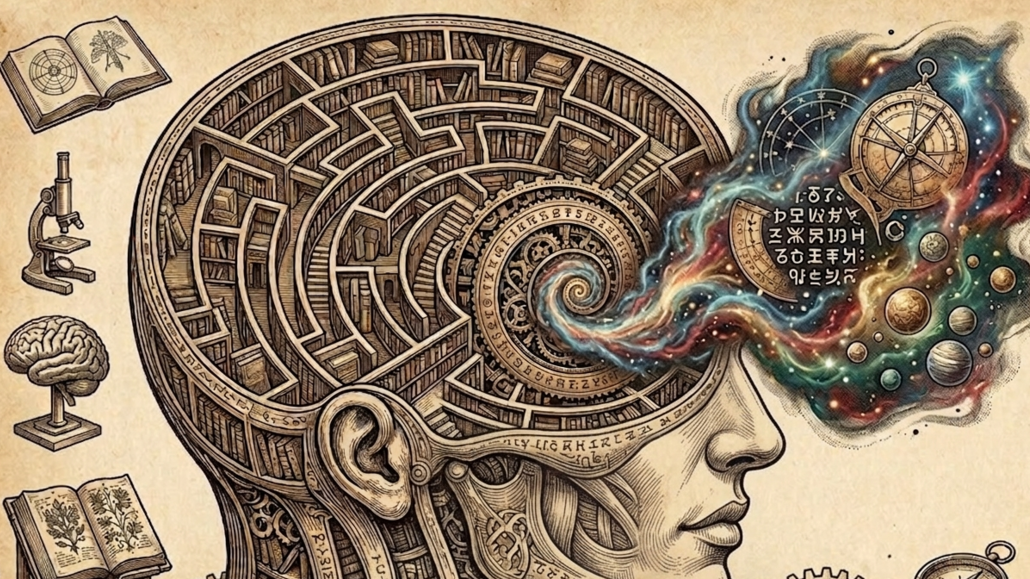
For Jorge Luis Borges, the mind is a labyrinth, and thinking means wandering through it. His stories remind us that every attempt to close the world inside a system is doomed to fail, and that too much knowledge may paralyze rather than liberate us. Borges on the mind is not a theory of mastery, but a lesson in human limits.
Jorge Luis Borges did not predict smartphones. He did not write about artificial intelligence. For much of his life, he worked as a librarian in Buenos Aires, surrounded by shelves and books. And yet, when we read him today, in an age of overloaded servers and algorithms that seem to think on our behalf, we may feel that he was writing about us.
His stories, though they often use fantastic plots or popular detective motifs, possess extraordinary intellectual precision. They read like miniature philosophical treatises. Borges often turns to the labyrinth, the library, and the journey in search of truth, only to suggest that truth must finally be found within the self. He is interested in the human mind, in the act of knowing, and in the traps human beings set for themselves.
In his work, Borges captured something lasting: a structure that does not change with technology. Something that has not changed for thousands of years. He saw that the human mind is like a labyrinth we build for ourselves, only to wander through it afterward.
In “The Aleph,” Borges describes a point — a specific place in the basement of a family home — from which the whole world can be seen at once. Every other place, every possible perspective, every smallest particle of reality: all of it appears simultaneously. The narrator stands before this vision and cannot bear it. Absolute knowledge, it turns out, does not illuminate. It blinds.
Today, we carry a small imitation of the Aleph in our pockets. Maps, films, opinions, encyclopedias, philosophies of life, all the events of the world sealed inside a little device with a glowing screen. At any moment, we can see the interior of a café in Tokyo or the arrangement of clouds above Patagonia. We believe this makes us stronger.
Borges showed that seeing everything does not mean understanding more. Quite the opposite: instant access takes away the time we need for reflection. Modern human beings, with lightning-fast access to all the knowledge in the world, scroll instead of thinking.
“The Library of Babel” revolves around a similar problem. The title library is an infinite gallery of hexagonal rooms, with shelves filled with books containing every possible combination of letters. Among them are works of genius, complete books, and books of truth. But there are also heaps of meaningless babble, random arrangements of signs that could never arise in any human language. And in the middle of it all stands a human being, tasked with finding the one true book. If he tries to carry out that task, he faces infinity and the prospect of madness.
Borges published the story in 1941. Today, we know very well what it means to live in such a library. Every answer lies within reach: every fact, every date, every statement made by someone, somewhere. The trouble is that we do not know which books tell the truth, which lie deliberately, and which arose by pure chance while pretending to be revelation. Too much knowledge does not lead to wisdom. It leads to the paralysis of choice.

In “Funes the Memorious,” Borges describes a man who, after an accident, gains a superhuman memory. Funes remembers absolutely everything: the shape of every cloud from every day, the arrangement of wrinkles on every cover, every detail of his life. He is a living, walking database. And he is completely helpless. Because thinking, as the narrator explains, depends on generalization and on forgetting differences.
Funes cannot forget. For him, every moment is separate, every detail distinct and unrepeatable. He cannot join facts into a whole. He cannot draw conclusions. His perfect memory is a junkyard. Is that not sometimes how we live? We take photographs, screenshots, notes we never return to. We believe that more means better, that storage means power. Borges seems to say that more means worse if a person does not know how to choose. And choosing requires the courage to reject something.
But Borges does not write only about knowledge. He also writes about plans, including the greatest and most ambitious ones, those that aim to encompass all of humanity. In “The Congress,” a group of intellectuals decides to create an assembly representing the entire world. They are not pursuing politics in the ordinary sense. Their ambition reaches further: they want to grasp totality, to gather everything that exists into a single act of thought, a single decision, a single plan. The impossibility of that dream soon becomes clear.
Every attempt at reduction loses something essential. Every attempt to include everything in the plan leads to paralysis. The Congress collapses, and the narrator finally realizes that the true “Congress” is the world that already exists, and all the people in it, with all their failures and successes, crimes and good deeds:
The Congress of the World began with the first moment of the world and it will go on when we are dust.
Borges reminds us of something we would prefer to forget: the whole is not for us. We may strive toward it, but we will never reach it. And perhaps that is a good thing. If we really did enclose the world in a single formula, we would stop asking questions. And without questions, there is no thought.
In “Tlön, Uqbar, Orbis Tertius,” Borges goes even further. He describes a planet invented by philosophers, whose detailed reality, coherent with their visions, gradually begins to displace the real world. Rules, solutions, and concepts that begin as innocent intellectual games and utopian visions start acting upon reality itself. Borges sees a clear trap here:
Ten years ago, any symmetrical system whatsoever which gave the appearance of order — dialectical materialism, anti-Semitism, Nazism — was enough to fascinate men.
Borges writes about his own time: about the grand narratives of the 20th century, which promised to understand and transform the world, and brought crime and destruction instead. He writes, too, about the fact that people often prefer an intelligible labyrinth woven by human hands to the real world, whose laws remain unreadable.
In “Blue Tigers” — a story less often cited, but no less important — the narrator finds mysterious stones that change in number. They cannot be counted, described by any mathematical system, or contained by any rule. They exist beyond logic, beyond everything the human mind can grasp.
Here, Borges shows that something will always remain outside every database. Something that cannot be predicted or controlled. It may be cosmic chaos. But it may also be art, chance, or someone’s unpredictable gesture. Without that remainder, the world would be predictable, empty, and unworthy of being known.
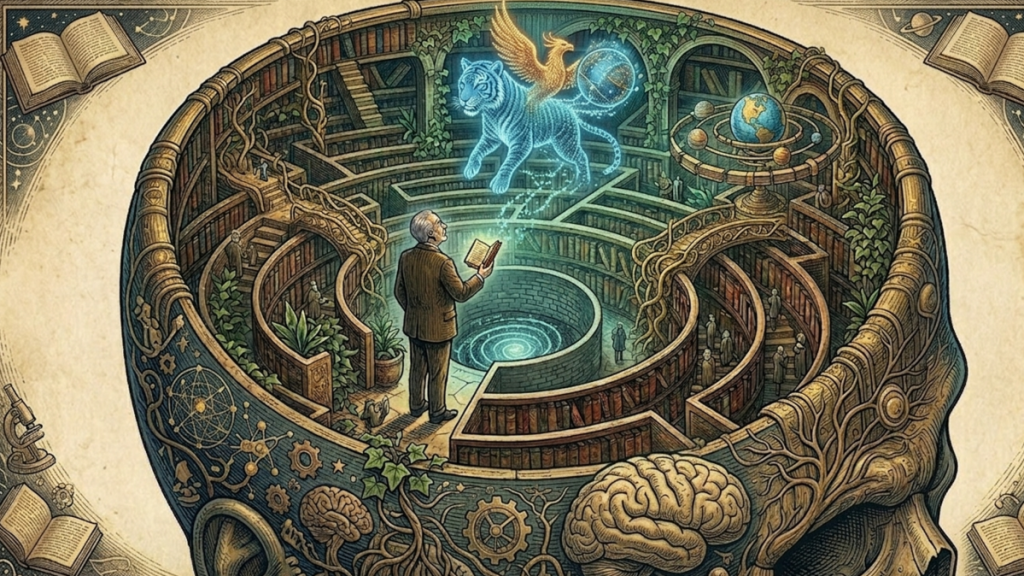
For Borges, the favorite image of the human mind was the labyrinth. Not one with a single entrance and a single exit, but rather a network of forking paths, where every decision opens new corridors and closes others. “The Garden of Forking Paths,” one of his most famous stories, offers precisely this metaphor for every act of knowing.
There is no map from above. There is no point from which the whole can be seen. We are inside. Every thought results from thousands of earlier choices: the paths we took and the ones we abandoned. Thinking means wandering, and there is nothing shameful in that. It is simply the only form of movement available to us.
Borges does not call us to flee from knowledge. He does not tell us to throw away our phones, much less our books. He calls us, rather, to learn how to live with incompleteness. To learn how to choose what matters and what we may safely discard. To learn how to forget. Forgetting is not a flaw in the system. It is the mechanism that allows us to think at all.
If we remembered everything, as Funes did, we would not be wiser. We would be paralyzed. If we had access to every path in the labyrinth at once, we would never move. We are condemned to one path at a time. To the fact that we will go in one direction and lose the rest. That loss can hurt. But it is precisely what makes us human.
It is also a choice of humility and caution toward great ideas and the ambitions of power:
(…) I joined the Conservative Party, which is a form of skepticism, and no one branded me a Communist, a Nationalist, an anti-Semite (…). In time, I believe, we shall deserve to have no governments.
In “Shakespeare’s Memory,” Borges describes a man who acquires the consciousness of his literary ideal. For years, the entire genius of the English playwright lives inside his head. Every line Shakespeare wrote, every thought he left behind, seems available to him. Endlessly, he can quote, analyze, compare, and summon what he needs. A living archive, he should be powerful. Instead, in the end, he gives it up. Another person’s greatness becomes unbearable. Rather than serve as the vessel of someone else’s genius, he longs to be himself: ordinary, limited, incomplete. Then comes the quotation — not from Borges, but from Shakespeare:
From this day, I begin to live from what I am.
This is not resignation, but liberation. We do not need to grasp everything, remember every fact, have access to all information, or know the answer to every question. We do not need to be geniuses, nor do we need to build a system that encloses the world inside a single formula. Our greatest strength lies in accepting our human limits.
Borges was not a pessimist in this. He simply showed the fixed points of human experience: fear of infinity, the need for meaning, the temptation to believe that there exists one book, one plan, one truth that will explain everything. The solution to the riddle of the labyrinth — the universe, and the human being who tries to comprehend it — lies within each of us.
Borges on the mind means understanding our limits, accepting them, and sometimes recognizing them as a warning against excess. His insight belongs as much to the 20th century he witnessed as to our own, whose labyrinths we can still cross by the light of his work.
This article uses quotations from Borges in Andrzej Sobol-Jurczykowski’s Polish translation, drawn from editions published by Państwowy Instytut Wydawniczy: Fictions, 2019; Brodie’s Report, 2021; The Book of Sand and Shakespeare’s Memory, 2025. For several quoted passages, I used established English renderings where they could be verified.
Read this article in Polish: Umysł w labiryncie. Borges o cenie nadmiaru wiedzy


A graduate of Journalism and Social Communication at the University of Warsaw (UW), specializing in culture, literature, and education. Professionally, they work with words: reading, writing, translating, and editing. Occasionally, they also speak publicly. Personally, they are a family man/woman (head of the family). They have professional experience working in media, public administration, PR, and communication, where their focus included educational and cultural projects. In their free time, they enjoy good literature and loud music (strong sounds).

Truth & Goodness
15 September 2026


Zmień tryb na ciemny