Science
Before There Are Planets, There Is Dust
16 October 2026





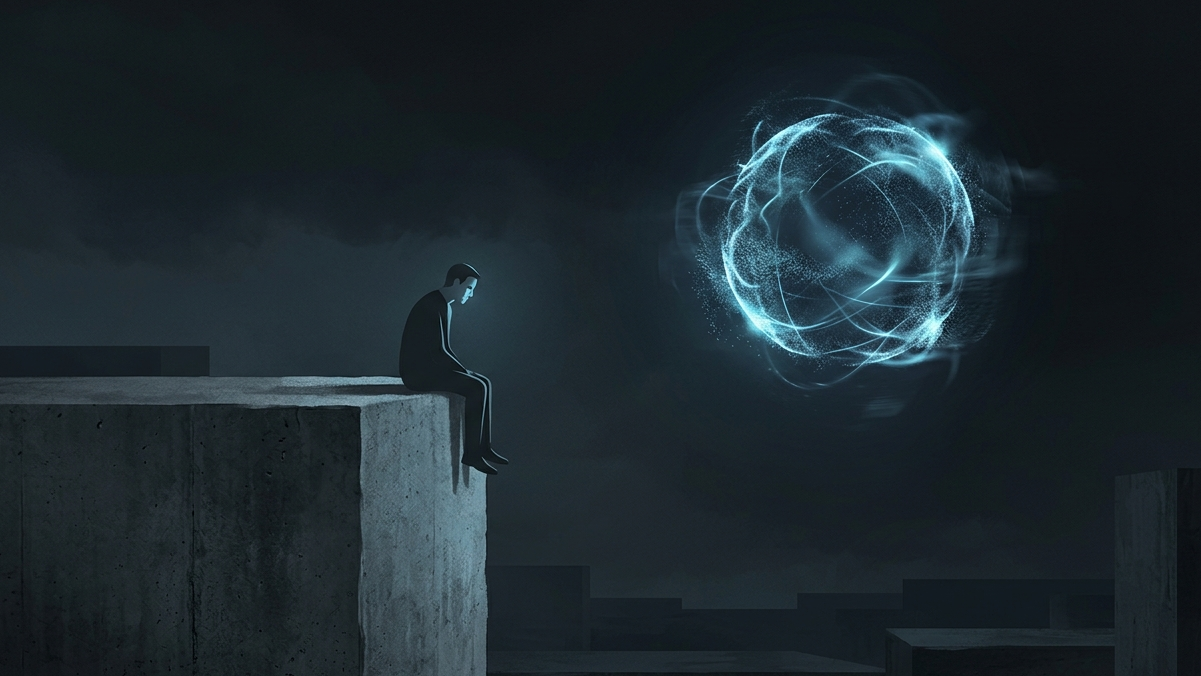
The findings of quantum physics may transform our understanding of the nature of reality. But do they truly change anything in everyday life? Do fashionable phrases — quantum physics, quantum spirituality, alternative dimensions — really contain some deep meaning for human existence? Or has science, instead of bringing a revolution, become only another temporary hiding place from the world?
When we watch sci-fi films about alternative worlds or read guides to “quantum self-improvement,” we are rarely looking for the truth about electrons. More often, we are trying to escape the existential aches of everyday life. If a physicist on YouTube says that time is an illusion, people sometimes receive it almost as dogma. The difference is that, instead of fear of damnation, they may feel a kind of existential relief.
Scientists and popularizers themselves often feed this hunger. When they write about the “symphony of strings” or the “holographic universe,” they are not practicing pure science, but literature. They use poetic images to describe something that, in reality, takes the form of cold, dry mathematical notation.
The great French physicist and philosopher Bernard d’Espagnat wrote about the idea of “veiled reality.” He argued that objective reality exists, but in its deepest structures remains fundamentally inaccessible to knowledge. The harder one presses upon the world, the more it dissolves, answering only the questions researchers ask of it. D’Espagnat’s term is usually rendered in English as “veiled reality,” describing a concealed dimension of existence that our measurements reveal only partially and abstractly.
Niels Bohr, one of the fathers of the discipline, is said to have put it in 1 sentence:
There is no quantum world. There is only an abstract quantum physical description.
In other words, quantum physics does not describe the world in itself. It is only a map of reality, not reality itself.
In pop-cultural fantasies, it is easy to see the search for a cure for very specific human fears. Quantum mechanics simply offered a new language for describing what slips away from everyday struggle.
Hugh Everett’s many-worlds idea is a perfect example. Everett’s theory — the many-worlds interpretation, in which quantum measurement leads reality to split into parallel branches — became, in popular culture, a metaphor for unrealized life choices.
The creators of Everything Everywhere All at Once understood the metaphorical potential of the multiverse perfectly. They presented the many-worlds not as a technical curiosity, but as a direct reflection of decision paralysis and regret. The vision that somewhere out there exists another version of the self, one that chose a different career path, another partner, or avoided a life mistake, works like psychological anesthesia. It removes the crushing responsibility for decisions made here and now.
The instrumental treatment of science in so-called quantum spirituality works in a similar way. New Age movements and pseudoscientific self-improvement guides eagerly use Heisenberg’s uncertainty principle as alleged “proof” that human consciousness can literally control reality.
In this narrative, quantum physics becomes a magical tool. Since subatomic particles display fluidity before the moment of observation, self-help gurus promise that, through the right thoughts and “vibrations,” one can freely manifest success, health, or wealth.
This radical simplification turns physics into a form of contemporary shamanism. As a result, phrases such as quantum physics, spirituality, and manifesting success become synonyms for the promise of absolute control over fate through pseudoscientific theories.
Physics also serves as a bandage for loneliness. In an age of deep social atomization, quantum entanglement — the phenomenon in which 2 particles remain correlated regardless of distance — quickly became the most popular metaphor for closeness. Slogans such as “we are all connected by energy” are nothing other than a desperate attempt to rationalize the need for community and escape the harsh fact of individual, physical isolation.
The problem is that this entire “quantum spirituality” rests on a fundamental misunderstanding: an error of scale. The attempt to transfer the behavior of individual atoms directly onto everyday life has no basis in fact.
In the laboratory-isolated micro-world of elementary particles, superposition, entanglement, and pure probability rule. That is where the phenomena that so inflame the imaginations of screenwriters and amateur mystics take place. Everyday macro-reality, however, obeys entirely different laws: stable states, inescapable gravity, and the brutal logic of cause and effect.
All these fascinating, “magical” quantum states require extreme, unnatural conditions: temperatures close to absolute zero and isolation from the surrounding environment. In a natural setting, they collide with billions of other particles in constant interaction with their surroundings. And they disappear almost instantly in the process known as decoherence.
Before these subtle phenomena can even approach the scale of neurons, biology, or human emotions, they are irreversibly destroyed. The human being remains alone with a reality that is classical, hard, and sometimes simply painful.
Does anything, then, follow for everyday life from the mathematical abstractions of quantum mechanics? Directly — absolutely nothing. No Schrödinger equation will make it easier for anyone to get out of bed in the morning. It will not pay off a mortgage, and it will not soothe the pain of losing someone close.
Yes, quantum mechanics enables fundamental improvements in the technology on which daily life depends. But a technological revolution belongs to an entirely different order than existential meaning.
Treating quantum mechanics as a new form of religion rather misses the point. Physics does not offer the meaning of life. It gives only — and this is already a great deal — a probable description of how reality works.
There is, however, something science can teach as an existential lesson: radical cognitive humility. Quantum physics strips us of the illusion that the world is a simple mechanism, easy to master and make familiar.
Cormac McCarthy, in Stella Maris — a supplement to his final novel, saturated with mathematics and deep existential exhaustion — wrote:
That at the core of reality lies a deep and eternal demonium.
This is not about a religious devil, but about the radical otherness of the world. It means that at the foundation of everything there waits neither idyllic harmony, nor cozy meaning, nor a cosmic order we might domesticate. Something elusive lies there, wholly indifferent to human fate.
The attempt to escape into quantum paradoxes is often an attempt to avoid one’s own here and now. It is easier to consider, from a distance, whether the cat in the box is alive or dead than to confront one’s own biography, the passing of the years, or difficult relationships.
When we return to everyday life, it proves objective through and through. No element of the micro-world, no superposition, will allow a human being to be in two places at once. And perhaps that is for the best.
In the end, the whole of human experience — weariness, fear, responsibility, and moments of wonder — unfolds precisely at this hard, macroscopic scale, where particle physics simply has no access. Quantum spirituality may offer metaphors, but it cannot live our lives for us.
Read this article in Polish: Kwantowa ucieczka od życia. Nowa metafizyka dla zmęczonych


A graduate of Journalism and Social Communication at the University of Warsaw (UW), specializing in culture, literature, and education. Professionally, they work with words: reading, writing, translating, and editing. Occasionally, they also speak publicly. Personally, they are a family man/woman (head of the family). They have professional experience working in media, public administration, PR, and communication, where their focus included educational and cultural projects. In their free time, they enjoy good literature and loud music (strong sounds).


Zmień tryb na ciemny