

Science
Before There Are Planets, There Is Dust
16 October 2026





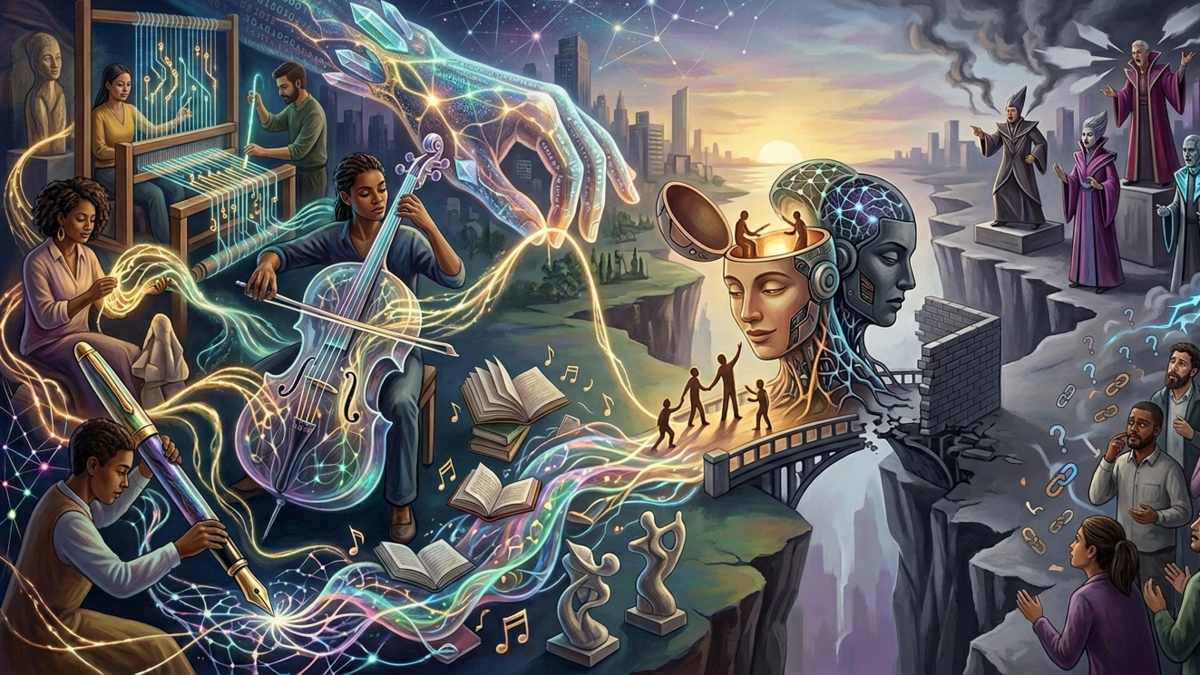
In the debate about artificial intelligence, people very often assume that the tool itself creates value. That all one needs to do is open ChatGPT, type a few sentences, and the machine will “do the rest.” But that is an oversimplification. In my understanding, ChatGPT is more an instrument than an autonomous creator. It is like a guitar. The same guitar will sound different in Prince’s hands than in Paco de Lucía’s. The instrument remains the same, but the music is completely different, because the source of style is not wood, strings, or electronics — the source is the human being.
Someone might say that this comparison misses the mark, because ChatGPT can generate “false notes” on its own — errors, simplifications, untrue information. But that is exactly how every instrument works. A guitar does not create music by itself. The player decides which sounds to draw out, which to silence, and which to combine into harmony. A professional musician controls the sound almost entirely. The same applies to AI. The user can control every sentence, every direction of the conversation, every tone, and every idea. We can compose our own style of working with the machine, choose elements, reject what sounds false, and build something of our own.
What is most interesting, however, is that with ChatGPT — as with an instrument — a person learns how to play. At first, conversations can be random, chaotic, superficial. But over time, technique appears. We learn to ask better questions, guide the narrative, build the structure of thought, and control the pace and direction of the answers. The more we “play,” the greater the fluency becomes. An experienced user can achieve results incomparable with those of someone who has only just begun. Not because they have a different AI model, but because they have developed their own language of communication with the tool.
A professional guitarist does not make mistakes in the same way, either. Prince or Paco de Lucía did not stand on stage thinking about every movement of the hand. After years of practice, the instrument becomes an extension of thought. Of course, weaker days happen. Sometimes form, concentration, or inspiration is missing. A performance may seem less brilliant. But even then, the artist remains himself — inimitable, recognizable from a single note. It is similar with ChatGPT. 2 people can use the same model and still create completely different things. One will sound superficial and predictable; the other will create something moving, original, and deeply human.
That is why I do not believe in the vision of a world in which AI replaces the individuality of the creator. On the contrary — AI can make it stand out even more clearly. One can learn to play like Prince. One can try to imitate Paco de Lucía’s technique. But one will never truly become them. Because real creativity does not come from the perfect reproduction of someone else’s style. It comes from the moment when a new idea enters the mind — something personal, unobvious, sometimes irrational — something we want to share with the world.
And it is precisely then that ChatGPT stops being “artificial intelligence” and becomes an instrument of human imagination.
I do not understand what purpose such a reaction serves to the mere possibility that Olga Tokarczuk might use artificial intelligence. I understand even less the language that has begun to dominate this discussion. “The little people,” “the rabble,” “the fairground.” Words full of contempt toward people who — often clumsily, emotionally, sometimes naively — are simply trying to understand a world that is changing faster than ever before.
Can the internet be brutal? Of course. Can comments be stupid, unfair, and hurtful? Without a doubt. But if the answer to that is an equally contemptuous tone toward society, then we are not solving the problem. We are only deepening the conflict. We are building yet another barricade between “those who know” and “those who do not understand.” And yet this very division is now one of the greatest problems of contemporary public debate.
The point is not to remain silent about the subject. Quite the opposite. Artificial intelligence will become one of the most important tools of the 21st century. It will influence literature, art, education, science, politics, and the way entire societies think. We need this conversation. But conversation does not mean mocking people for their fears or morally placing oneself above others.
A different response is possible. We can calmly explain what AI really is today: not a magical machine that writes books on behalf of a person, but a tool — sometimes inspiring, sometimes helpful, sometimes banal. We can ask the author herself whether she uses AI, how she uses it, and what value she sees in such support.That would be an interesting conversation. Perhaps even a fascinating one. Because for many artists, artificial intelligence is becoming something like a new notebook, an interlocutor, a laboratory of ideas.
Meanwhile, we increasingly observe a mechanism known for years: instead of explaining reality, we start digging in. Some shout that AI will destroy culture. Others reply that its critics are backward, small-minded, and unworthy of taking part in the discussion. As a result, everyone loses, because instead of conversation we get an emotional tribal war.
And yet the history of technology shows something entirely different. Every new tool has stirred fear. The typewriter was supposed to kill literature. Photography was supposed to destroy painting. The internet was supposed to kill books. Meanwhile, the world simply changed. Some people used those changes creatively; others rejected them out of fear or misunderstanding. But contempt for people trying to keep up with change never helped.
That is precisely why words that strip society of dignity sound so wrong to me. Democracy, culture, and public debate do not mean that the better educated despise those who are less oriented. They mean patient explanation, even when the other side proves tiring, emotional, or unfair.
Because if we truly believe today that AI will become something natural in creative work, then we need calm, education, and honest conversation all the more. Not superiority. Not contempt. Not the language of class, which divides people into enlightened elites and “the rabble.”
The most disturbing thing in this whole story is not even that someone might have used AI in creative work. The most disturbing thing is how quickly a debate about technology turns into a debate about who has the right to speak and who should be mocked and stood against the wall.
And yet the world is already divided enough. We do not need more words that only deepen that division.
The paradox of this text lies in the fact that an article seemingly written in defense of Olga Tokarczuk may, in practice, have exactly the opposite effect. The author, while trying to protect the writer from criticism, also builds a clear division: “us” and “them,” supporters and opponents. And when defense takes the form of aggression, contempt, or moral superiority, critics can very easily begin to identify the author himself with the person he is defending.
As a result, the discussion stops being about literature, the meaning of using AI, or the boundaries of creativity, and begins to fuel a spiral of mutual hostility. This is especially dangerous in the age of social media, where emotions spread faster than arguments. Even if the intention was to defend the author, one may unconsciously create a situation in which part of public opinion begins to ascribe to her the tone and views of the people speaking on her behalf.
And yet the true power of literature does not lie in closing discussion, but in the ability to open it.
Read this article in Polish: AI jako instrument wyobraźni. Spór o twórcę i technologię


Zmień tryb na ciemny