Humanism
The Answer Machine and the Vanishing Art of Doubt
08 July 2026






We usually think about the dangers of artificial intelligence in terms of job loss or an apocalyptic machine rebellion. Far less often do we notice that one of the greatest dangers is hiding in our own heads — in the place where AI cognitive offloading slowly teaches us to give up the effort of thinking for ourselves.
Recent research described in Psychology Today presents a scene that could take place at a university, in an open-plan office, or at a high school student’s desk at home. People solve tasks — mathematical and verbal ones — for several minutes. Some of them have access to an advanced chatbot; others work entirely on their own. At a certain point, everyone loses access to the machine. After that, they are asked to face the next problems without support.
It turns out that those who had used artificial intelligence for a short time perform noticeably worse after it is switched off. They achieve weaker results, give up more quickly, lose motivation, and lose faith in their own abilities.
Researchers call this process “agency decay.” It is not only that the brain, like any muscle, weakens when it is not exercised. The problem lies in a shift in the point of reference. After a few minutes of working with a machine, ordinary thinking begins to feel suspiciously heavy, inefficient, even archaic.
What only yesterday we would have regarded as normal intellectual effort now appears as “unnecessary exhaustion,” because somewhere nearby there is already a ready-made answer from artificial intelligence. The dangers connected with this are real.
This becomes especially clear where school assignments meet the internet at home. A student with a tool on their phone that can write an essay, outline a presentation, summarize an assigned text, or solve a homework problem in seconds quickly learns that effort is optional — and that the most efficient strategy is to contribute as little as possible.
It is enough to paste in the assignment, correct a few sentences, add a personal reflection, and submit the work. Thinking becomes a service we outsource to artificial intelligence.
One could say that the calculator once “took away” labourious written calculation from us, and yet no one mourns that loss today. The difference lies in how much thinking we allow machines to do on our behalf. The calculator freed the mind from a mechanical operation. Consequently, it made room for more complex forms of reasoning.
Contemporary AI systems, in their most convenient chatbot form, are beginning to enter precisely that space. They do not only calculate. They interpret, summarise, evaluate, and suggest “how to think about a given problem.” This is no longer a simple instrument. Instead, it is a kind of ready-made pattern of thought to which one merely has to adapt.
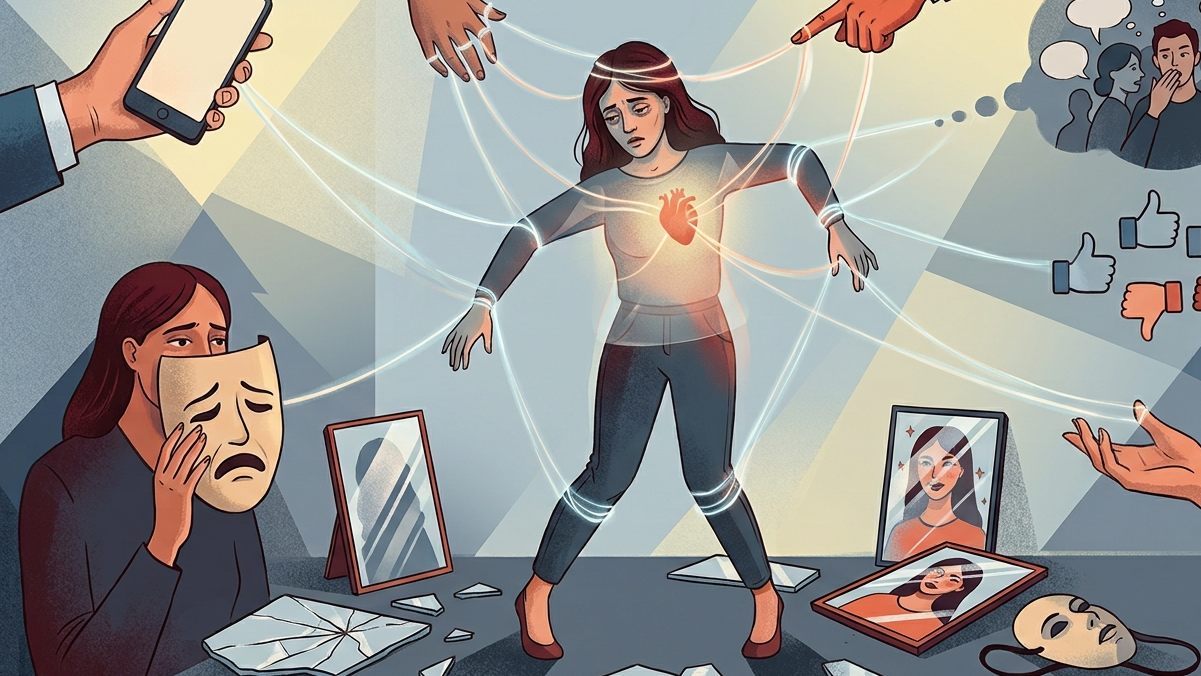
The paradox is that machines do not think for us because they have become “smarter,” but because we give ourselves fewer and fewer chances to make an intellectual effort. The real danger does not lie in artificial intelligence gaining consciousness. Instead, it lies in the possibility that we, step by step, will give up our own. This is not the triumph of technology over biology. Rather, it is our own decision to delegate what is most difficult and most human.
On one hand, we gain time, efficiency, and access to enormous knowledge. On the other, we lose something fundamental: the habit of wrestling with uncertainty, frustration, and complexity.
For centuries, philosophers have emphasised that humanity takes shape through effort, and they saw thinking as something more than a tool for solving problems. Thinking was a way of being with oneself. It was a practice of inner conversation in which we learn to listen to our own doubts and allow them to speak at all.
When we give up independent thought, we weaken not only specific skills, but an entire attitude toward reality. We begin to avoid uncertainty because artificial intelligence has taught us that the answer is always within reach.
In science, this may mean a decline in the quality of hypotheses and in the critical verification of results. In public debate, it may mean an easier acceptance of ready-made narratives, less tolerance for nuance, and deeper divisions.
Democracy needs citizens who do more than react to slogans. It needs people who can stop and stay with them for longer, ask a few uncomfortable questions, admit ignorance, and look for sources. If everyday contact with AI mainly teaches us to trust what “came out of the model,” and teaches us less and less patient verification of our own, then we will also find it easier to accept persuasive but false political narratives.
In public debate, one can already see how easy it is to generate a “discussion” that in reality consists of repeated patterns: ready-made comments, automatic summaries, synthetic opinions.
In a world where a significant part of the information circulation can be created or at least amplified by algorithms, one question becomes especially important: who is still trying to think on their own account, even at the cost of mistakes and unpopular conclusions?
Artificial intelligence and the threats connected with it should not lead us to the radical conclusion that AI must be rejected entirely. Technology is, and will remain, part of our world, just as the printing press, radio, and the internet once became part of it. The point is to learn how to use it in a way that strengthens our abilities rather than replacing them.
We can treat AI as a “suggestion machine” that helps organise thoughts but does not relieve us of decisions. We can consciously leave ourselves space for tasks performed “the old way.” In doing so, we do not lose contact with our own agency.
Perhaps, then, the true challenge of the age is not whether artificial intelligence will defeat us, but whether we will find enough courage within ourselves to keep practising the art of thinking in its shadow. Not because machines are evil, but because without that art we gradually forget who we are. That is the deepest cost of AI cognitive offloading.
Read this article in Polish: Mózg na autopilocie. Jak sztuczna inteligencja oducza nas myśleć

A Journalism and Social Communication graduate with 15 years of experience in the media industry. He has worked for titles such as "Dziennik Łódzki," "Super Express," and "Eska" radio. In parallel, he has collaborated with advertising agencies and worked as a film translator. A passionate fan of good cinema, fantasy literature, and sports. He credits his physical and mental well-being to his Samoyed, Jaskier.


Zmień tryb na ciemny