Culture
A Life Spent Becoming Someone Else’s Ideal
12 October 2026





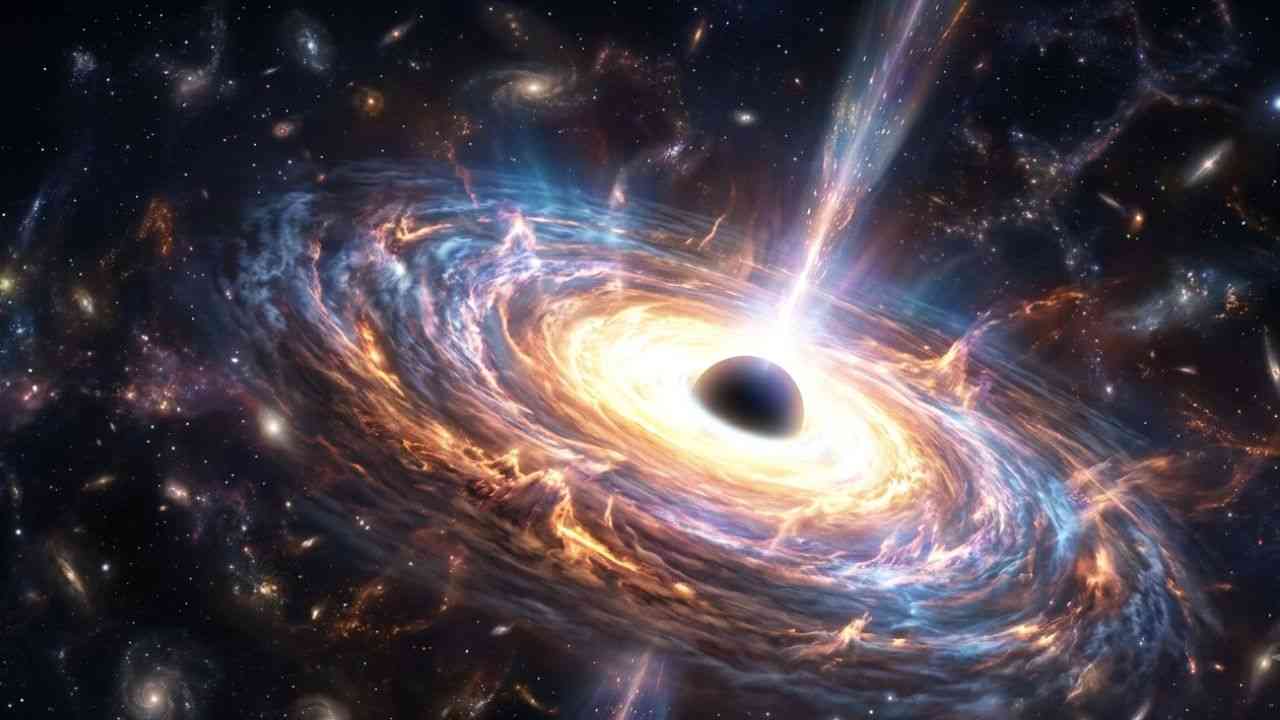
When the universe was just 850 million years old, a quasar powered by a supermassive black hole was already shining. Astronomers have now found that its light changes gently over time. This flickering quasar lets them peer into the place where a black hole feeds on matter and ask how such giants could grow so quickly after the Big Bang.
A quasar is the intensely bright center of a galaxy. It draws its energy from supermassive black holes. The quasar J0439+1634 was already shining almost one billion years after the Big Bang. Now astronomers have discovered that its light is not constant, but changes subtly over time.
An international team of researchers, including scientists from the Massachusetts Institute of Technology and the Max Planck Institute for Astronomy, analysed years of observations of the quasar J0439+1634. This allowed them to detect small changes in its emission. Consequently, they could connect these changes with processes taking place in the matter falling into the black hole.
Such “flickering” makes it possible to study the accretion disk: a rotating cloud of heated gas and dust that circles a supermassive black hole before being swallowed by it. In this way, scientists can better understand how the first black holes in the universe grew to enormous sizes.
The brightness of the quasar J0439+1634 turned out to change over time. This is a characteristic feature of active galactic nuclei. It suggests that matter does not fall into the black hole in an even, orderly way. The disk around it is a dynamic environment, full of irregular gas inflow, turbulence, and changes in the intensity of radiation. These processes are responsible for the observed variability.
As we read in an article published in the scientific journal Nature Astronomy, the structure of the disk surrounding the black hole is fairly ordered, even though we are observing it near the beginning of the universe’s existence. This means that the physical mechanisms of accretion may have worked in a similar way both in today’s cosmos and in the earliest phase of its formation.
This provides direct evidence that the same feeding processes and structures observed in the nearby universe already existed at very early stages of cosmic development, despite very different cosmic conditions — something never seen before,
– said Prof. Anna-Christina Eilers, one of the MIT astrophysicists involved in the observations, in comments published by MIT Physics.
The space discovery made by the MIT-led team is highly significant. It allows scientists to place tighter limits on models of supermassive black hole growth. And the quasar J0439+1634 tests different scientific theories. These include how quickly black holes could have reached enormous masses in the first millions of years after the Big Bang. They also consider what conditions supported their rapid growth.
This makes it an important step toward a more precise description of their variability near the beginning of the universe. When the results of this work are combined with future space discoveries, we may better understand how the most extreme cosmic objects formed and grew. The flickering quasar does not solve the mystery on its own. But it gives astronomers a rare signal from a time when the universe was still young — and when some black holes were already growing with astonishing speed.
Read this article in Polish: Światło leciało 13 mld lat. Przyniosło zagadkę z młodego Wszechświata


A graduate of journalism and social communication at the University of Rzeszów. She has been working in the media since 2019. She has collaborated with newsrooms and copywriting agencies. She has a strong background in psychology, especially cognitive psychology. She is also interested in social issues. She specializes in scientific discoveries and research that have a direct impact on human life.



Zmień tryb na ciemny