Truth & Goodness
Circadian Rhythm and the Quiet Order of the Day
04 September 2026





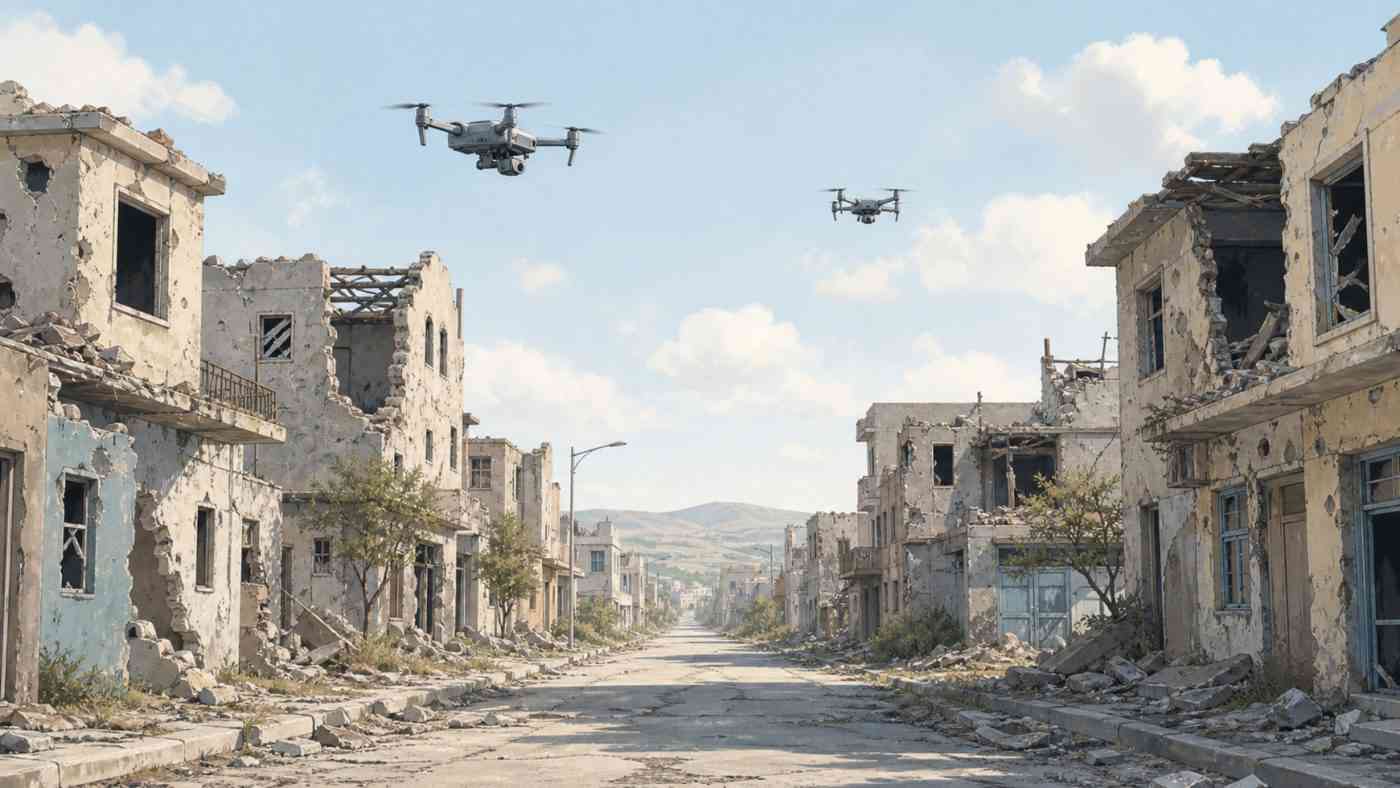
The human being is disappearing from the front line of modern war, while the decision to fire increasingly passes to the computer. Autonomous weapons that select and destroy targets on their own are no longer science fiction, but battlefield reality. When human hesitation and fear vanish from killing, the traditional idea of guilt begins to collapse.
Artificial intelligence is entering the modern battlefield to an ever greater extent. New interception systems can independently detect, track, and destroy targets, while the human being more and more often plays the role of an observer who merely approves the general framework of action. We can already see this today beyond Poland’s eastern border, where autonomous weapons are becoming part of everyday combat.
The Ukrainian military is now deploying a new generation of autonomous drones that can automatically intercept Russian Shaheds. According to Ukraine’s Ministry of Defence, these systems perform as much as 95 percent of the entire interception process.
The operator observes the battlefield and selects a target. From that point on, artificial intelligence guides the drone independently and carries out the attack. Other Ukrainian solutions, such as the fully automated Sky Sentinel turret, can already detect targets, calculate trajectories, and open fire without a soldier operating them manually.
From a military point of view, this is a revolution: faster reaction, lower risk for one’s own soldiers, and more enemy drones shot down. It is also a shield against the harshest experiences of the front. Modern armies have long struggled with waves of post-traumatic stress disorder, depression, and suicide. If a soldier does not see bodies, does not hear screams, does not smell burning, perhaps it will be easier for him to return to life after war.
The problem is that, along with trauma, the sense of shared responsibility may also weaken. When someone can say, “the system classified the target that way,” or “that was the algorithm,” the human being gains a convenient buffer behind which his own conscience can hide.
For centuries, war, despite all its brutality, contained a certain human brake. A soldier could break down, refuse an order, feel remorse, look the enemy in the eye — even if that enemy remained an enemy. These “weaknesses” — fear, empathy, guilt — sometimes worked as natural barriers against excessive violence. Machines have no such limits. They do not suffer psychological collapse, do not hesitate, and do not refuse to carry out an instruction. Artificial intelligence in war acts with precision and without emotion.
Military psychologists have shown for years that physical and technological distance — from the rifle, through the aircraft, to the drone — lowers the moral barrier to using force. Autonomous systems introduce a new level of that distance. A human being can be reduced to the role of a system administrator who “only initiates the process.”
The decision to kill becomes increasingly remote and abstract. The operator no longer has to track the target for long minutes. He does not see the consequences of his action in real time in the same way a fighter pilot or sniper once did. One click is enough — and the algorithm takes over the rest.
Delegating the decision to attack to machines undermines the moral structure of decision-making. A soldier or operator who can say that the system made the decision instead of him can more easily cut himself off from the consequences of his actions. This changes not only the psychology of the individual, but also the cultural imagination of guilt and responsibility.
This becomes most dramatic in moments of error. If an autonomous drone mistakes a civilian car for a military vehicle, the classical model of responsibility begins to crumble. Until now, it was possible to trace the chain of command: to determine who gave the order, whether procedures were followed, and whether negligence had occurred.
In the world of autonomous systems, that chain is cut by the “black box” of machine learning, where decisions are made in a way that even the creators cannot fully explain.
Guilt spreads across the entire network: from the engineer who trained the model on imperfect data, to the company that sold the system, to the commander who deployed it, and the state that decided such a margin of error was acceptable. The more decisions we hand over to algorithms, the more the link between a specific person and a specific act of violence dissolves.
In practice, this creates the risk that, in the event of tragedy, no one will bear full responsibility. And the absence of responsibility is one of the most dangerous catalysts of violence.
Behind this moral ambiguity, the economics of war is also changing. Autonomous drones are relatively cheap, can be mass-produced, and their loss does not create the political costs associated with the deaths of one’s own soldiers. As a result, the threshold for entering a conflict may become lower. If one can send swarms of machines controlled by artificial intelligence into the air instead of people with names and families, the temptation to use force grows.
Escalation also becomes easier because it is less visible. Instead of coffins returning home, we see statistics on equipment consumption and charts showing interception effectiveness. In such a world, war increasingly resembles the management of technical resources rather than the existential drama of a society sending its citizens to the front.
Autonomous weapons do not only change the way combat operations are conducted. They also transform the political calculation of risk.
War has always been a place where the human condition revealed itself — both in its worst form and, at times, in its most heroic dimension. When the human being increasingly disappears from this equation — both as the one who kills and as the one who can refuse, hesitate, or feel guilt — we lose something essential. We lose not only control over decisions of life and death, but also a certain moral horizon in which violence remains a human act, and therefore subject to judgment, conscience, and responsibility.
The development of autonomous weapons is becoming harder to stop. The question is whether we can preserve a sufficiently strong human element in that process. Because if machines kill with ever greater efficiency, while we find it ever easier to cast off guilt, then in the end it will not only be war that changes. Our idea of responsibility, courage, and harm will change as well.
Read this article in Polish: Wojna bez żołnierzy. Kto będzie winien, gdy strzela AI?


A Journalism and Social Communication graduate with 15 years of experience in the media industry. He has worked for titles such as "Dziennik Łódzki," "Super Express," and "Eska" radio. In parallel, he has collaborated with advertising agencies and worked as a film translator. A passionate fan of good cinema, fantasy literature, and sports. He credits his physical and mental well-being to his Samoyed, Jaskier.



Zmień tryb na ciemny