Truth & Goodness
Modern Warfare, Old Words: Why We Misread Today’s Conflicts
03 October 2026





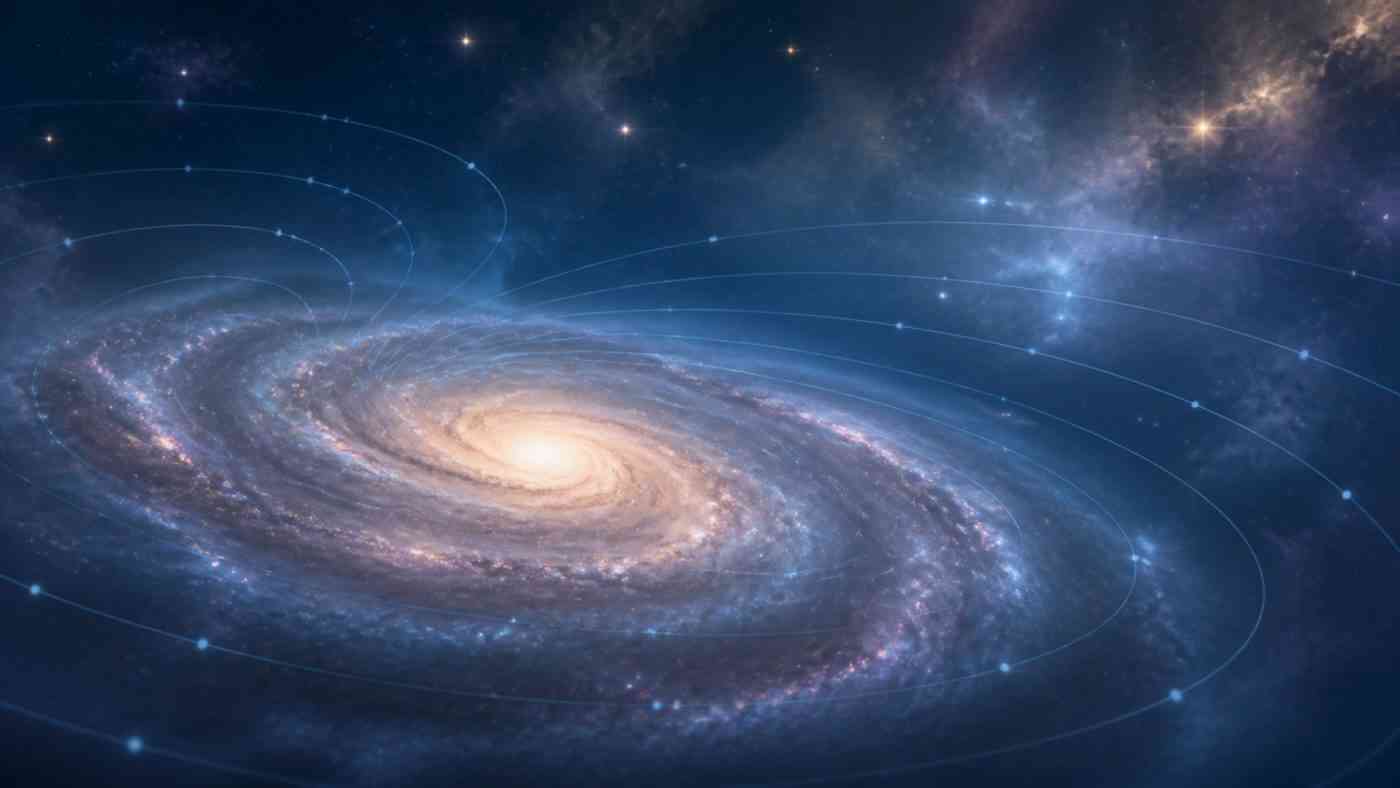
The universe has a way of surprising us with contradictions. The invisible part of the cosmos seems almost absent in some places, yet unexpectedly dense and active in others. New research suggests that the dark matter mystery may have a simple explanation.
Dark matter is an invisible component of the universe. We cannot see it or touch it, but gravity reveals its presence: in the motion of galaxies, the behavior of galaxy clusters, and the bending of light around massive objects. Much suggests that dark matter makes up an important part of the cosmos and plays a crucial role in forming the structures we observe today.
At the same time, scientists still cannot detect it directly. No wonder the dark matter mystery has remained one of the most intriguing questions in modern astronomy for decades.
The problem does not lie only in the fact that we cannot see something. It also lies in the fact that different observations seem to contradict one another.
Some dwarf galaxies have surprisingly “diffuse” centers, as if dark matter does not concentrate there as strongly as older models predict. Elsewhere, astronomers detect compact clumps of the same matter that strongly bend light from distant objects. Until now, researchers have struggled to reconcile these 2 kinds of phenomena within a single, simple picture.
A new hypothesis proposed by physicists from the Chinese Academy of Sciences offers a simpler answer than another round of increasingly elaborate models. Instead of assuming that dark matter consists of just 1 type of particle, the researchers point to the possible existence of at least 2 types: heavier and lighter ones.
According to this model, these particles do more than attract one another through gravity. They also collide with one another. Those collisions produce a process similar to what we observe in star clusters: heavier objects slowly drift toward the center, while lighter ones spread outward. The same mechanism, operating in different environments, may produce different effects — and this is exactly why the idea has drawn attention.
This model connects several well-known cosmic discrepancies and shows that they may have a common source. Instead of treating each anomaly separately and searching for a separate explanation, we get one more coherent story about how dark matter behaves under different conditions. This shift in perspective makes the hypothesis promising: it does not multiply entities beyond necessity, yet it brings order to several problems at once.
At the same time, we need to stress that this remains a hypothesis. Simulations and theoretical models suggest that such a mechanism could work, but more precise sky surveys and measurements of gravitational lensing will provide the decisive test.
Future observations will have to confirm whether dark matter really arranges itself across the cosmos in a more complex way than scientists have assumed so far, and whether the same model holds up across different scales — from small galaxies to the large-scale structure of the universe. Only then will researchers be able to speak not merely of an interesting idea, but of a real step toward unraveling the dark matter mystery.
If the model holds, it will change more than the answer to the question of what dark matter consists of. It will change our broader idea of the structure of the cosmos: a world in which, beneath the appearance of chaos, a surprising order may lie hidden.
Read this article in Polish: Zagadka ciemnej materii rozwiązana? Ta teoria wyjaśnia wszystko


A Journalism and Social Communication graduate with 15 years of experience in the media industry. He has worked for titles such as "Dziennik Łódzki," "Super Express," and "Eska" radio. In parallel, he has collaborated with advertising agencies and worked as a film translator. A passionate fan of good cinema, fantasy literature, and sports. He credits his physical and mental well-being to his Samoyed, Jaskier.



Zmień tryb na ciemny