Science
Before There Are Planets, There Is Dust
16 October 2026





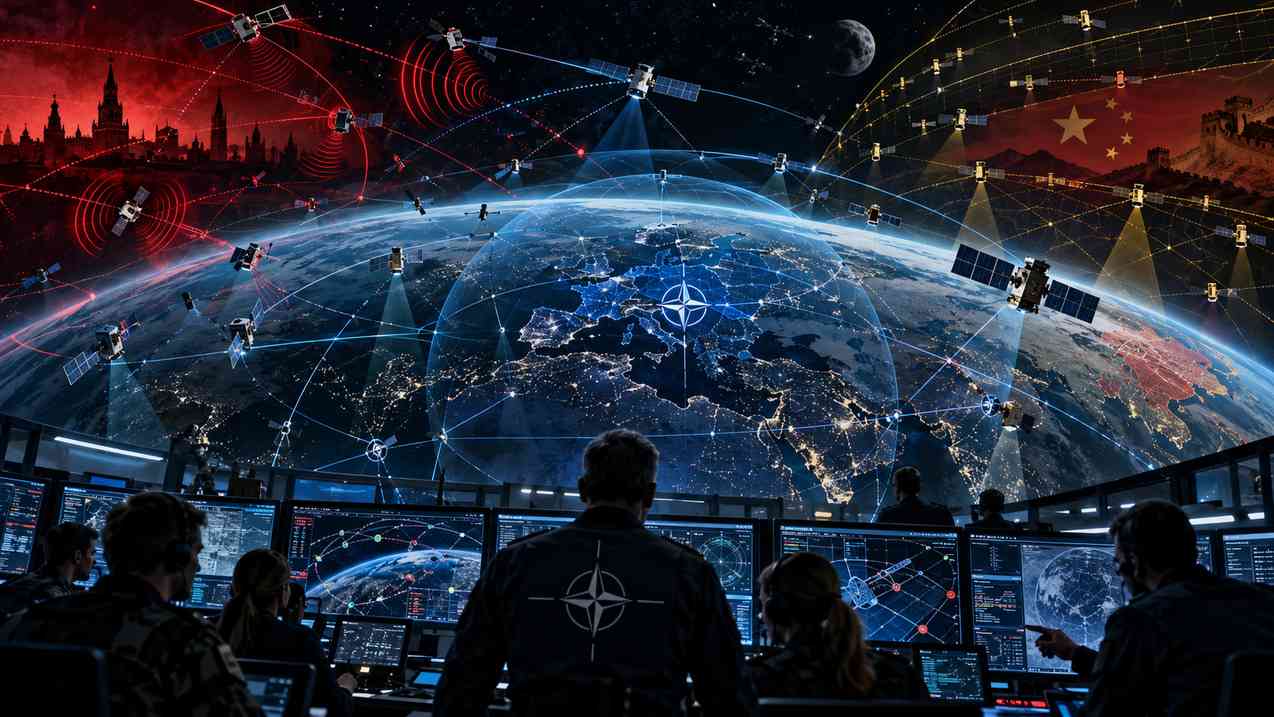
For most of its history, NATO looked to space without seeing it as an arena of conflict. Satellites formed an invisible backbone. They provided communications, navigation, and reconnaissance, allowing military forces to see farther and respond faster. They were indispensable, yet remained in the background. No one treated them as territory that needed defending. That era is over. NATO space policy now reflects a different reality.
In an analysis published in Space Policy, Zhou Shun and He Qisong show how the Alliance’s view of potential threats in orbit has changed in just a few years. Space is no longer merely a technical extension of operations on Earth. It has become a distinct arena of competition. Two countries drove this shift, each in a different way.
Russia provided the wake-up call. Its ability to disrupt and destroy satellite systems, followed by the lessons of the war in Ukraine, revealed how heavily modern military forces depend on assets in orbit. Without satellites, there are no reliable communications, no precise navigation, and no comprehensive picture of the battlefield. Taking away a military’s satellites means more than removing a few devices. It is rather like depriving it of part of its vision and sense of direction.
Russia therefore accelerated NATO’s response: exercises under conditions of interference, data integration, greater resilience, and procedures for situations in which space infrastructure no longer functions as it does in peacetime.
But China, the authors argue, better explains where the Alliance is ultimately heading. Why? Because the issue extends beyond a single crisis or the threat of a particular attack. The challenge China presents is less dramatic, but more fundamental. Beijing is steadily expanding its capabilities and treats orbit as part of a long-term economic, technological, and military strategy. This pushes NATO beyond responding to events toward changing how it thinks.
Hence the emphasis on interoperability, shared standards, cooperation with private companies, and the development of structures such as the Space Operations Centre. Major strategic changes often begin with new procedures and institutions rather than new weapons. NATO, however, is not building a separate space command of its own.
It still relies primarily on member states’ systems and commercial infrastructure. It has no space army and does not intend to take control of orbit. It is trying to ensure that more than 30 countries view space in similar ways.
That means enabling them to agree on what constitutes a threat, when a malfunction becomes an attack, how to share information, and how to respond when satellites—often owned by governments or private companies—become part of a conflict.
NATO does not make space law or dictate the rules governing the world’s use of orbit. States and international forums remain the main settings in which those norms take shape. The Alliance works differently: it aligns how its members perceive threats, then translates that shared assessment into policy. This is where the most intriguing paradox emerges. Russia forced NATO to look up, but China ensured that the Alliance would no longer look away.
Both countries have taught NATO that space is now an enduring part of competition between major powers. This amounts to more than another phase of military modernization. For years, the West treated space almost as a system that was simply supposed to work. Now it is becoming a place where technology, security, and political imagination meet.
NATO still does not control orbit. But it increasingly understands that future conflicts may begin long before the first shot on the ground: with a lost signal, a blinded satellite, or a system we suddenly cease to trust.
Read this article in Polish: NATO coraz mocniej patrzy w kosmos. Sojusz ma tam nowy problem


Journalist. Born on the left bank of Warsaw. A graduate of the Faculty of Political Science and International Studies at the University of Warsaw. He began by writing about pop culture and current events, and today he specializes in geopolitics. Beyond journalism, he is interested in film and acts in an amateur dramatic theatre.



Zmień tryb na ciemny