Humanism
What Happens When Winning Stops Being Proof of Worth?
11 October 2026





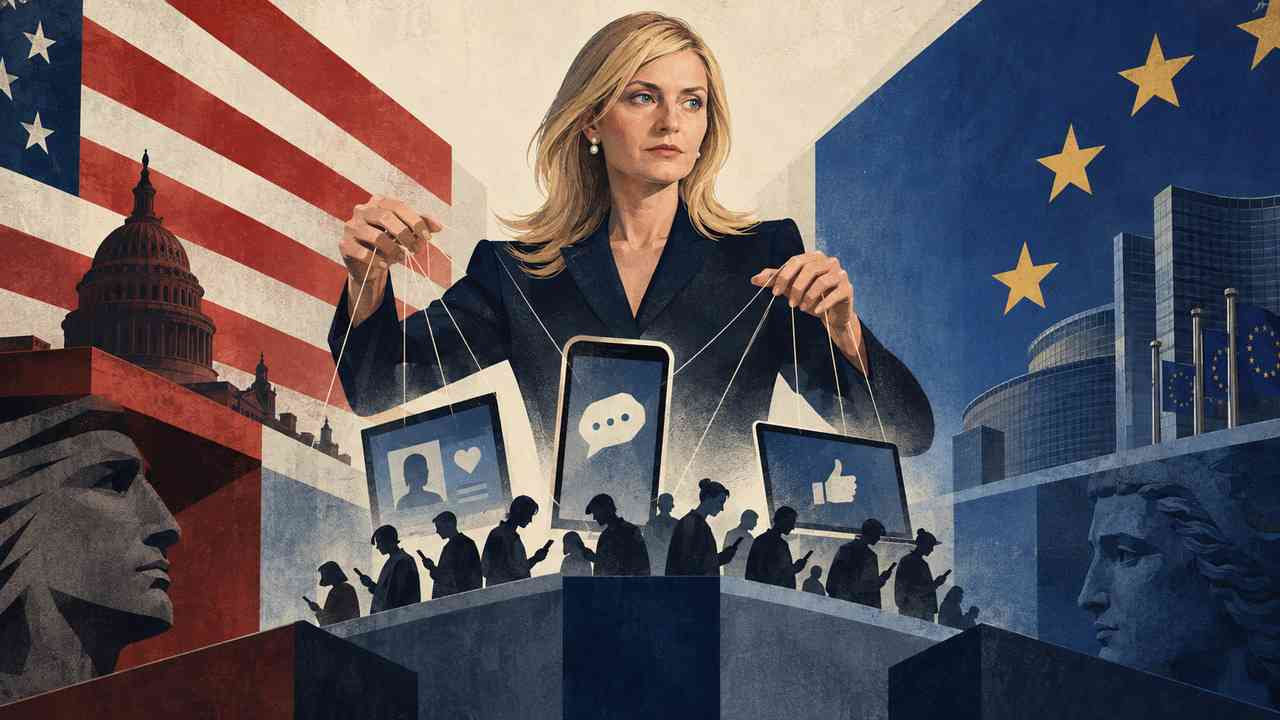
Imagine a diplomat arriving in a European capital not to discuss trade, security, or war, but to debate the rules governing online speech. The United States is increasingly turning freedom of expression into a point of dispute with its European allies — raising a deeper question about who has the authority to define the boundaries of free speech regulation.
One of the key figures behind this policy is Sarah B. Rogers, the US Under Secretary of State for Public Diplomacy. In February 2026, she visited Dublin, Budapest, Warsaw, and Munich. In Budapest, she appeared alongside Balázs Orbán, the political director of the Hungarian prime minister, and spoke about freedom of speech and regulations that, in the view of the Trump administration, place excessive restrictions on public debate.
In Warsaw, she met with Agnieszka Jędrzak, Under Secretary of State at the Chancellery of the President of Poland. At the residence of US Ambassador Tom Rose, she also took part in the opening of celebrations marking the 250th anniversary of American independence.
Rogers has made no secret of her intention to use her position to promote the American understanding of freedom of speech beyond the borders of the United States. In a conversation with Reuters journalists in Budapest, she said directly that her office would use grants to support free speech initiatives in Western democracies.
And this is where the larger story begins. The dispute between Washington and Brussels is no longer only about whether the European Digital Services Act (DSA) is too restrictive. Increasingly, it concerns a deeper question: who has the authority to define the boundaries of free speech, and whether one country can attempt to influence the regulations adopted by its allies.
The Digital Services Act imposes obligations on the largest online platforms concerning, among other things, illegal content, transparency requirements, and risk assessments.
In August 2025, Reuters revealed the contents of an internal cable from Marco Rubio, in which American diplomats were instructed to campaign for changes to, or the repeal of, the DSA. They were expected to meet with representatives of governments, businesses, and civil society organizations and collect examples of what Washington considers censorship.
In this way, the United States began using its own diplomatic apparatus to put pressure on laws governing the European Union.
Brussels responds that the DSA is not aimed at American companies or political views, but rather seeks to create a safer digital environment while preserving freedom of expression. Washington therefore speaks about protecting free speech, while Brussels speaks about protecting users and enforcing the law. Both sides appeal to the same values, but they define the main risks differently.
In February 2026, the Trump administration announced plans to fund initiatives supporting free speech in allied countries. In July, The Guardian revealed documents concerning planned grants for British organizations: $7 million for 878 and $5 million for Free Speech Union International. A separate $3 million allocation was intended for the Jobs Foundation.
The documents cited issues such as mass migration, censorship, “lawfare,” and transnational regulations as part of the justification. In the case of Free Speech Union, the stated goal included defending freedom of speech and opposing excessive digital regulation.
It is important to note, however, that these were not funds that had already been distributed. The State Department emphasized that the decisions were still under review. Toby Young, associated with Free Speech Union, confirmed that the organization was interested in receiving funding but denied that it had received any grant.
The political significance of the issue remains substantial. The planned grants were intended for organizations ideologically aligned with the current administration and could support their role in the European debate over speech and regulation.
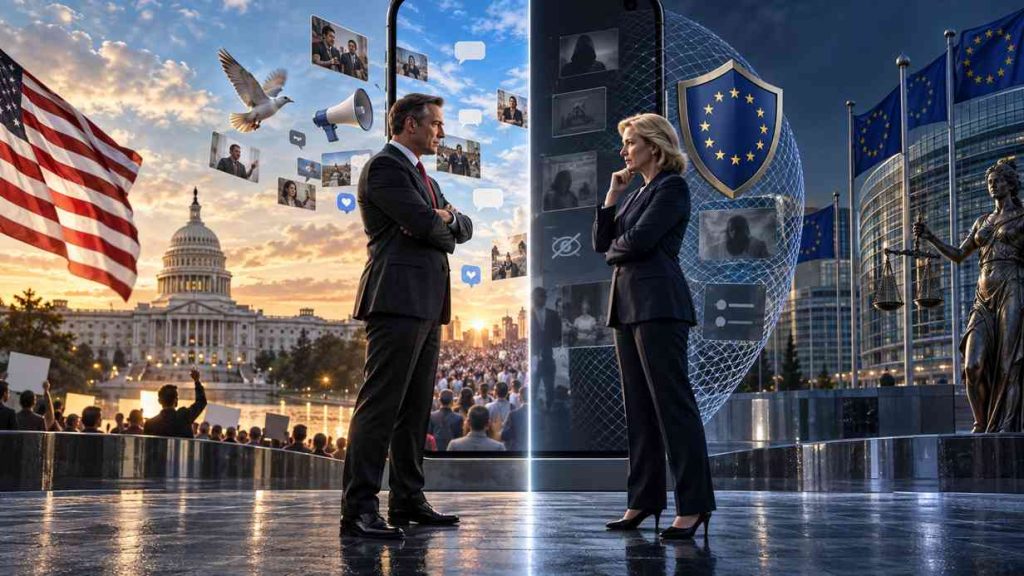
The grants are part of a broader shift. In December 2025, the United States imposed entry bans on five Europeans, including former EU Commissioner Thierry Breton. Rubio accused them of attempting to pressure American platforms, while Rogers portrayed them as representatives of a European system of censorship.
Breton is a particularly significant figure in this dispute. As European Commissioner for Internal Market, he was one of the politicians responsible for overseeing the implementation and enforcement of the DSA.
Washington has therefore begun treating European regulators not merely as partners with whom it may disagree, but also as individuals against whom instruments of American foreign policy can be used. This marks a significant change in the tone of transatlantic relations.
The difficulty is that public opinion research in Europe does not show that digital regulations are widely perceived primarily as a threat to freedom. According to a YouGov poll from October 2025, 53 percent of French respondents believed social media platforms were regulated too weakly, while only 6 percent thought they were regulated too strongly.
In April 2026, 79 percent of French respondents supported banning social media use for people under the age of 16. Similar views were also prevalent in the United Kingdom, Germany, Italy, Spain, and Poland.
This does not mean, of course, that Europeans agree on how to approach free speech regulation or internet governance. It does show, however, that the dispute over the DSA is not a simple conflict between “freedom” and “censorship.” At stake is a broader question: how should freedom be understood in an environment where a handful of private companies have enormous influence over global communication?
The same direction is suggested by European Commission data. In a 2026 Eurobarometer survey, 71 percent of Europeans said they were concerned about cyberbullying and online harassment of children, while 70 percent expressed concerns about online grooming and sexual exploitation.
If the dispute over internet regulation is part of a broader political landscape, it is worth looking at the wider picture. The political right, which often criticizes globalization and supranational institutions, has itself spent years building international networks of cooperation.
Political scientists Pablo de Orellana and Nicholas Michelsen described this approach as “reactionary internationalism.” The term refers to movements that challenge the universalist principles of the liberal order while simultaneously creating transnational organizational structures — networks of conferences, foundations, think tanks, and educational institutions operating on both sides of the Atlantic.
The paradox, then, is that groups critical of globalization often make use of precisely the opportunities created by international cooperation. The Trump administration is adding a new element to an already existing network: state support. This time, the issue is not only private foundations or ideological organizations, but official American diplomatic funding intended to support initiatives connected with freedom of speech and opposition to European regulation.
The scale of private funding also shows that such networks did not emerge overnight. According to data from the European Parliamentary Forum, the Spanish organizations HazteOír and CitizenGO collected more than $32 million between 2009 and 2018. These were private funds gathered over many years. The grants planned by the Trump administration, by contrast, were intended to come directly from the state budget.
For the average internet user, this dispute begins with questions far more concrete than grand politics. It concerns whether children are safe online, how far regulations should extend, and where the line lies between protecting users and restricting freedom of speech.
Only after these questions comes the political dimension. Who sets the rules governing the internet? Can foreign money influence domestic ideological debates? And can a government use its diplomatic power to persuade allies to change their own laws?
Europe has every right to defend its regulations and criticize the DSA. The United States has an equally legitimate right to warn about the consequences of excessive regulation. The difficulty begins when one side assumes that it should decide the boundaries of freedom of speech beyond its own territory.
Freedom of speech remains a shared value. Yet we are increasingly divided over a fundamental question: who has the authority to determine where freedom ends and censorship begins?
The debate over free speech regulation is therefore not only about technology or law. It is about political power, democratic legitimacy, and the future of communication in a world where the internet has become one of the most important arenas of public life.
Read this article in Polish: Wolność słowa czy regulacja? USA rzucają wyzwanie Europie


Content marketing specialist with his heart in journalism and English translations. An active writer for 20 years. Majored in economy. He has authored several non-fiction books, one of which won an award at the Ladek Mountain Festival. Sports, hard rock, and Italian cuisine afficionado.



Zmień tryb na ciemny