Science
Before There Are Planets, There Is Dust
16 October 2026





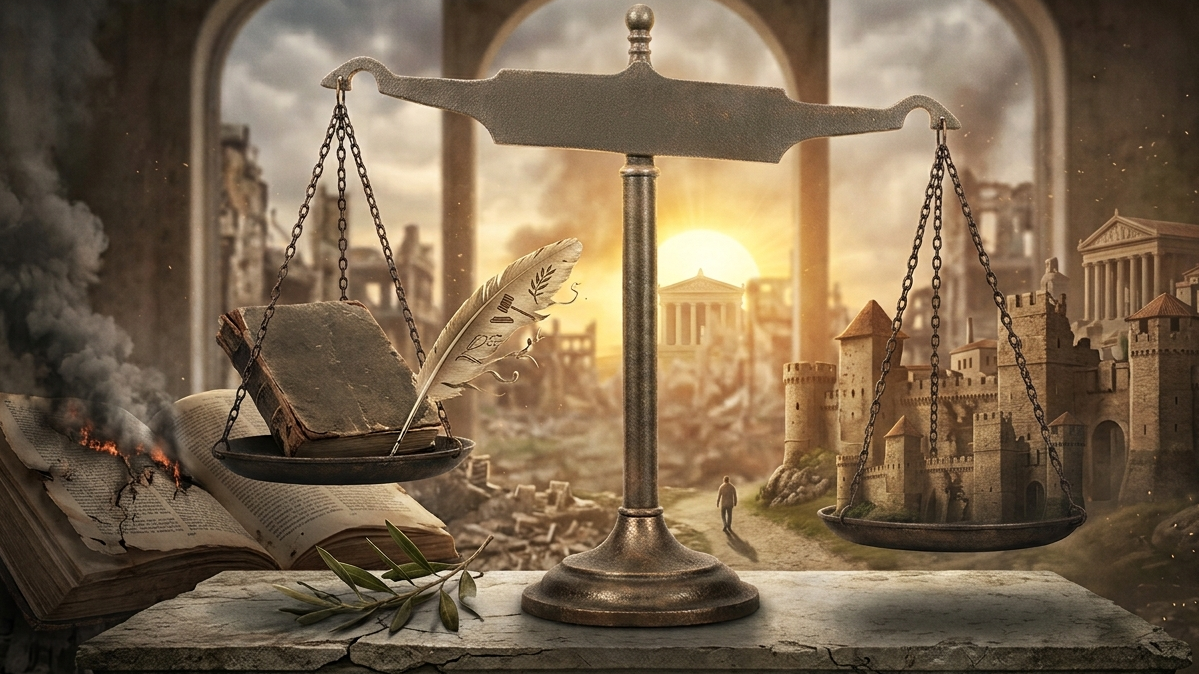
The question of when military conflict can be justified has accompanied humanity since the dawn of history. Yet it has never received one universal answer. Just war theory was meant to serve as humanity’s moral compass, but the very idea of justice has proved dangerously open to manipulation. We can see this both in ancient treatises and in dispatches from today’s news agencies, which ruthlessly expose the paralysis of international institutions.
The paradox of our time does not lie in the difficulty of defining evil. Today we can recognize aggression and war crimes perfectly well. Intuitively, we know the difference between attack and defence. We know the difference between a strike on a military target and the bombing of civilians. Furthermore, we distinguish between interrogation and torture, between a prisoner of war and a hostage.
The real problem begins when aggressors try to dress their own violence in the robes of higher necessity. It ends when the international community and international law prove powerless against those who choose violence.
To understand contemporary crises, we must first return to normative roots. In philosophical and legal tradition, just war theory rests on the separation of two fundamental questions. Public debate constantly confuses these two questions.
The first concerns whether one may start a war at all, or jus ad bellum. This involves just cause, legitimate authority, and right intention.
The second concerns how a war may be conducted, or jus in bello: the principles of proportionality and the absolute protection of bystanders.
The right to use force and the law of armed conflict are two entirely different orders. Even a cause one side considers absolutely just does not give it a mandate to murder civilians, take hostages, torture prisoners, or use scorched-earth tactics. Yet the gap between declared justice and brutal practice has always existed.
Already in antiquity, thinkers tried to distinguish war from ordinary banditry. The Roman model assumed that conflict could not be a pure act of piracy. It had to be preceded by a formal demand for redress.
From today’s perspective, of course, this had nothing to do with pacifism. Rome could destroy its enemies methodically and ruthlessly. Cicero openly admitted this when recalling the total destruction of Carthage and Numantia.
What remains crucial, however, is that even then people recognised a boundary between war and common plunder. They also saw the difference between war and an unlawful attack driven by pride.
Contemporary conflicts brutally test these theoretical frameworks. The war in Ukraine — which the Kremlin cynically refuses even to call a war — is presented in the mirror of Russian propaganda as a model example of how the Russian version of justice works.
Russia builds its narrative on three pillars. First, it invokes a supposed response to NATO’s aggressive expansion. Then it raises the argument that Russian-speaking populations in Donbas needed protection. Finally, it presents Ukraine as a state ruled by Nazis and posing a direct threat to Russia’s security.
The first two arguments juggle real geopolitical processes: the enlargement of the Alliance and the dispute over the status of Donbas were facts. But the conclusion drawn from them — that Russia had the right to launch a military invasion — is complete lawlessness. The third argument, about the supposedly Nazi character of the Ukrainian state, is pure propaganda absurdity.
The existence of radical right-wing groups is a fact in many countries. And Kyiv’s unfortunate historical and symbolic decisions, such as giving one military unit the name Heroes of the UPA in 2026, only fuel this narrative. None of this changes the fact that Ukraine remains a democratic, sovereign state.
For Russian imperialism, these pretexts were enough to set a full-scale war machine in motion. From the beginning, however, Putin’s real aim was to break the spine of Ukrainian statehood, overthrow the legal authorities, and force the geopolitical capitulation of the entire region. This included the withdrawal of NATO infrastructure from countries admitted after 1997. Notably, Poland was one of those countries.
This imperial theory has been accompanied by criminal practice: the deliberate shelling of hospitals and residential districts, and the methodical destruction of energy infrastructure repeated each autumn. This is classic state terrorism, aimed at breaking society’s morale through cold and darkness. Putin’s war is a striking, unmistakable example of aggression that is false in its premises and barbaric in its means.
The conflict between Israel and Hamas presents an entirely different dynamic, and one far more difficult to assess. Hamas is not a sovereign state, but an organized terrorist structure. Yet the absence of state prerogatives does not mean that the organization acts in a legal vacuum. As a party to an asymmetric conflict, it remains strictly bound by international humanitarian law.
The explosion of violence on October 7, 2023, did not come from nowhere. It was preceded by decades of occupation in the West Bank, the blockade of the Gaza Strip, and the failure of peace processes. No historical background, however, can justify the slaughter of civilians. Hamas’s attack on southern Israel, in which about 1,200 people were murdered, was a textbook act of terror.
Israel’s military response confronted the world with dramatic questions about how far a state may go in defending its own citizens. By building its military infrastructure under hospitals, schools, and dense residential areas, Hamas turned its own civilians into human shields and an insurance policy. Tel Aviv, however, decided that it was prepared to pay this bloody price.
Even with full recognition of Israel’s right to eliminate a terrorist threat, the way this operation was conducted came into glaring conflict with the principles of proportionality and the protection of civilians. Cutting the Gaza Strip off from water, energy, and humanitarian aid, combined with carpet bombing, led to a humanitarian catastrophe.
According to figures attributed to the Palestinian Ministry of Health, by mid-2026 more than 72,000 Palestinians had been killed in the Gaza Strip. This number included more than 21,000 children identified by name.
The result of this strategy has been the moral and legal isolation of Israel’s authorities. The decision by the International Criminal Court to issue arrest warrants for Prime Minister Benjamin Netanyahu and former defence minister Yoav Gallant is not yet a final judgement. It does, however, amount to a formal recognition that there are reasonable grounds for accusations of war crimes.
An analysis of these two radically different theatres of war exposes a brutal truth: contemporary war has not so much escaped moral concepts as drastically expanded its arsenal. Classical just war theory, created for symmetrical clashes between states, can no longer keep pace with the reality of asymmetric and hybrid conflicts.
The context of the so-called “Gerasimov doctrine” illustrates this phenomenon well. The fluid mixing of political pressure, disinformation, cyberattacks, economic blackmail, and targeted violence makes it extraordinarily difficult in the modern world to identify the precise moment when a conflict begins.
Information war or hybrid war can continue for decades below the threshold of open kinetic aggression. States can be destroyed without formal declarations of war and without regular armies crossing borders. This method is cheaper, easier to deny, and more resistant to spectacular battlefield failures.
There is no need to blame postmodern relativism for this state of affairs. The problem lies deeper. Different cultural and civilisational circles have always defined the rules of coexistence differently. Raw force has ultimately dominated every moral code since the Neolithic age.
Today, our greatest problem is not a lack of concepts. We understand perfectly well what classical just war theory means, and we can identify criminals without difficulty.
The crisis lies in the complete paralysis of institutions responsible for enforcing these standards. Today, there is no effective, universally recognised arbiter equipped with real instruments of coercion. No one is capable of drawing an uncrossable line between brutal politics and international lawlessness.
With intellectual nostalgia, we may return to the writings of Aristotle, St. Augustine, or even Carl von Clausewitz. He today appears almost like an idealist from an age when gentlemen first politely informed one another of their intention to wage war.
Modern secrecy, asymmetry, and gray-zone operations do not invalidate the concept of justice. They simply invalidate the possibility of enforcing it against those who possess brute force. That is the tragedy of just war theory today: it can still name evil, but it cannot always stop it.
Read this article in Polish: Wojna (nie)sprawiedliwa. Komu dziś służy prawo międzynarodowe?

Analyzes, describes, and comments on contemporary politics. Particularly interested in international relations, history, literature, new technologies, and the Polish stock market. He's also a decent beekeeper.



Zmień tryb na ciemny