Culture
A Life Spent Becoming Someone Else’s Ideal
12 October 2026





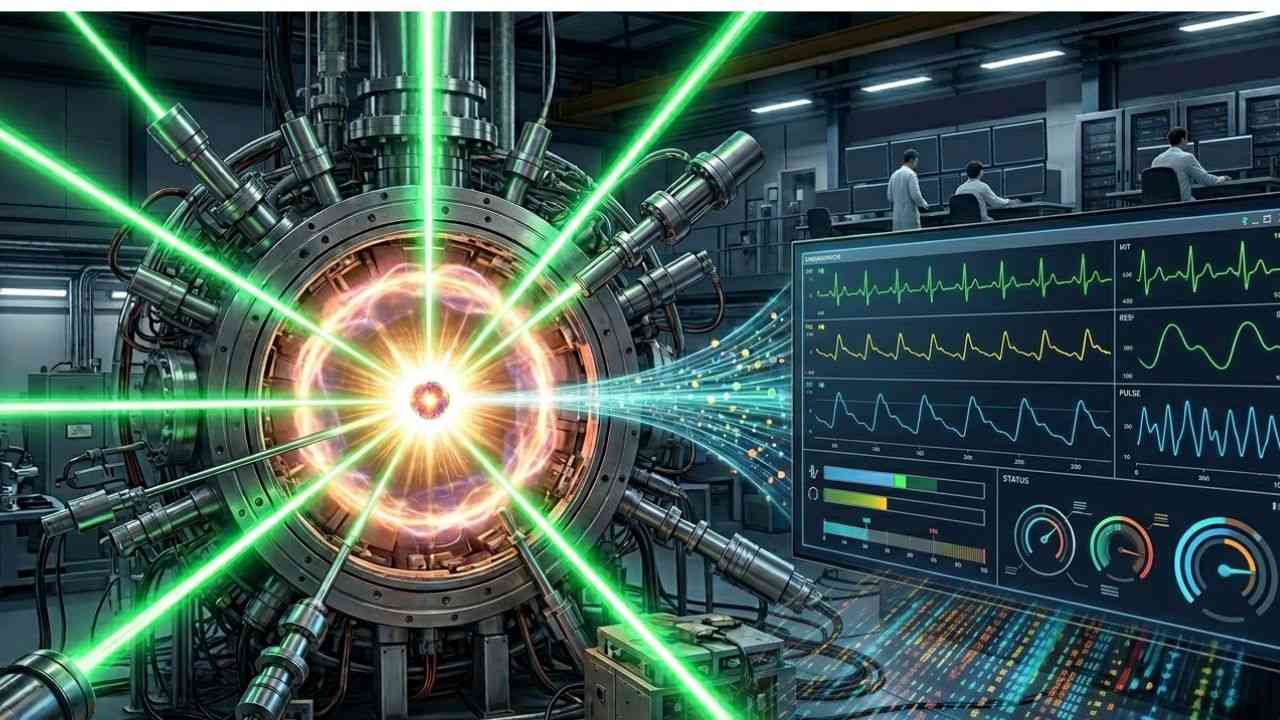
Nuclear fusion research is often decided after the laser flash itself, when physicists must read from the data what happened to matter heated like the inside of a star. A new method may help them do just that: it separates signal from noise and shortens calculations that, until now, could hold up the most important analyses.
Researchers have presented a method that, in tests, allowed selected simulations to run up to 50 times faster. It could help analyze experiments related to nuclear fusion, planetary interiors, and extreme states of matter. The new procedure significantly improves the complex computer simulations needed to study matter under very difficult conditions.
Let us begin at the beginning. Matter can exist in extreme states inside stars, during violent cosmic processes, and in the interiors of gas giants, where enormous temperatures and high pressure prevail. Such conditions can also be briefly recreated on Earth, in the laboratory, including during experiments involving laser-driven nuclear fusion.
That is why physicists try to study matter in conditions too hot, too dense, and too short-lived simply to be “seen.” Such experiments make it possible to better understand processes taking place in space and to test how matter behaves.
Researchers usually use X-ray scattering for this purpose. The radiation strikes a sample, and the way it scatters carries information about temperature, density, and the behavior of particles. The problem is that measurement data alone are often not enough to determine unambiguously what is happening inside the matter. The signal can be incomplete, difficult to read, and open to different interpretations.
That is why computer simulations are needed. They make it possible to build theoretical models and compare them with experimental results. Only then can researchers try to determine what the sample’s temperature really was, what pressure prevailed inside it, and how the electrons behaved. To understand the processes occurring in extreme states of matter, scientists need to know what real conditions existed in the sample being studied.
Until now, physicists often faced a difficult choice. They could use simpler models that worked quickly but left too much to guesswork. Or they could reach for much more precise tools, so demanding that they could consume vast amounts of supercomputer time.
One of the most accurate approaches is TDDFT, or time-dependent density functional theory. In practice, it allows researchers to track how electrons respond when matter is violently knocked out of equilibrium. But the higher the temperature, the more quantum states must be included. The simulation becomes heavier, slower, and increasingly vulnerable to numerical noise. In such a study, that noise can cover the most important trace left by the experiment.
The core of the advance in nuclear fusion research, published in the Nature Portfolio journal npj Computational Materials, is not greater computing power. It is a smarter use of the data produced during simulation.
The key is to filter information that has real physical meaning and separate it from noise generated by the computational process. Crucially, this kind of “sifting” is meant to preserve the subtle details of the signal, because those details carry the most important information about the processes under study. The authors describe a method based on mapping the dynamic structure factor to an imaginary-time density-density correlation function, combined with convergence tests and noise attenuation.
Tests of the new method produced a very clear result. Selected simulations ran up to 50 times faster than before. For researchers, this means they can analyze more scenarios and compare models with experimental results more precisely, without having to drastically increase the use of supercomputers.
The international team of scientists also showed that the quality of the analyses improved markedly. It is therefore no surprise that a method with such strong results already has a clear destination. In the future, it could contribute to the creation of a fusion power plant and be used at the European XFEL near Hamburg. That facility is one of the world’s most advanced sources of X-ray radiation. It allows scientists to recreate, with great precision, conditions that occur during fusion processes and inside stars and planets.
The method may also help calculate the properties of matter, including radiation absorption and electrical conductivity. The authors of the nuclear fusion research hope that, in the coming years, the procedure may develop into one of the basic tools for analyzing extreme states of matter.
Read this article in Polish: Fuzja jądrowa coraz bliżej. Pomógł ślad po błysku


A graduate of journalism and social communication at the University of Rzeszów. She has been working in the media since 2019. She has collaborated with newsrooms and copywriting agencies. She has a strong background in psychology, especially cognitive psychology. She is also interested in social issues. She specializes in scientific discoveries and research that have a direct impact on human life.



Zmień tryb na ciemny