Culture
The Reports Were Written by Friends
10 October 2026





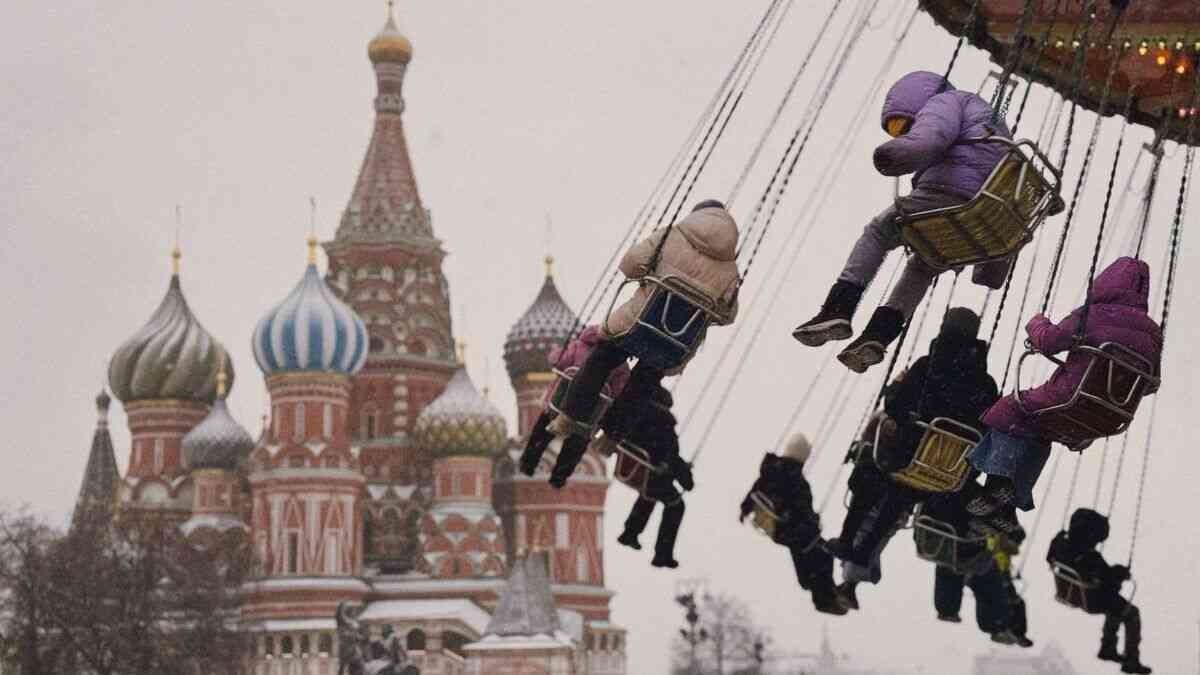
Russian conservatism has roots far older than Vladimir Putin’s rule. Since the 19th century, Russian ideologues have portrayed the state as a defender of religion, family, and tradition against Western influence. That language remains part of Russian politics today. Behind these declarations of values, however, lies a vision of the state and its place in the world.
Russia’s account of its own conservatism is approaching its 200th anniversary. Particularly now, during the war in Ukraine, Russia’s ideological conservatism seeks to influence the European right. Unfortunately, it has had success, even though the reality behind the conservative façade bears little resemblance to the propaganda.
It is a remarkable story. Polish, Italian, and above all French conservatism can be situated much more readily within Europe’s cultural traditions. Yet the image of Russia as a bastion of morality and spirituality, standing against a rotten and dying West, has nevertheless taken hold.
In 1833, shortly after the defeat of Poland’s November Uprising, Russia’s minister of national education, Count Sergei Uvarov, formulated his famous triad: “Orthodoxy, Autocracy, Nationality.” It was intended as an ideological response to the new and dangerous ideas arriving from Western Europe in the wake of the French Revolution.
The tsarist authorities presented Russia as a state that preserved Christian order, hierarchy, and tradition. The West, meanwhile, supposedly descended into revolutionary chaos, rationalism, and atheism. This marked the emergence of a contrast between a spiritually healthy, stable Russia and an ideologically turbulent Europe.
In the 1840s, the Slavophiles developed this vision further. They included Ivan Kireyevsky, Aleksey Khomyakov, and the Aksakov brothers. They criticized Western European individualism and materialism, contrasting them with Orthodox spirituality and Russia’s communal ethos. Mikhail Pogodin and Fyodor Tyutchev wrote along similar lines.
The image of the West as an aging civilization, disintegrating and losing its moral strength, became increasingly entrenched in Russian conservative thought. Russia supposedly represented a younger, spiritually healthier society, capable of preserving the values Europe was gradually abandoning. This intellectual milieu established the familiar contrast between a moral Russia and a decaying West.
In the second half of the 19th century, the conservative narrative evolved into more elaborate philosophies of history. In Russia and Europe, published in 1869, Nikolay Danilevsky argued that Western civilization had already entered a phase of exhaustion, while the Slavic world, led by Russia, had yet to achieve its historical greatness.
The still more radical Konstantin Leontiev regarded democracy, egalitarianism, and Western liberalism as forces that reduced societies to uniformity and decay. Russia should therefore resist European influence and preserve its autocratic and religious character.
By the end of the 19th century, an almost complete repertoire of ideas existed that Russian propaganda would repeatedly revisit: the West as a decadent civilization in decline, and Russia as the defender of tradition, spirituality, and a distinct civilizational model.
We are therefore dealing with concepts formulated between 1833 and 1869. Yet they sound strikingly current and remain a constant presence in contemporary Russian rhetoric. Another 150 years of ideological projects followed. Russia developed a rich repertoire of concepts, from the Third Rome to Eurasianism. Russia is more than a state. Above all, it is an ideological project intended to hold together a territory so vast that no administration could manage the task alone. Statehood itself is not enough.
This conservatism, however, did not emerge organically. From the outset, it depended on its circumstances. Until the 18th century, the Polish–Lithuanian Commonwealth effectively restricted Russia’s access to Europe. It served as an ideological buffer and a bridge, but also as a barrier to the transmission of ideas. For this reason, as well as economic ones, European currents—from the Enlightenment to industrialization—reached Russia later. To its rulers, who held power firmly in their hands, social, cultural, and eventually political transformations consequently appeared more revolutionary than they did elsewhere.
Russia adopted a conservative stance toward a world it had barely come to know before that world began changing rapidly. Understandably, it feared not railways or factories so much as ideas that threatened its system of power: democracy, civil rights, and secularization.
Initially, this pushed Russian elites toward counterrevolution: a fierce defensive reaction to the currents unleashed by the French Revolution and its aftermath. Later, the contradiction of wanting Western factories and armies, but not Western freedom, became one of the foundations of Bolshevik terror and communist totalitarianism. In many respects, communist rule proved to be less the negation of tsarism than its intensification.
For an understanding of Russian conservatism, the tsarist era matters chiefly as a source of ideas. The communist period remains important today because it destroyed old elites, created new ones, shaped the Cold War, and established continuities among those holding power.
Around 60 percent of the elites associated with Putin’s regime had ties to the Soviet communist nomenklatura, according to a 2022 study by Maria Snegovaya and Kirill Petrov. The researchers examined the elites’ professional and family connections to the Soviet nomenklatura. Most of these ties involved its middle and lower ranks.
After the collapse of the Soviet Union, some former party and security elites retained their influence. Members of these circles also entered the new structures of political and economic power. This continuity among personnel means that Russia’s present system of power remains significantly connected to the Soviet legacy, including earlier power structures and methods of organizing the state apparatus.
From the perspective of Russian conservatism, a major change had therefore occurred. Tsarist conservatism rested on fear of Western ideas that might bring down the tsar. The Soviet model of conservatism, shaped largely under Stalin, and its Putin-era counterpart take a hostile and confrontational stance toward the West.
Contemporary Russia presents itself as a state that safeguards traditional values, family, religion, nationhood, patriotism, and national independence. It portrays itself as a country that consciously resists changing Western social norms and remains faithful to the traditional social order.
On one side, then, stands a Russia associated with God, family, children, homeland, tradition, patriotism, history, and social order. On the other stands a West associated with increasingly liberal social norms, LGBT identities and movements, changing gender roles, feminism, multiculturalism, cosmopolitanism, and the weakening of the traditional family.
The traditional family is one of the most important elements of this image. The state emphasizes marriage between a woman and a man, motherhood, fatherhood, raising children, and having large families. Hence the slogans about “strong families,” “protecting motherhood and childhood,” “supporting large families,” and “fighting for the nation’s future.” Demographic policy becomes part of the state’s responsibility for its own future.
Orthodox Christianity remains an important part of this picture, linked to patriotism, historical memory, and national identity. Through these associations, Russia presents itself as a defender of Christian heritage and the religious foundations of social life.
Russia’s conservative message, however, extends beyond family and religion. A strong state, order, patriotism, cultural independence, and the protection of national identity also occupy a prominent place. So does opposition to imposing a single political system and set of social norms on every society.
Russia presents itself as a distinct civilization, entitled to preserve its own social norms, culture, and system of values. This connects to a vision of a world with multiple centers of power, in which no state or cultural sphere should impose its principles on the others. The defense of traditional values thus becomes intertwined with the defense of national independence. Russia consequently casts itself as a conservative great power.
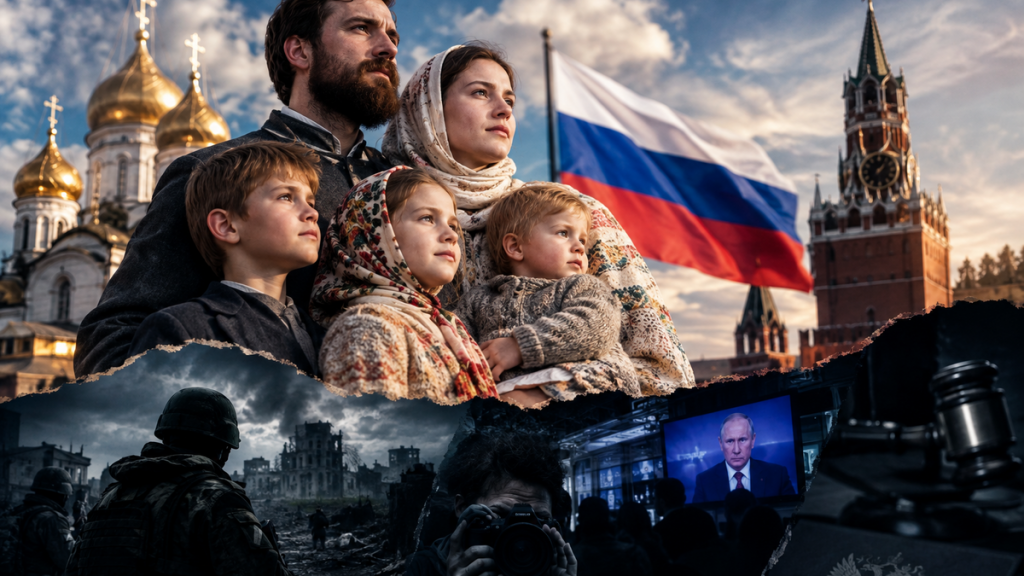
Russian propaganda primarily omits those aspects of social life and government that do not fit the image of Russia as a religious, family-oriented, morally ordered state.
This is most apparent in religious observance. The official message highlights Orthodox Christianity, churches, officials attending religious ceremonies, and the state’s close relationship with the Russian Orthodox Church. It gives far less attention to low levels of regular religious practice. According to Levada Center data from February 2026, 55 percent of Russians did not attend religious services, while 16 percent reported attending at least once a month.
A similar discrepancy appears in family life and demographics. Russia’s message emphasizes large families, motherhood, and the need to increase births, while devoting much less attention to its profound demographic crisis. The number of births fell from approximately 1.94 million in 2015 to about 1.26 million in 2023. The Kremlin itself described the situation as very serious.
Domestic violence remains in the background, as does the fact that a declared commitment to protecting the family does not always translate into effective protection for its members. The complexity of public attitudes toward abortion also goes largely unmentioned. Despite the state’s increasingly conservative policies, a 2026 survey found that 47 percent of Russians still supported access to abortion on request, while 10 percent favored a complete ban.
The image of a “healthy society” also leaves out serious social and health problems: exceptionally high numbers of HIV infections compared with Western countries, shortcomings in Russian health policy, and limited access to certain methods of preventing infection.
The message of order, sovereignty, and a strong state likewise omits high levels of corruption, the dependence of private ownership on relationships with the state apparatus, the absence of civil society, and the subordination of law to political power.
Then, of course, there is authoritarianism with totalitarian elements: media control, the murders of journalists and opposition figures, imperialism, and an aggressive foreign policy that has no qualms about initiating further armed conflicts and committing war crimes during them.
The elements of Russia’s conservative image that most clearly reflect reality concern state policy and some public attitudes. Russia does pursue restrictive policies toward LGBT people. It promotes large families, reinforces traditional gender roles, restricts access to abortion, and grants the Russian Orthodox Church a privileged position.
State documents have also formally incorporated “traditional values” as an element of Russian identity, security, and foreign policy. It is therefore no fiction that the Russian state has genuinely moved toward social conservatism in recent years.
Opposition to liberal changes in social norms is real too. Strongly traditional attitudes toward gender and homosexuality exist in Russian society. Hostility toward LGBT people, attachment to traditional gender roles, acceptance of hierarchy, patriotism, and symbolic identification with Orthodox Christianity are not propaganda inventions. In one survey, 72 percent of respondents regarded homosexuality as morally unacceptable.
Orthodox Christianity also genuinely plays a very important role in Russia’s national and state identity. A large proportion of Russians identify as Orthodox, and the Church has a significant symbolic and political presence. Religion connects with Russian history, patriotism, and statehood. Senior church leaders cooperate with the authorities, including in promoting a particular model of family life and demographic policy.
Russia’s social and state conservatism is real: opposition to liberalizing social norms, strong traditional gender norms, pronatalist policies, and appeals to Orthodox Christianity, patriotism, a strong state, and sovereignty. What is false—or at least greatly exaggerated—is the presentation of these real elements as proof that Russian society is deeply religious, family-oriented, and traditional.
Russia’s conservative project is the ideology of an authoritarian and aggressive state that invokes family, religion, tradition, and order while restricting political pluralism, suppressing independent media, and repressing its opponents.
Russian armed forces are also responsible for the deaths of journalists carrying out their work during the war against Ukraine. The case of photojournalist Maks Levin is particularly well documented. According to an investigation by Reporters Without Borders, Russian soldiers executed him. Within Russia itself, the history of murders of journalists critical of the authorities, such as Anna Politkovskaya, also involves unresolved questions about who commissioned the killings and the state’s failure to identify them. The European Court of Human Rights condemned Russia for this failure.
In this context, conservatism becomes more than a program of social values. It forms part of a state ideology that presents Russia as morally entitled to oppose the West. It subordinates tradition, religion, nationhood, and family to the state’s objectives.
The fundamental weakness of Russia’s conservative project therefore goes beyond the gap between declared values and actual practice. The problem runs deeper: the language of morality and tradition serves to legitimize an authoritarian system, militarism, and imperial policy. A “strong state” means concentrated power; “order” means restricted pluralism; “sovereignty” means the state’s right to reject external constraints; and “traditional values” means a state-defined catalog of acceptable social attitudes.
Russian conservatism is thus less an attempt to restore a traditional society than a state ideology that provides moral justification for authoritarian rule. It presents that rule’s conflicts with opponents at home and abroad as a struggle to defend civilization.
Read this article in Polish: Rodzina, religia, porządek. Za fasadą tradycji kryje się coś innego

Analyzes, describes, and comments on contemporary politics. Particularly interested in international relations, history, literature, new technologies, and the Polish stock market. He's also a decent beekeeper.

Zmień tryb na ciemny