Truth & Goodness
Western Factories, Without Western Freedom
09 October 2026





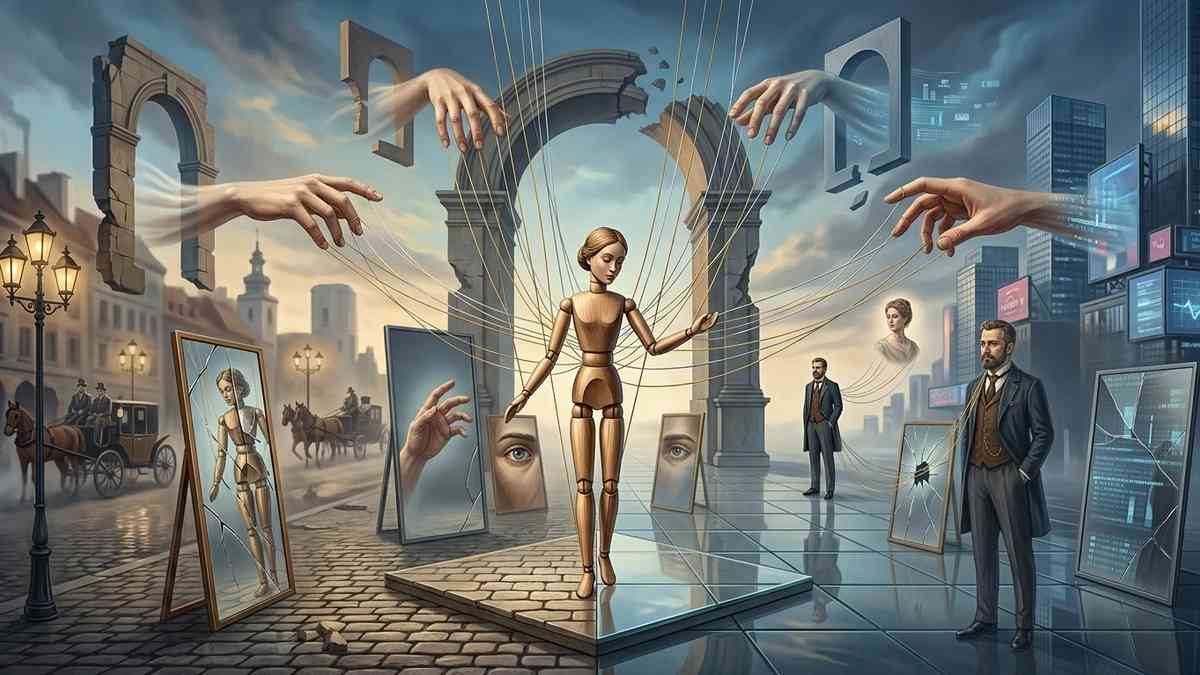
Nearly 140 years on, The Doll by Bolesław Prus is returning not only to the screen, but also to questions that hardly belong to the 19th century alone. How much of our ambition is truly our own? How much do we do for love, and how much for recognition? And what happens when our entire lives begin to depend on someone else’s judgment?
Across online forums and social media, Poles are locked in a fierce dispute over the latest interpretations of Bolesław Prus’s The Doll. On one side stands the Netflix series directed by Paweł Maślona. On the other is Maciej Kawalski’s almost 3-hour film. Both feature a roll call of Poland’s finest and most recognizable actors. Some of us also remember the 2 earlier adaptations: Wojciech Has’s 1968 film, starring Beata Tyszkiewicz and Mariusz Dmochowski, and Ryszard Ber’s 1977 television series, with Małgorzata Braunek and Jerzy Kamas in the leading roles. There is plenty to fight over.
Who best captured the mood of Prus’s novel? Which leading lady of Polish cinema most convincingly embodied Łęcka? And which screen gentleman persuaded us most as Wokulski? A glance at the online forums makes it clear that emotions are running high. The 2 newest adaptations have simply thrown a grenade into the debate.
Perhaps, then, it is worth returning briefly to the original novel and asking whether The Doll still has something timeless and universal to say. We can leave the arguments about the relative merits of performances and directorial interpretations to others. After all, it is no coincidence that a novel written in 1887–1889 has now inspired another 2 adaptations in the 21st century.
Bolesław Prus’s The Doll turns out to be a surprisingly relevant novel for contemporary readers. Its central concerns extend far beyond 19th-century Warsaw. Viewed from a little distance, it becomes a story about the need for love, the desire for recognition, social inequality, loneliness, upward mobility, money, illusions, and the search for a place in the world. These concerns are timeless and universal because they touch on human nature and our relationships, both private and social. They involve our emotions, our inner lives, and the choices we make every day.
A lesson we might draw from reading the book, or watching any of its adaptations, is this: achieving success is not enough; we also need to know why we want it. In this respect, Wokulski is a strikingly modern protagonist. He embodies the upwardly mobile individual. He makes money, expands his business, invests, helps others, and seeks entry into a world previously closed to him. Much like many people today, in the 21st century. Yet when he achieves what he wanted, it turns out that… it brings him no sense of fulfillment. This raises a very contemporary question: can success really bring happiness if it rests on the need to prove our worth to others?
Wokulski does not simply want to love Izabela. In a sense, he wants her to confirm his own worth. If he wins the love of a woman from the aristocratic world, he will be able to believe that he truly belongs there. The Netflix series places particular emphasis on this aspect of his story.
It portrays Wokulski as a man who desires not only love, but also respect, belonging, and social advancement. His relationship with Izabela becomes an entanglement of obsession, social class, freedom, and money. What lesson does this offer today’s generations? Sometimes we are not fighting for what we truly want. We are fighting for what we believe will make us worthy in other people’s eyes.
Another strikingly contemporary issue, present in both the novel and its adaptations, is a man’s idealization of a woman. In everyday life, of course, the same process works in the other direction. Wokulski does not so much encounter a particular woman, Izabela Łęcka, as construct an image of an ideal woman in his mind: his Bela. The fundamental problem is that the real Izabela cannot live up to this idealized figure.
How relevant this seems in the 21st century, amid social media, dating apps, and a culture built around appearances. Are we getting to know another person, or falling in love with their image? What choices—and, above all, what decisions with tragic consequences—can this process of idealization lead us to? We might ask the question another way: do we really love the other person, or do we sometimes love our own story about them?
Wokulski also reveals another painful dimension of human existence. We can change our job, social circle, home, and financial status, yet still feel: “I do not belong here.”
Wokulski exists between worlds. He is suspended between 2 social classes, eras, and sets of values, which profoundly damages his sense of belonging. He is no longer a poor shop clerk, but he never truly becomes an aristocrat. He has money, but lacks the right pedigree. He belongs to the old Romantic world while also embracing modern capitalism and science.
The Doll brilliantly reveals the thoughts, emotions, and inner experiences of someone who has no real roots anywhere. What is more, his search for a place in the world fails to bring him the peace he longs for.
Wokulski is not the only character to offer a timeless warning. Łęcka does too: we should not live at the mercy of other people’s expectations, especially those of society as a whole. Izabela inhabits a world that tells her who she should be. She must be an aristocrat, maintain her social standing, marry appropriately, and embody a particular way of life. Perhaps that is why Maślona’s adaptation gives this aspect of her story a more contemporary treatment.
Here, Łęcka has plans and ambitions of her own. Another character, Countess Wąsowska, becomes a figure of female freedom: someone who lives beyond convention and other people’s expectations. This is a valuable interpretive variation, presenting a woman in a different light from that prescribed by the 19th century.
Whatever the director’s vision, however, the question Prus raises remains relevant: how much of my life is truly mine? And how much of it follows a script written by my family, social circle, class, culture, or the media?
Rzecki also deserves our attention, revealing another form of loneliness that feels familiar today. He lives by values that the world around him increasingly regards as outdated. He remains faithful to friendship, loyalty, ideals, memories, and his own moral code, despite all the external circumstances that seem to contradict his convictions.
We can read him as someone who cannot find his footing in a world that has changed the rules of the game. This, too, is a distinctly contemporary experience, probably familiar to many people. As technology, social relationships, the labor market, and ways of communicating change, many feel disoriented. The world they knew and grew up in seems to be disappearing. Feelings of alienation, of being misunderstood, or even of rejection can then begin to dominate their inner lives.
Finally, there is perhaps the most important question of all: who is the doll of the title? More precisely, what would have to happen for me to become a doll myself? The title is undoubtedly a powerful metaphor. A person can become someone moved by various forces: money, background, love, ambition, public opinion, convention, and other people’s expectations. If we begin yielding to them, we can lose ourselves and our natural impulses. If we submit to other people’s influence and forget what it means to be authentic, we may become mere puppets before we even notice.
In this sense, Wokulski is a “doll” controlled by his love, Izabela by her social position, the elder Łęcki by the old world, and Rzecki by his past. Both the novel and its later screen adaptations explore this problem from different perspectives, naturally using different approaches and placing their emphasis in different places.
Even the few interpretations discussed above suggest that, paradoxically, The Doll by Bolesław Prus may be less a story about the 19th century today than a story about someone trying to answer the question: “Am I living my own life, or merely playing a role that others have assigned to me?” Am I still myself, or have I already become a doll?
Whatever the disputes and our individual preferences, may each of these screen interpretations encourage us to reflect on this deeply human question.
Read this article in Polish: Kiedy człowiek staje się lalką? Ta opowieść wciąż jest o nas


Deals with contemporary philosophy, mainly French, in the current of existentialism, philosophy of dialogue and relations, and phenomenology. Privately, passionate about Mediterranean vibes, crime stories – preferably Scandinavian and a lover of animals and long walks. In the surrounding world, unfortunately, less and less surprised.
Zmień tryb na ciemny