Humanism
What Happens When Winning Stops Being Proof of Worth?
11 October 2026





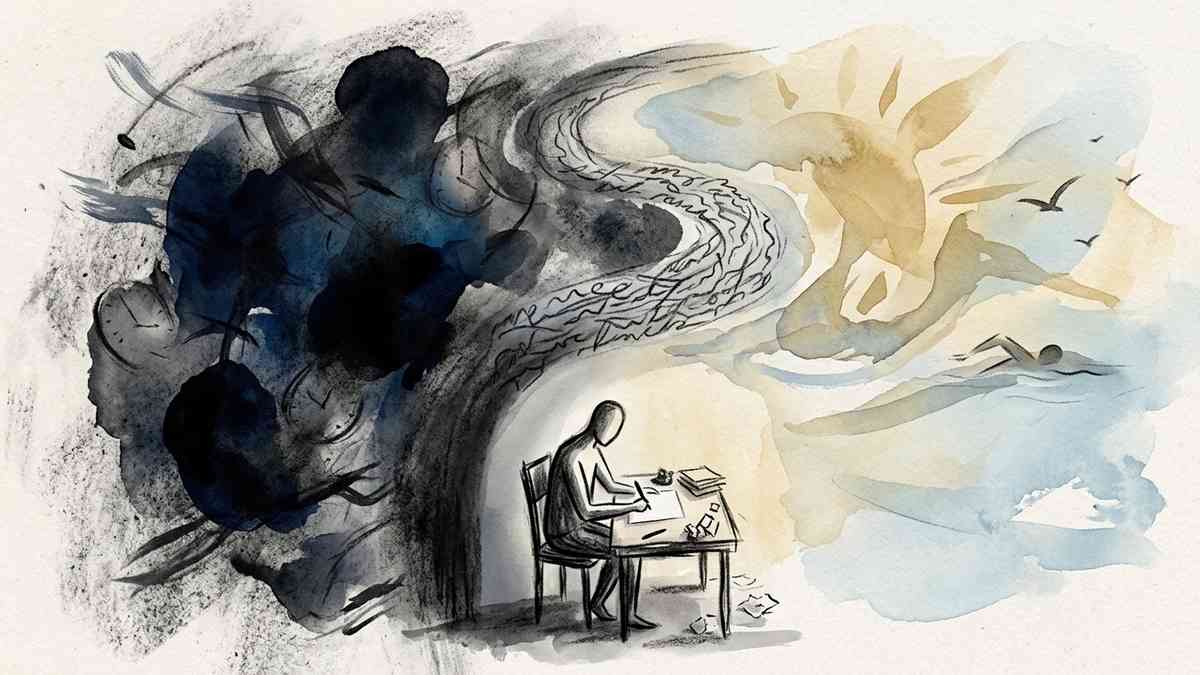
Haruki Murakami swims and runs, Kafka could write only at night, and Samuel Beckett began writing intensely once he accepted sadness as an inseparable part of his life. He loved walks in good company. Great writers are often obsessively absorbed in writing, and their routines can take surprising forms. Writers’ routines have never looked the same, but discipline helped many of them finish the work.
When Haruki Murakami works on a book, he gets up at 4 in the morning. He writes for 5 or 6 hours without a break. In the afternoon, he runs or swims, or does both, then reads and listens to music. He makes sure to go to bed at 9 in the evening. He follows this routine without the slightest deviation. Why? As he said in The Paris Review:
“The repetition itself becomes the important thing; it’s a form of mesmerism. I mesmerize myself to reach a deeper state of mind.”
Mesmerism is a healing theory and practice based on the idea of a human magnetic force. In the 18th and 19th centuries, people believed that every human being possessed an internal life fluid that could influence other people. Through the mutual action of these fluids, so-called magnetic sympathy emerged, leading to a spiritual bond between individuals.
Although this theory, devised by Franz Anton Mesmer, was later dismissed as pseudoscience, Murakami appears to use it successfully in building his public image. Nor can we exclude the possibility that there is a grain of truth in it. Murakami, the grandson of a Buddhist monk, enjoys undiminished popularity, and his books continue to magnetize generations of readers.
As a young novelist, Henry Miller wrote from midnight until morning. Then one day he realized that he was, in fact, a morning person, and began working from breakfast until lunch. Later he would take a nap and then go back to writing, often until nightfall. Over the years, he noticed that everything he wrote after noon was unnecessary or barren. Two or 3 hours in the morning were enough for him to write what he considered essential. He claimed that working during the same morning hours helped him maintain a daily creative rhythm.
“I know that in order to have those true moments of insight into oneself, one has to be very disciplined, to lead a disciplined life,”
he said in one interview.
Immanuel Kant was a master of discipline. The philosopher lived his entire life in Königsberg and rarely left it. He never married. For more than 40 years, he taught the same subjects at the local university.
Because he led such a regular and orderly life, people saw him as an automaton devoid of character, Mason Currey argues in Daily Rituals: How Artists Work. His neighbors could be certain that at exactly 3:30 in the afternoon, Kant would leave his house in his gray coat, holding a Spanish cane.
Other biographers, however, claim that Kant’s life was not quite so passionless. His health did not allow him to lead a riotous life – he had a congenital defect of the skeletal system, which made his chest too small and put pressure on his heart and lungs – but he was a brilliant conversationalist and a good host.
He believed that maxims formed the core of character, and he developed his own and followed them to the end of his life. He got up in the morning when his servant woke him. He drank 1 or 2 cups of tea and smoked a pipe. Then he prepared lectures and wrote. His lectures began at 7 and lasted until 11. Afterward, Kant went to an inn for lunch, his only proper meal of the day.
He ate simply, liked well-roasted meat, and drank wine with it. After lunch, he went for a walk and stopped along the way to visit his closest friend, Joseph Green. During the week, they talked until 7 in the evening, and on weekends until 9. Sometimes other friends joined them. After returning home, Kant worked and read. He always went to bed at 10.
Thomas Hobbes had interesting, ascetic habits. Hobbes, who died in 1679, described life in the state of nature as solitary, poor, nasty, brutish, and short. Yet the English philosopher lived a long life and died peacefully in bed at the age of 91.
He rose every day at 7 in the morning, ate bread and butter, and went for a long walk that lasted until 10. On the way, he meditated. After returning home, he wrote his thoughts down on paper, which he pinned to a board. Lunch was served to him precisely at 11.
In old age, he gave up wine and meat and began eating fish every day. After lunch, he smoked a pipe and immediately threw himself onto the bed for a half-hour nap. In the afternoon, he wrote and revised his morning notes. In the evening, before sleep, he sang popular songs, because he believed singing was good for the lungs and prolonged life.
Honoré de Balzac reportedly drank about 50 cups of coffee a day. He wrote mainly at night, from 1 in the morning until daybreak. His biographers believe he took part in orgies of work interrupted by orgies of pleasure. He died young, at just 51. Charles Dickens, who wrote 15 novels, 10 of them more than 800 pages long, needed absolute silence in order to write.
He even installed an additional door in his study to muffle outside noise. Precisely at 2 in the afternoon, he set off on a 3-hour walk through the countryside. When he returned, he was full of energy, which, as his brother-in-law wrote, seemed to flow from every pore of his skin, as if from some reservoir.
Franz Kafka could write only at night, when the house was asleep. During the day, his work as a clerk absorbed him. Yet he never gave up writing at night, because for him writing was his entire world. Samuel Beckett was regarded as a man whose whole life revolved around an almost psychotic obsession with writing, as another writer, Paul Strathern, recalled. One day, Beckett said of himself:
“I should constantly be in depression, but relief comes from realizing that I can now accept this dark side as dominant in my personality. By accepting it, I make it begin to work in my favor.”
Beckett loved walks, often solitary ones. There is an anecdote that once, while he was walking with a friend, the friend remarked:
“Look what a beautiful spring it is, the birds are singing, everything is in bloom. It makes you want to live!”
Beckett replied:
“I wouldn’t go that far.”
The master of horror Stephen King writes every day, all year round, including on his birthday and during vacations. In his memoir On Writing: A Memoir of the Craft, he compares a writer’s work to a creative sleep, and a writing routine to the evening preparations for sleep. He believes the writing room should be a personal place, one where a person can surrender to dreaming.
In his view, both in sleep and in writing, we learn to remain still while allowing the mind to free itself from the ordinary, rational thinking of everyday life. Just as the body and mind grow accustomed to the right amount of sleep — 6 or 8 hours — the waking mind can be trained to enter a creative sleep. Its result may be vivid waking dreams, that is, literary works.
One way or another, you have to sit down and write. Bernard Malamud, the novelist and author of The Jewbird, among other works, believed that the method of work itself mattered less if the writer was disciplined. In his view, to write a book, you first have to make time for it, not “steal” it. The stories that come to mind are worth writing down. In the end, everyone develops their own way of working, and the most important solutions have to be found within oneself. This may be the quiet truth behind writers’ routines: not that they guarantee genius, but that they make it harder for the work to disappear.
Read this article in Polish: Kafka nocą, Murakami o świcie. Zaskakujące nawyki znanych twórców


A journalist, writer, playwright, painter, and therapist working towards certification. The author of 9 books, including Jak odzyskać duszę, Gdy nadwrażliwość wystawia rachunki. Czterdzieści dwa listy o miłości, życiu i śmierci, co-written with philosopher Professor Lech Witkowski, and Miłość w Ejlacie, published by PIW. A graduate in Political Science from Nicolaus Copernicus University in Toruń, she also completed the European Journalism Programme at the Natolin European Centre and the Academy of Transpersonal Therapy in Warsaw. Her work has appeared in Twórczość, Odra, Czas Literatury, Helikopter, and Dialog.


Zmień tryb na ciemny