Humanism
The Answer Machine and the Vanishing Art of Doubt
08 July 2026





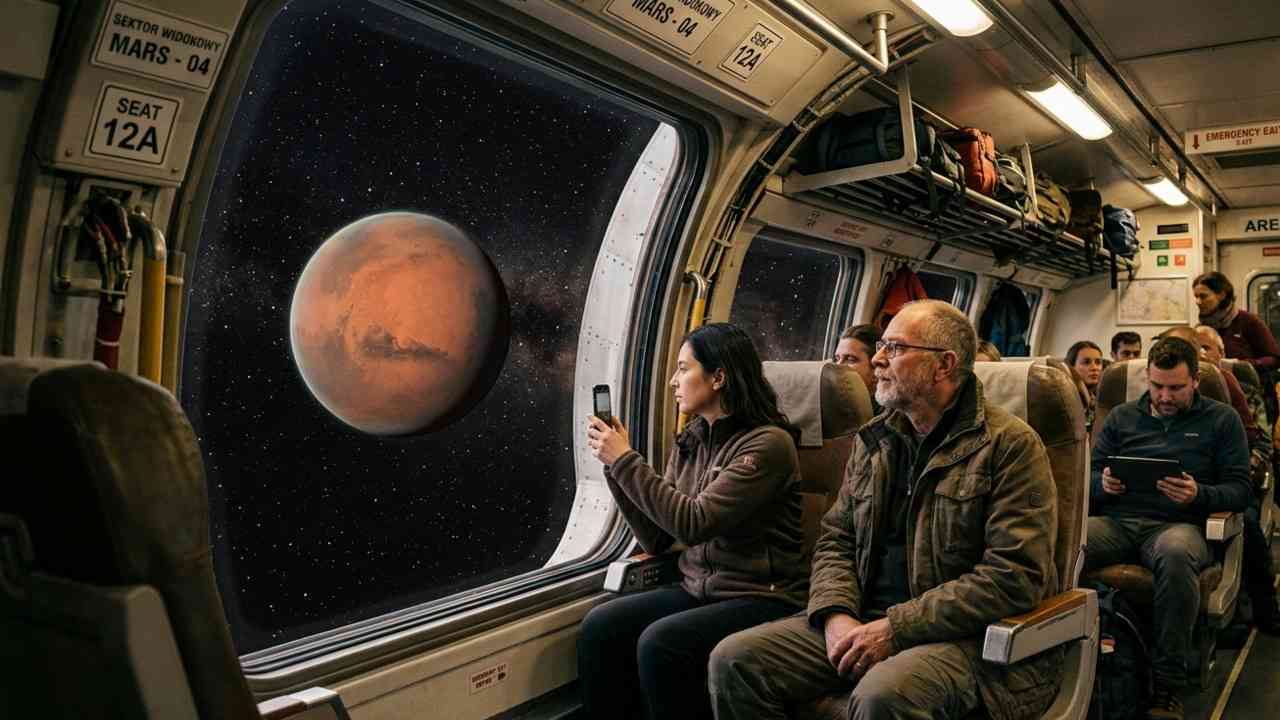
For decades, it seemed that space would become the next chapter in the history of civilization. In this insightful essay, a renowned writer reveals the less obvious reasons why humanity remains tethered to its home planet. While we dreamed of the stars, the future of interplanetary travel has become a ghost of an era that never came to pass.
Andy? No, we can’t meet today. I’m on the Moon right now, and this afternoon I have a corporate meeting on Mars, so I definitely won’t make it to Titan before midnight…
Isn’t this, or something very similar, how life in the future was imagined decades ago? The “future” being our present times. What went wrong? Why are we still welded to the Earth, with nothing indicating that we will take any significant step into the Cosmos in the coming decades?
In literature and cinematography, the motif of space travel and the exploration of alien planets was common, if not dominant. Of course, in many cases, space and alien worlds became a pretext for showing human behavior in situations of danger or alienation.
It was a way to depict the building of a new civilization or to ponder the limits of tolerance—and even more broadly, the possibilities of knowing and understanding an alien intellect that might completely deviate from our standard concepts (such as the sentient ocean in Stanisław Lem’s novel Solaris).
But many creators simply played with the theme of interstellar travel, inventing alien civilizations with different anatomy and physiology, astonishing social behaviors, and technology distinct from our own. Many also portrayed space travel as a continuation of the voyages of the great explorers of the Renaissance—a grand adventure driven by a desire for profit or the thirst for knowledge and conquest.
If we had asked any sci-fi writer, journalist, filmmaker—or even a regular person on the street—in the 1950s, 60s, or especially the 70s whether we would be traveling across the Solar System in 50 years, and if we would have permanent, inhabited bases at least on Mars and the Moon, I am certain the vast majority would have answered that this cosmic dream would surely come true.
Instead, it is 2026. Fifty-seven years have passed since the first Moon landing, and we are not only stuck on Earth like pickles in a jar, but we have actually recorded a cosmic regression. The last time a human foot stepped on the Moon was in 1972.
What caused our cosmic catastrophe? Why were we, as a civilization, so full of hope regarding space exploration in the 60s and 70s, while today we are indifferent, resigned, or—most often—simply skeptical about both the technical possibilities and, above all, the purpose of investing such vast financial resources and risking human lives for essentially no measurable benefits?
The Cold War between the civilizations of the Soviet East and the American West was fought not only on military and political fields. This war was also waged in the realms of economics, culture, and even sports. For example, the Olympic Games invariably became an arena for struggle—not just for athletes, but for political systems. The propaganda of the “people’s democracies” treated sports competitions as a substitute for war.
When the Cold War began to fade and eventually ended with the collapse of the Soviet Union and its satellite system (though perhaps “entered a different phase” is more accurate than “faded”), cosmic competition firstly became propagandistically redundant, and secondly, its gargantuan costs raised doubts.
Americans didn’t want voyages into space; they wanted a better life here on Earth. Consequently, NASA’s budget was drastically slashed. In the 60s and 70s, NASA’s activities consumed over 4% of the entire US budget annually. Today, it is approximately 0.35%.
Unfortunately, the sad truth that will accompany us for decades is that we lack the technical means to venture not only into deep space (beyond the Solar System) but even into “near-deep” space—the exploration of the Solar System itself. First and foremost, we are still using archaic rocket propulsion, while other methods (nuclear engines, solar sails, warp drives) remain only in the sphere of theoretical deliberation.
The Parker Solar Probe, the fastest vehicle built by man, moves at a speed of over 600,000 kilometers per hour. Does that seem like a lot? On an Earth scale—phenomenal. On a Cosmic scale—not so much. The Parker Solar Probe would need over 7,500 years to reach the nearest star, Proxima Centauri.
Furthermore, the Parker Solar Probe utilizes gravitational forces to gain acceleration and is a relatively small probe, about the size of a passenger car. A spacecraft for humans would have to be significantly larger and, crucially, protect the crew from cosmic radiation. Currently, space agencies estimate that a one-way trip to Mars, using the latest available technology, would take between 3 to 6 months.
When it comes to Mars, there is another issue: Mars is culturally interesting (countless myths, novels, films) and appeals to the imagination, but as a target for a manned base, it is simply uninteresting and difficult to explore. Much more engaging would be Titan—Saturn’s moon—but it is roughly five times further from Earth than Mars.
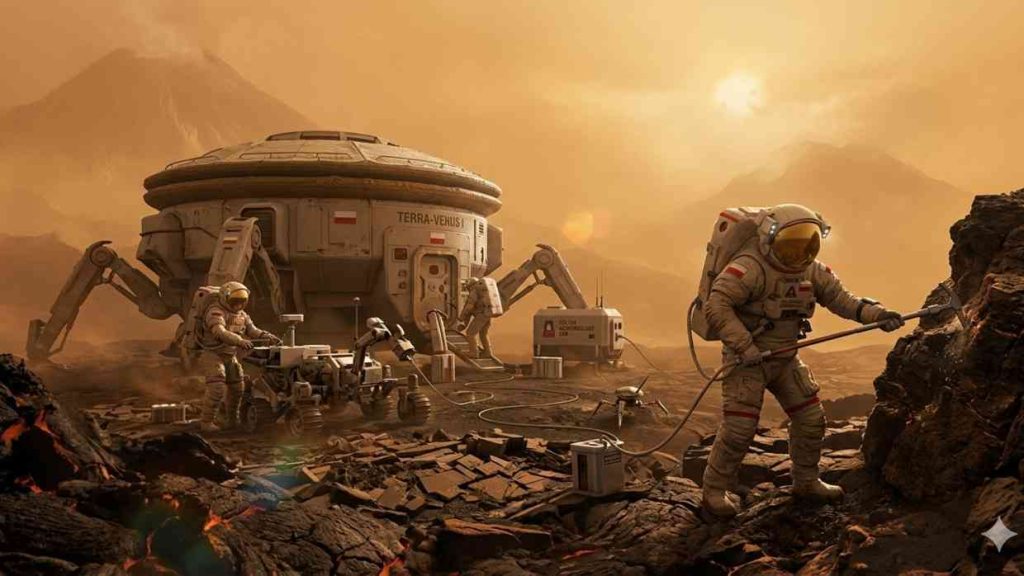
Our civilization has always been pushed forward by an exploratory spirit. After all, Homo sapiens spread across the globe from a single region in Africa, and then for millennia, we wanted to penetrate the unpenetrated and investigate the uninvestigated.
The problem is that space travel is a much more complicated task than the colonization of overseas continents. Moreover, it is not evident within any reasonable time horizon that it could be profitable. In short, profitable mines on the moons of Jupiter or Saturn will remain merely an idea for science-fiction creators for a very long time.
The truth is that even though moons like Enceladus or Titan are incredibly interesting places where biological life likely exists, they will certainly not become a source of income in our lifetime (nor likely in the lifetime of our grandchildren). Therefore, the future of interplanetary travel remains shackled by economic reality.
This civilizational indolence in space exploration has become fantastic fodder for conspiracy theories regarding the Moon landing. From the very beginning, there was a group of people who believed the Moon landing was a hoax—staged in a secret military base by a prominent sci-fi director (Stanley Kubrick’s name was often mentioned) and prepared by special effects experts.
And when no manned mission returned to the Moon for over 50 years (since 1972), these conspiracy theorists grew in strength. Their argument—that if it isn’t possible to organize a manned mission to the Moon in the 2000s, it certainly wasn’t possible in 1969-72—started to seem logical to some.
I admit, I might have begun to doubt the reality of the 1969 mission myself if not for one fact: there were a total of SIX manned missions where astronauts stood on the lunar surface! Twelve men walked on the Moon in total. Staging something like that would be technically and socially impossible, and above all, it would defy logic.
After all, each subsequent fraud (if they were frauds) would increase the probability of a slip-up. Why multiply these lies when the propaganda success was already achieved in 1969 during the first landing?
It is also worth noting that Soviet propaganda, while at war with the US, never doubted the reality of the American conquest of the Moon. If there had been any grounds for such doubts (even the most trivial!), the Soviets would have been the first to alert the world and organize a campaign of defamation and ridicule.
I am absolutely certain that hundreds of Soviet scientists and intelligence officers scrutinized every frame of the American lunar missions and listened to every communication. Finding any evidence of a forgery, even a stretched one, would have been a godsend for Soviet propaganda. Yet, nothing of the sort happened. If you are interested in how scientists have debunked the claims of conspiracy theorists, there is plenty of material on the internet, point by point, proving the absurdity of the accusations or the blatant lies associated with them.
As a creator and lover of fantasy, I lament that our mundane reality has not caught up with the colorful visions presented to us in our childhood and youth. The swamps of Venus, the giant jungles of Jupiter, the navigable deserts of Mars, and the mines of Pluto are not within our reach. Not because they don’t exist, but because even if they did, we wouldn’t know how to reach them.
And even if we did know how, everyone would still decide it’s more profitable to invent the next revolution in smartphones. For example, a smartphone that displays holograms. And instead of exploring the Cosmos, we would sit with our noses in more games and applications. Sad… For now, the future of interplanetary travel is being traded for better screens.
Read the origianl article in Polish: Jacek Piekara: Dlaczego kosmiczna przyszłość nie nadeszła


Jacek Piekara: One of Poland's most popular fantasy writers, a journalist, and a columnist. He is the author of the widely acclaimed "Inquisitor Series" (Cykl Inkwizytorski), dozens of books, and numerous short stories. Piekara has also contributed to specialized and popular press, including the magazines Click! and Gambler. In addition to literature, he writes scenarios for computer games and works as a publicist.



Zmień tryb na ciemny