Humanism
The Answer Machine and the Vanishing Art of Doubt
08 July 2026





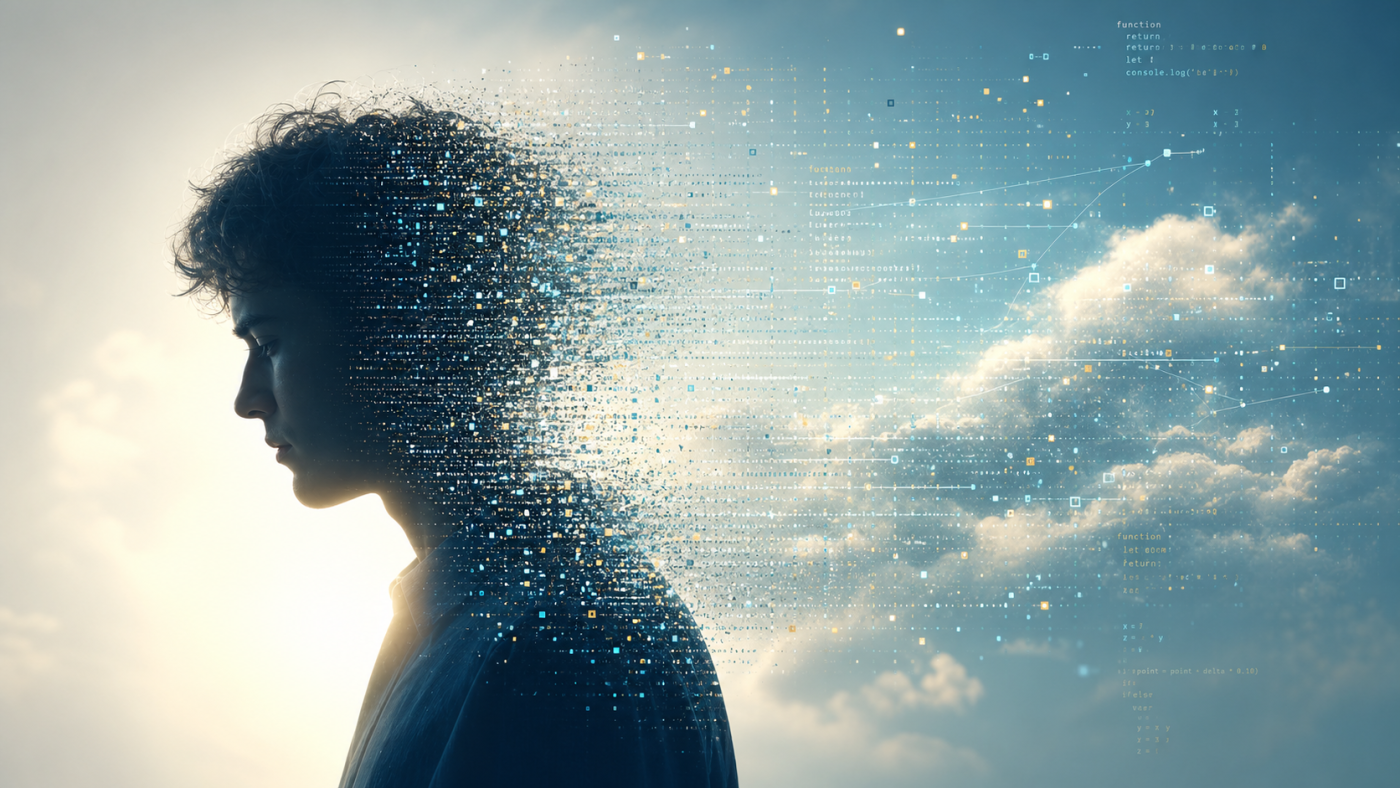
Digital immortality is moving beyond sci-fi as tech leaders imagine archived minds and robot bodies. But what happens to the fragile life we hope to truly save?
The startup Nectome, which said it wanted to “archive the human mind,” proposed a method for chemically preserving the brain so that its structure could one day be recreated in a computer. The procedure was described as “100 percent fatal.” Even so, Sam Altman paid 10 thousand dollars for a place on the waiting list, assuming that minds would soon be “digitized.”
Elon Musk, in turn, sketches a vision in which a brain-computer interface creates an “approximate snapshot of the human mind,” which could then be uploaded into the humanoid robot Optimus. Yet he himself stresses that “you will no longer be exactly the same person.” The record would only be an approximation, and life in a metallic body would change the way that consciousness exists. Here, digital immortality appears as the promise of a person’s “backup copy.”
Supporters of mind uploading assume that if we manage to reproduce all neural connections and brain states, then a program running on a sufficiently powerful computer will behave as we do. It will remember our life, react in similar ways, and speak as we speak. But this raises a question: is the essence of a person an informational structure that can be copied, or rather the continuity of experiencing the world from a first-person perspective?
From the perspective of lived experience, it matters whether our consciousness continues to “flow” without interruption, or whether death cuts it off and a highly convincing replica starts running somewhere else. Copying a file does not transfer the “identity” of the original item. It creates a new object with the same data. In the same way, digital immortality may preserve a pattern of behaviour without necessarily preserving the same subject.
In most philosophical traditions, the human being is not a pure cloud of information, but an embodied creature. We always think and feel “from within” a particular body. Pain, fatigue, ageing, physical limits: all of these help shape our biography and our choices, and therefore also the identity that technology is trying to “save.”
If the digital “self” were detached from the body and placed in an environment where experiences could be reset, copied, and modified at will, it would be difficult to speak of the same person. The person who learned the world through fragility and vulnerability would be gone. Embodiment is not merely a carrier. It is a co-author of our story. Remove it, and the protagonist changes, even if the name and memories remain the same.
Technological projects of immortality treat death primarily as a problem to be solved. A system failure that can be prevented with the right backup copy of the data. Yet many philosophers, from the classics to existential thinkers, have argued that the experience of finitude is not merely a curse. Above all, it is a source of intensity and meaning in our choices.
Death is not only an enemy. It gives life weight and urgency. Martin Heidegger spoke of “being-toward-death” (Sein-zum-Tode) as a fundamental structure of human existence. The awareness of finitude is precisely what gives choices meaning, relationships depth, and moments intensity.
In a world where decisions can be endlessly reversed, where we can duplicate ourselves and “start over,” the stakes that now give weight to relationships, commitments, and responsibility begin to disappear. Digital immortality may therefore lead, paradoxically, not to a fuller life, but to an erosion of meaning. In such a situation, choices lose their finality. And with that, they lose the sense that “this moment truly matters.”
The pursuit of immortality is, on one level, an expression of a deep love of life. It is a desire to extend joy, creativity, and connection. On another level, it is a form of escape from the nature of that very life. We want to preserve what we love, while at the same time rejecting the condition that allows it to become lovable to us in the first place.
This is where the paradox lies. Digital immortality is both an act of supreme hope and an expression of existential fear. We love life so much that we want to keep it forever. At the same time, we fear its nature: its fragility, uncertainty, and irreversibility. We try to flee death, but in doing so we risk losing what death makes precious.
The spectre of “eternity in the cloud” promises that we will never truly lose anything. There will always be a record, an avatar, an emulation. But if real life also consists in losing, regretting, saying goodbye, and being unable to rewind the tape, then digital eternity may be more an illusion of safety than a real extension of human existence.
Perhaps, then, the most important question the technological age poses to us is not “how can we save ourselves forever?” but “what are we actually trying to save?” And can digital immortality preserve it if it destroys the very condition that defines it?
Read this article in Polish: Technologia obiecuje wieczność. A co z prawdziwym życiem?

A Journalism and Social Communication graduate with 15 years of experience in the media industry. He has worked for titles such as "Dziennik Łódzki," "Super Express," and "Eska" radio. In parallel, he has collaborated with advertising agencies and worked as a film translator. A passionate fan of good cinema, fantasy literature, and sports. He credits his physical and mental well-being to his Samoyed, Jaskier.

Zmień tryb na ciemny