Humanism
Only School Can Change the World
26 September 2026





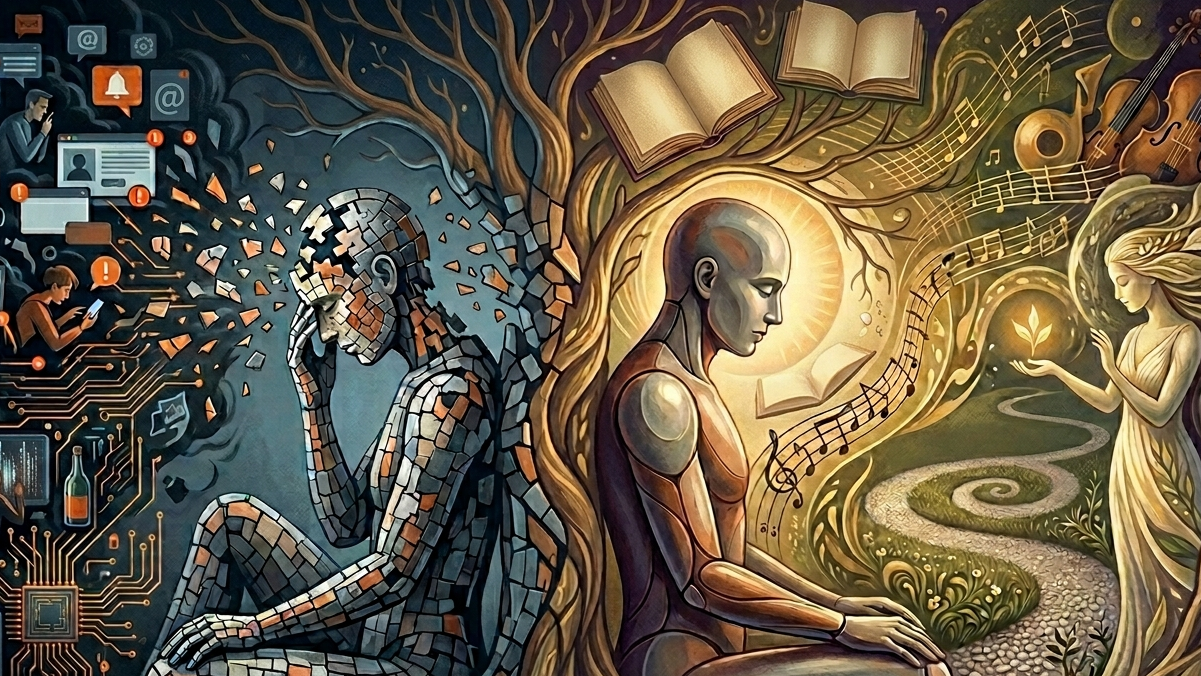
In Western culture, boredom occupies a peculiar space. It is neither sin nor virtue. Yet anyone who has paused in their rush knows it can be a surprisingly intense experience. There are, however, two faces of boredom, and one of them is worth cultivating.
Saying that “time drags” is just a safe euphemism. The truth is that boredom is a quiet, systematic attack on the cohesion of our “self.” The modern world has built a powerful defense against this state: screens, notifications, algorithms suggesting endless content, auto-played episodes. The goal is clear: to prevent the moment when nothing happens.
Why? Because in that “nothing,” something fundamental begins to occur. A person is left alone with their own time. For many, such a situation — a lack of structured activity and imposed purpose — is unbearable.
In 2014, psychologist Timothy Wilson conducted a famous experiment at the University of Virginia. A significant number of participants preferred to administer mild electric shocks to themselves rather than spend several minutes alone in an empty room with their thoughts. One participant chose to shock himself dozens of times just to occupy his attention — a striking diagnosis of our contemporary condition.
Boredom is neither entirely good nor entirely bad. It is a form of emptiness that is either filled with something toxic or opens us to something new.
The first face of boredom can be dangerous. It drives panic-driven escape — not to switch to better activity, but to completely drown out awareness of idleness. Hence alcohol, overwork, compulsively checking a phone, toxic relationships, or overeating. Anything to silence the question that grows loudest in the silence: what is this all for?
Clinical psychology has long noted links between chronic boredom and depression or addiction. But this is only the tip of the iceberg.
The same boredom also creates susceptibility to simple and radical narratives. Precision is important here: 20th-century totalitarian regimes did not arise solely from boredom. Communism and Nazism had deep roots in ideas, revolutionary violence, and social crises. Yet these systems mastered managing human boredom. They controlled free time meticulously, eliminating space for “being unused.” Parades, mass rallies, constant occupation of free time sanctioned by authority — nothing was left idle.
In a totalitarian state, one could not simply sit and do nothing. Emptiness was suspicious, potentially criminal. Hannah Arendt, in The Origins of Totalitarianism, noted that the ideal ground for mass control is isolation and destruction of the human capacity for inner dialogue — the kind of thinking that arises in silence. Those who cannot tolerate their own emptiness will trade freedom for any, even absurd, purpose imposed from above. Anything to stop being alone with themselves.
The second face of boredom, however, can be salvific. Here lies the space for what is most precious: deep reading and deep listening.
Both practices confront us with boredom. Slow reading, lingering over a sentence, following the author’s train of thought without jumping ahead — all require time that does not offer instant gratification. The same applies to listening to music. We are not talking about three-minute algorithmic singles, but multi-layered albums, symphonies, or jazz, with development, drama, and return.
Immersion in reading or music demands patience, which our overstimulated brains initially perceive as boredom. This is the critical moment when most of us break: we reach for a phone, skip a track, abandon the book. We cannot endure the silence.
Yet in this emptiness — in the seemingly barren space between sentences or notes — creative imagination is born. Michel de Montaigne, leaving an administrative career, locked himself in his tower to simply let his mind remain idle.
From this idleness and boredom arose Essays, one of the most important works of European humanism. The state in which a person is no longer used by expectations, habits, or systems turning every second into a product — what Tomasz Stawiszyński calls “being unused” — is perhaps the most precise definition of the second face of boredom.
Nearly four centuries ago, Blaise Pascal wrote in Pensées that all human misery arises from one thing: the inability to sit quietly in a room. He meant the same thing: panic before idleness. Yet in those moments when nothing happens and nothing is demanded of us, we can hear what is usually drowned out by digital noise — a forgotten thought, a hidden longing, or simply the longed-for peace.
Boredom also has a strong connection to the nature of our work. Experience of emptiness depends on what we do daily.
People in conceptual or decision-heavy roles constantly complain about lack of time, stimulus overload, and excessive obligations. Their problem is oversaturation. Conversely, repetitive work — like assembly line or logistics tasks — generates a different kind of fatigue. This is not creative calm, but monotony without dynamics.
Workers performing the same mechanical movements for eight hours paradoxically lack access to the second face of boredom — the one that allows deep reflection. Their minds, though unengaged in complex tasks, are exhausted by repetition. After such a day, the natural defense is to seek immediate, effortless stimulation.
This is the trap of the modern entertainment market. The cheapest, most convenient, and widely available remedy for monotony is a smartphone — free apps, social media, short videos designed for instant dopamine hits.
Thus, the modern consumption model offers the simplest and most barren time-killing exactly where routine fatigue is greatest. Instead of space for calm and autonomous thinking, we get digital noise that masks fatigue without giving real rest.
The same escape mechanism — in a more drastic form — is visible in children today. Boredom used to be a natural part of growing up. Every child experienced moments when there was nothing to do. From that unbearable emptiness, the best ideas were born: forts from chairs and blankets, drawings, inventive games with a stick and three stones. Boredom was a biological engine of creativity.
Modernity ruthlessly stifles this engine. When a child says “I’m bored,” a parent — often tired and overstimulated themselves — reflexively hands over a screen. Tablets or smartphones become digital pacifiers, immediately calming the child with a flood of colorful and loud stimuli.
The cost is enormous. Developmental psychology and neurobiology warn that giving a child a tablet during boredom deprives them of self-regulation mechanisms. They don’t learn to handle frustration or generate thoughts and actions independently. Their brains become conditioned to instant gratification from external stimuli.
Later effects appear in schools and psychology offices: reduced concentration, inability to focus on a book or play for long periods, and chronic anxiety when the screen is removed. Allowing children to experience boredom — to “sit in emptiness” for a few minutes — is now one of the most difficult and important educational tasks. Creative thinking emerges in that discomfort zone.
On a daily level, simple exercises help: standing in a queue without checking a phone, walking to work without headphones, spending a few minutes a day without looking at any screen. Initially, it hurts. A brain cut off from dopamine drops will protest and demand instant stimulus. Over time, the ability returns. Paradoxically, boredom can be trained.
This state remains ambiguous. Attempts to eliminate boredom completely are not only doomed to fail but are also dangerous. They lead to a life of constant escape rather than engagement with what matters.
Boredom is one of the few opportunities where we can still hear the most important questions: Does what I am doing have meaning? Or is there no inherent meaning, and must I build it myself?
Søren Kierkegaard wrote that boredom is the demonic beginning of all evil. While he sought remedy in ethics and faith, modern psychology adds that the ability to endure boredom without fleeing into stimuli is the first step toward inner freedom.
Both the destructive and the creative faces of boredom exist within us. Boredom is neither friend nor foe. Those who can sit with it without panicking suddenly discover something extraordinary: time stops dragging. Instead, it begins to exist — and today, that matters a great deal.
Read this article in Polish: Cisza, która leczy i pustka, która niszczy. Dwa oblicza nudy


A graduate of Journalism and Social Communication at the University of Warsaw (UW), specializing in culture, literature, and education. Professionally, they work with words: reading, writing, translating, and editing. Occasionally, they also speak publicly. Personally, they are a family man/woman (head of the family). They have professional experience working in media, public administration, PR, and communication, where their focus included educational and cultural projects. In their free time, they enjoy good literature and loud music (strong sounds).


Zmień tryb na ciemny