Culture
A Life Spent Becoming Someone Else’s Ideal
12 October 2026





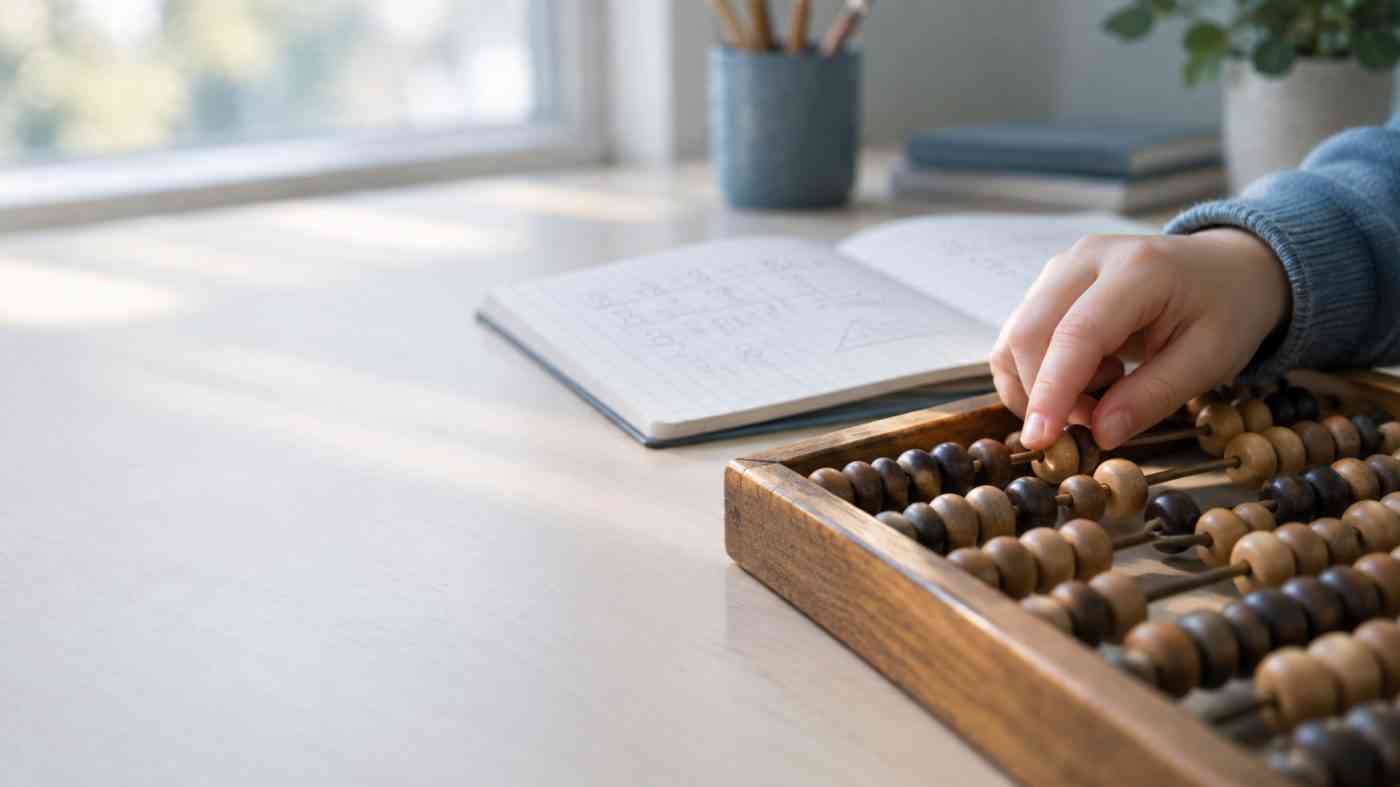
Today, an abacus for kids may look like a classroom relic from a time when calculators were a luxury and no one had heard of apps. A wooden frame strung with beads seems almost too simple for modern mathematics education. Yet research suggests that this very simplicity may help children find their way around the world of numbers.
When a child counts on an abacus, addition and subtraction do not have to rely entirely on memorizing rules. Numbers take on a visible form, and children can follow each stage of a calculation by moving the beads. At first, they work with a physical abacus. Over time, however, they learn to remember the arrangement of the beads and recreate it in their minds.
Researchers from Zhejiang University and the University of Texas examined this approach to learning mathematics. The study involved more than 400 Chinese students in grades 1–5. Some children took 2 hours of abacus classes each week, while a comparison group spent the same amount of time doing traditional mathematics and reading exercises.
Students in the abacus classes achieved better results on arithmetic tests at every grade level included in the study. The difference was already visible among first-graders after just 3 months of lessons. These students also performed better when comparing numbers, arranging them in the correct order, and quickly assessing relationships between values.
Children learning with an abacus did better not only on tests measuring calculation speed. The researchers also compared their results on end-of-semester exams covering a broader range of material, including tasks requiring the practical application of mathematics, basic geometry, and more complex problems. Students in grades 2–5 who used an abacus achieved better results on these tests than their peers.
The researchers also examined what might explain the stronger performance of children who learned arithmetic with an abacus. In the younger grades, more efficient number processing appeared to play a particularly important role. In grades 4 and 5, better arithmetic performance also went together with better results on tasks testing attention and short-term memory.
This may have something to do with the way children learn. During calculations, they do not simply retrieve a memorized answer. Instead, they mentally work with an arrangement that they previously created with their hands.
A previous study published in 2019 in The Journal of Neuroscience produced similar results. Researchers randomly divided children into 2 groups. One group spent 5 years learning to calculate with an abacus for 2 hours a week. During the same period, the other group completed additional exercises in traditional arithmetic and reading. At the end of the program, students who had learned with an abacus performed better on calculations and on tasks that required them to remember the arrangement and position of elements.
The authors of that experiment emphasized, however, that the benefits of the training had a specific scope. Children who learned with an abacus did not achieve better results on a test of general reasoning ability. There is therefore no basis for claiming that learning with an abacus by itself increases general intelligence.
It may, however, support skills that are useful when doing arithmetic: performing calculations efficiently and remembering the successive steps of a calculation.
In practice, an abacus for kids can be viewed not as a return to an old-fashioned [school] nor as a replacement for ordinary lessons, but as one way of presenting abstract concepts in a more tangible form. It may be particularly useful at the beginning of a child’s education, when the notation “7 + 5” can still look to some students like a collection of symbols rather than a description of a concrete change in quantity.
An abacus does not guarantee success in mathematics. Available research nevertheless suggests that it can support arithmetic, an understanding of relationships between numbers, and, after longer periods of training, visual-spatial memory as well. It is better understood as an additional learning tool than as a universal solution. It allows a child to see a calculation first and only later carry it out independently in their mind.
Read this article in Polish: Wygląda jak zabawka z przeszłości. Pomaga ćwiczyć nie tylko liczenie


A Journalism and Social Communication graduate with 15 years of experience in the media industry. He has worked for titles such as "Dziennik Łódzki," "Super Express," and "Eska" radio. In parallel, he has collaborated with advertising agencies and worked as a film translator. A passionate fan of good cinema, fantasy literature, and sports. He credits his physical and mental well-being to his Samoyed, Jaskier.



Zmień tryb na ciemny