Culture
A Life Spent Becoming Someone Else’s Ideal
12 October 2026





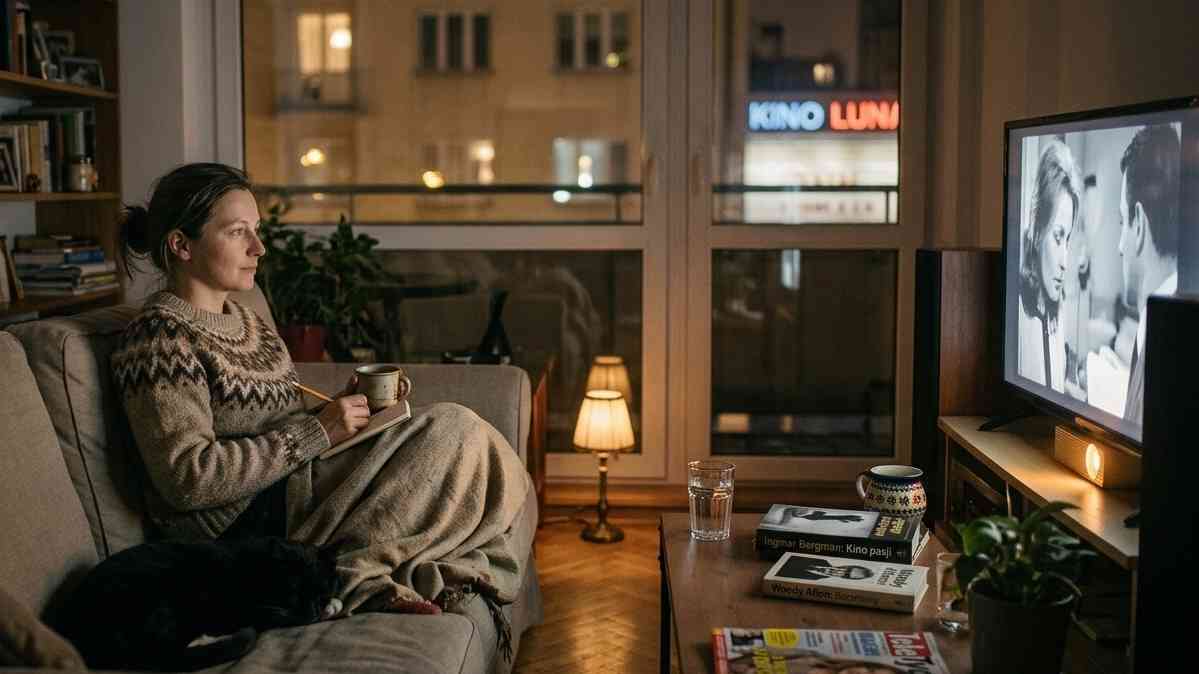
Everyone goes through a crisis at least once in life. There are many ways out of it: conversation, therapy, travel, a book. Cinematherapy at home is one of them. And it can prove surprisingly powerful.
The first screening of a film by the Lumière brothers in 1895 shocked audiences so deeply that, according to cinema’s founding legend, some rose from their seats, thinking the locomotive on the screen, moving toward them, would truly run them over. At the time, cinema appeared as a new form of entertainment, a way to detach oneself from factory reality, from a life we might now call a kind of Groundhog Day: like the marmot in the chocolate commercial, sitting there and wrapping things in silver foil.
Gradually, however, film began to become a more elaborate form of storytelling, drawing crowds to cinemas in search not only of escape from everyday life, but also of inspiration and a kind of catharsis. When we went to see a film by Woody Allen or Ingmar Bergman, the outing carried a double excitement.
We expected good cinema, of course. But we also wondered what these 2 extraordinary personalities had come up with this time. Allen: the mocker and neurotic who spent years in psychoanalysis — and spoke openly about it — in order to gather material for his work. Bergman: the filmmaker who crossed the boundaries of time and space, giving us cinema that resists interpretation and instead penetrates the most hidden corners of the human soul.
One anecdote captures how extraordinary these two masters of cinema were. Ingmar Bergman once asked Liv Ullmann, by then his former wife, living in the United States but still the muse of his films, to introduce him to Woody Allen. Liv invited them both to dinner.
Bergman felt so overwhelmed that when he saw Allen, he said only 1 word: “Welcome.” Allen merely nodded. For an hour, they ate together in deep, concentrated silence. After the meeting, both men reacted in almost the same way. “Oh, Liv, thank you! That was an extraordinary experience,” Allen said as he walked her home. Later, Bergman called to express his gratitude: “Liv, I have to thank you. It was truly a tremendous experience.”
Who among us would not want to meet someone in whose presence we might feel exactly that? Someone with whom the gravity of the moment, the joy of encounter, and mystery itself mingle to the depths. In a time when everything seems handed to us on a tray, when an excess of impressions, stimuli, and objects hardly lets us breathe, contact with a mystery we do not even want to decipher becomes a touch of the sacred, something each of us longs for deep down.
This is how Sophia Loren and Marcello Mastroianni meet in Ettore Scola’s 1977 film A Special Day. She is the wife of a fascist, a mother of 6, a simple woman. He is a neighbor persecuted by Mussolini’s regime. They spend a morning together. That encounter lifts her several levels higher in human consciousness. Nothing in her life will ever be the same again, because in 1 moment she experiences an awakening: pain and bliss at once. She matures through an encounter with the “Other.”
Wojciech Jerzy Has’s 1964 film The Saragossa Manuscript also carries an initiating power into maturity. It tells the story of a young officer in the Spanish army, Alphonse van Worden, played by Zbigniew Cybulski, who travels through the Sierra Morena mountains. He enters a mysterious world full of intrigue and strange events, and his experiences shake him free from the chains of his previous way of thinking. The film’s unique, nested structure and storytelling style influenced many directors, including Luis Buñuel and David Lynch.
The giants of cinema often draw on the avant-garde in order to create films that attract enormous audiences. Young viewers increasingly struggle to read the films of the New Wave masters or the Cinema of Moral Anxiety without cultural codes they have not had time to absorb. Mature directors, however, know how to transform their avant-garde masters creatively into the language of contemporary cinema: cinema that can delight viewers and even breathe new life into them.
This brings us to Paolo Sorrentino’s 2013 film The Great Beauty. Without hesitation, one could call it a film for the ages. Sorrentino himself makes no secret of his debt to Federico Fellini, especially when he constructs treatises on passing time and dazzling visual spectacles. In The Great Beauty, the main character, Jep Gambardella, is an aging writer and journalist who has grown bored even with parties among the celebrities of this world.
Like Odysseus, he tries to reach his Ithaca, which appears to be the end of life itself. Yet he does not surrender to the panic of passing time. He takes care of himself down to the smallest detail and celebrates friendship, although, having nothing left to lose, he remains painfully honest in his assessment of reality. He moves through the world as if still searching, though he is no longer looking for anything in particular. Questions remain with him, but he has no illusions that an answer will come.
In Jep Gambardella, as in a mirror, we see the truth of the human condition. The human being is a paradox. An unfathomable mystery. As long as we are alive, the ball is still in play. We all stand at the edge of an abyss. And instead of judging one another, comparing ourselves, elevating ourselves, and taking offense, the only sensible thing we can still do is offer one another affection. We should offer ourselves an even more tender kind of affection. Because we have to endure ourselves for an entire life.
The Great Beauty is a treatise of the highest order. It leads us into the realm of human beauty, the beauty of a person who is always becoming. To become, a person does not need to make special decisions. It is enough to observe, as Jep Gambardella does. Life will do much on our behalf anyway, once we realize that we do not need to travel far in order to experience something extraordinary. It can happen on the way from the kitchen to the living room in our own apartment.
Cinema has always offered an escape. But it can also become something more: a tool for working through difficult emotions, finding hope, and recognizing one’s own story in the story of a character. Cinematherapy at home does not require specialist equipment or expert knowledge. It requires a conscious choice and openness to what a film has to say. In a time when it has become easier to reach for yet another series to scroll through, it is worth pausing with a work created for a deeper experience.
Read this article in Polish: Czy kino może leczyć? Filmoterapia w domowych warunkach


A journalist, writer, playwright, painter, and therapist working towards certification. The author of 9 books, including Jak odzyskać duszę, Gdy nadwrażliwość wystawia rachunki. Czterdzieści dwa listy o miłości, życiu i śmierci, co-written with philosopher Professor Lech Witkowski, and Miłość w Ejlacie, published by PIW. A graduate in Political Science from Nicolaus Copernicus University in Toruń, she also completed the European Journalism Programme at the Natolin European Centre and the Academy of Transpersonal Therapy in Warsaw. Her work has appeared in Twórczość, Odra, Czas Literatury, Helikopter, and Dialog.

Zmień tryb na ciemny