Humanism
The Freedom to Choose, the Fear of Choosing
29 September 2026




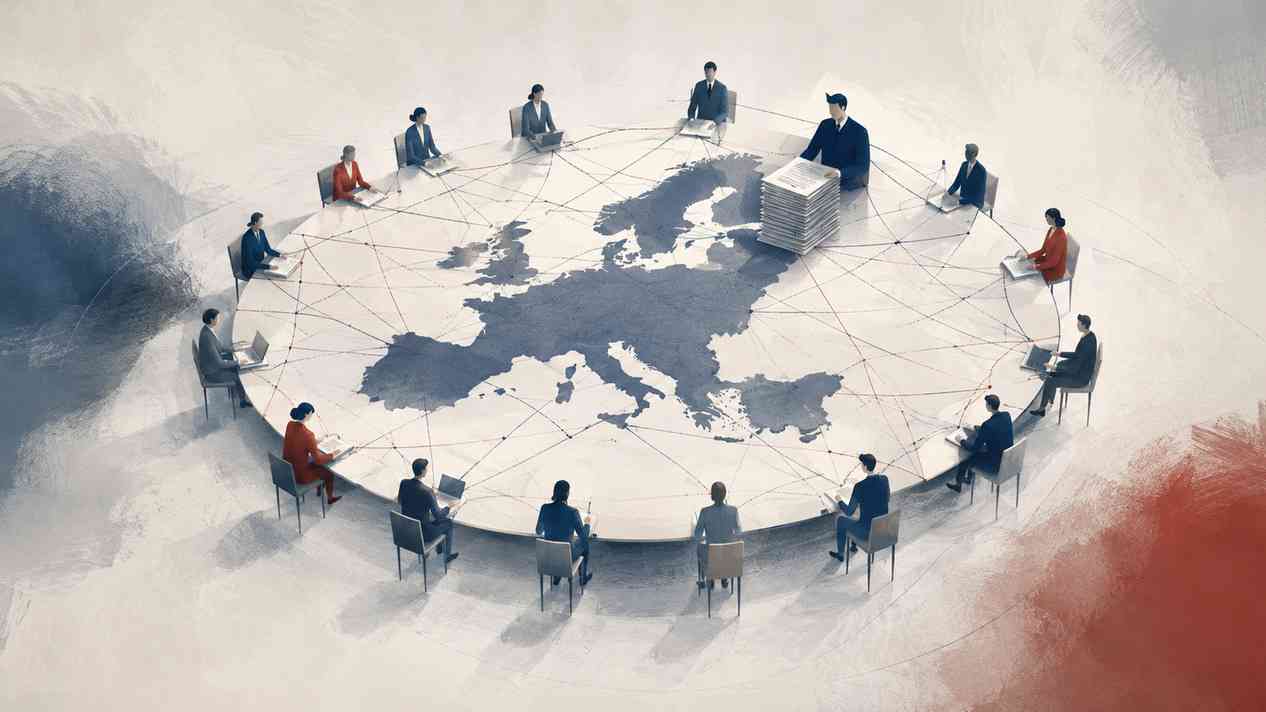
The European Union did not abolish power politics. It moved them from open confrontation into offices, votes, and behind-the-scenes negotiations. The largest economy gives Germany in the EU a clear advantage, but it does not guarantee victory. The winner is the one who can build a coalition, seize the initiative, and persuade others. Is Germany really calling the shots in the EU today? Dr. Justyna Schulz, an expert on economic policy and the European Stability Pact, analyzes the question.
In Polish public debate, one thesis appears more and more often: that real power in the European Union lies in the hands of the largest member states, above all Germany. In its most radical form, this view comes down to the belief that EU institutions primarily serve Berlin’s interests and that European integration has become a tool for strengthening Germany’s political and economic position.
This marks a clear shift from the way European integration tended to be viewed before the Union’s enlargement to Central and Eastern Europe. At that time, many presented the European Commission as an institution that balanced the influence of the largest states and effectively represented the common European interest.
This change in how people perceive the Union did not come from nowhere. It reflects an evolution in how people view the rules inside the EU itself. Two contrasting attitudes toward equality among member states — those associated with Chancellor Helmut Kohl and European Commission President Jean-Claude Juncker — can symbolize that change.
People used to say that Helmut Kohl, to emphasize the principle of equality among member states, would mention Luxembourg before Germany. Jean-Claude Juncker, by contrast, when asked in 2016 why France faced no sanctions for violating budget rules, replied: “because France is France.” For many observers, that sentence became a symbol of unequal treatment among member states.
The question, then, arises: does the EU truly function as a “Franco-German directorate,” with its institutions mainly serving the interests of the two largest member states?
No one can seriously deny that cooperation between France and Germany plays a key role in the process of European integration. At the same time, the EU remains a system of multi-level governance, built on the division of competences, elaborate decision-making procedures, and mechanisms that balance the influence of member states and supranational institutions.
With such a structure, it is hard to imagine even the largest states imposing their solutions unilaterally. Their economic strength certainly gives them influence, but not enough on its own. They must know how to build coalitions and reach compromises with the other participants in the decision-making process.
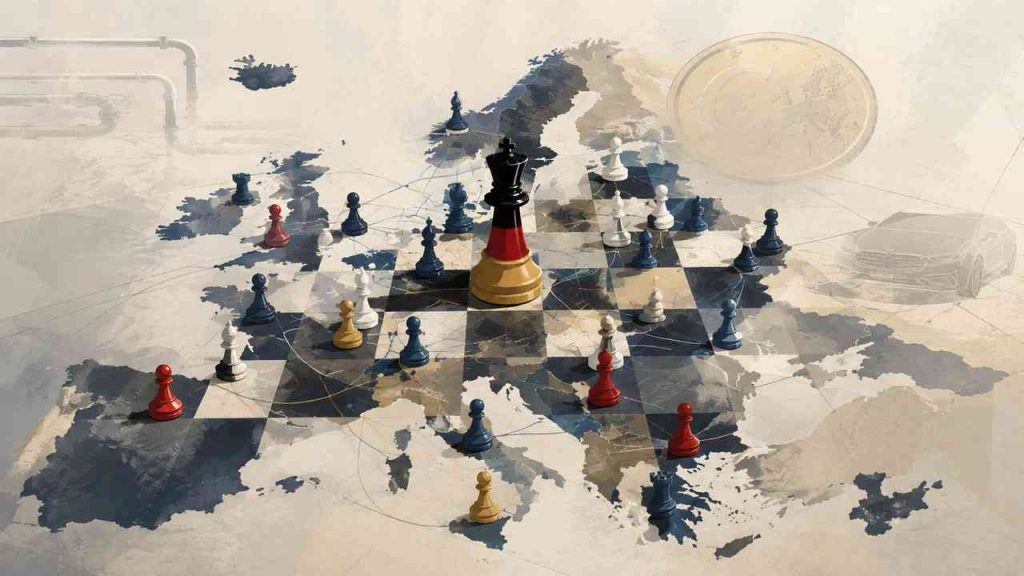
Energy policy offers one of the examples most often cited by those who argue that Germany holds a dominant position in the EU. Although the European Parliament, the European Commission, and a large number of member states repeatedly criticized the construction of Nord Stream 2, Germany pursued the project consistently.
The European Commission proposed an amendment to the Gas Directive that prohibited combining the role of gas supplier with the ownership of infrastructure, as in Gazprom’s case. Thanks to a compromise with France, Germany managed to soften those rules in relation to Nord Stream 2.
It would be too simple, however, to treat this case as proof that the Union stood helpless before Germany. Nord Stream 2 shows, above all, the limits of the European Commission’s competences in relation to member states, which, as the “masters of the treaties,” retain decisive influence over the shape of EU law.
At the same time, the case reveals that Berlin’s special position stems less from any ability to impose decisions unilaterally than from the capacity of Germany and France to work out compromises and renegotiate proposals put forward by the European Commission.
Germany’s role in the eurozone offers one of the clearest examples of the ambivalent nature of power in the EU. The paradox lies in the fact that the country widely seen as the main beneficiary of the monetary union often had to accept solutions that contradicted its own economic philosophy at crucial moments.
France strongly supported the project of a common currency from the beginning. Politically, it offered an answer to the growing economic power of reunified Germany. In French public debate, the Deutsche Mark and the Bundesbank often received the label of Germany’s “atomic weapon,” because they allowed Germany to exert indirect influence over the monetary policy of other European states. The common currency aimed to reduce that asymmetry and bind German monetary policy more tightly to common European institutions.
For Germany, giving up the mark carried fundamental political and economic significance. Chancellor Helmut Kohl accepted the euro as the price he was willing to pay for French support for German reunification. At the same time, Berlin assumed that the new monetary union would operate according to rules developed by the Bundesbank. German elites believed that the treaty provisions and the structure of the European Central Bank would effectively protect those rules.
The eurozone debt crisis after 2010 revised those assumptions. Faced with the threat that the monetary union could fall apart, member states adopted one solution after another that gradually moved away from the euro’s original foundations.
Paradoxically, precisely when the European and Anglo-Saxon press wrote about the “Germanization of Europe,” the “dictate of Berlin,” or the dominance of German ordoliberal economic philosophy, negotiations behind closed doors produced a gradual erosion of the solutions that Germany regarded as the foundation of monetary union.
From France’s perspective, the evolution of the eurozone meant the realization of one of its strategic goals. A philosophy once dominated by the Bundesbank gradually gave way to solutions that increased financial solidarity and the shared bearing of risk. At the same time, a narrative took hold that presented Germany as the greatest beneficiary of the common currency, mainly because its exporters benefited from a euro weaker than a standalone Deutsche Mark would probably have been.
Many German economists reject this simplification. They argue that Germany’s export success historically did not depend on a weak currency, but on the high competitiveness of its industry, forged under the pressure of a strong mark. Germany gradually accepted solutions involving fiscal transfers, common debt instruments, and an ever-deeper community of financial responsibility, even though they run against Germany’s culture of fiscal stability.
From this point of view, Berlin became a participant in a system whose rules increasingly diverge from Germany’s original assumptions. Compared with the era when the Deutsche Mark and the Bundesbank held a dominant position, Germany’s influence over the European monetary order is now limited by interdependence, even though Germany remains one of the most important actors shaping the direction of eurozone reform.
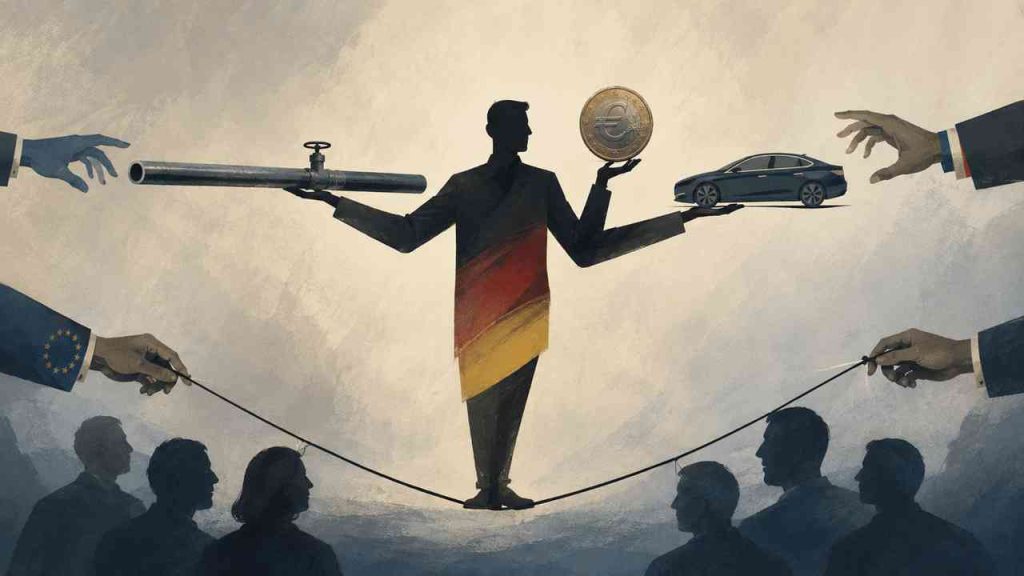
The EU’s Fit for 55 package offers one of the least obvious cases for analyzing Germany’s influence over EU decision-making. The European Commission, led by Ursula von der Leyen, a politician from Germany’s CDU, prepared the program. It gained support from most of the dominant groups in the European Parliament, including the European People’s Party, the Greens, and left-wing groups in which German MEPs play an important role.
From Germany’s perspective, the most controversial element of the package was the ban on registering new cars with internal combustion engines from 2035. From the beginning, this solution raised serious objections among some business circles and experts.
Critics argued that an accelerated departure from internal combustion technology would weaken one of the most important competitive advantages of the European, and especially German, automotive industry, while making it easier for electric-vehicle manufacturers from China to expand. In practice, this meant devaluing technologies in which German companies had held a global advantage for decades.
Despite these concerns, Germany voted in favor of the package after the European Commission accepted an amendment from Olaf Scholz’s government allowing the registration of vehicles powered by synthetic fuels, or e-fuels.
Berlin’s consent to this solution surprised many experts. It was hard to reconcile the image of Germany as the dominant state in the EU with the fact that it accepted regulations limiting the development of a sector that forms one of the pillars of its economic advantage.
Today, Chancellor Friedrich Merz and representatives of the CDU/CSU have taken steps aimed at weakening the regulations that prohibit the sale of combustion-engine cars, even though German political circles, especially the Greens and parts of the center-left and liberal camps, had earlier played a decisive role in shaping EU climate policy.
Equating the EU’s position with the interest of the German state often oversimplifies the matter. Germany does not form a single political actor. Competing parties, the federal government, the Länder, MEPs, social organizations, and interest groups all help shape the direction of European policy, and their positions can differ radically.
Second, the Fit for 55 example shows that decisions made at EU level can produce outcomes that harm even the largest member state.
Third, the case shows how strongly perceptions of decision-making processes differ across member states. In many member states, including Poland, people often interpret EU solutions as the result of German dominance. Meanwhile, a large part of German public debate focuses on the belief that Berlin bears disproportionately high costs to preserve the unity of the community and accepts solutions that depart from its own interests.
This conviction helps explain the AfD’s programmatic demand that Germany leave the eurozone and the EU in its current form. German debates also emphasize the effectiveness of the French public administration in EU decision-making processes and its ability to place people in key posts within EU institutions. Germany, by contrast, supposedly follows the so-called “German Vote” strategy: the German government abstains in Council meetings because domestic German actors cannot agree on a common position.
Germany’s position in the EU is far more complex than popular claims about German dominance or the existence of a “Franco-German directorate” suggest. Germany undoubtedly has the largest economic potential in the Union and an exceptional capacity to build coalitions. Yet this does not give it the ability to impose its own solutions unilaterally.
In many cases, Berlin must accept compromises that only partly match its interests and sometimes even weaken the advantages that form the foundation of the German economy.
The EU did not abolish power politics; it changed their character. Economic potential still matters, but it is not enough. Effectiveness depends on the ability to build coalitions, use institutions, and persuade partners. Integration replaced the classic logic of great-power rivalry with an institutional system in which influence depends on the skillful use of procedures to build support for one’s own proposals.
Rivalry among states did not disappear. It simply moved from military confrontation to the plane of institutional negotiation.
The ability to conduct these negotiations determines the real position of states in contemporary Europe. This means that the position of member states does not follow automatically from their size. The history of European integration offers many examples of effective influence by medium-sized and small states, especially when they know how to create durable coalitions or use the institutional tools available in the decision-making process.
The examples above also show that the EU is neither a classic association of sovereign states nor a structure subordinated to a single hegemon. It is a system of multi-level governance in which influence is relational and depends on the ability to build compromises.
Even the two largest member states, France and Germany, must constantly negotiate the scope of their influence with each other and search for compromises that allow them to reach a common position. In the end, Germany in the EU may have power, but it does not have command.
Read this article in Polish: Potężne Niemcy, ograniczona władza. Kto rządzi Unią?


Chief Analyst in the “Germany–State–Society–Economy” team at the Institute for Western Affairs. She specializes in economic policy, eurozone reform, the European Stability Pact, and Polish-German economic relations. From 2017 to 2025, she served as Director of the Institute for Western Affairs.


Zmień tryb na ciemny