Science
Before There Are Planets, There Is Dust
16 October 2026





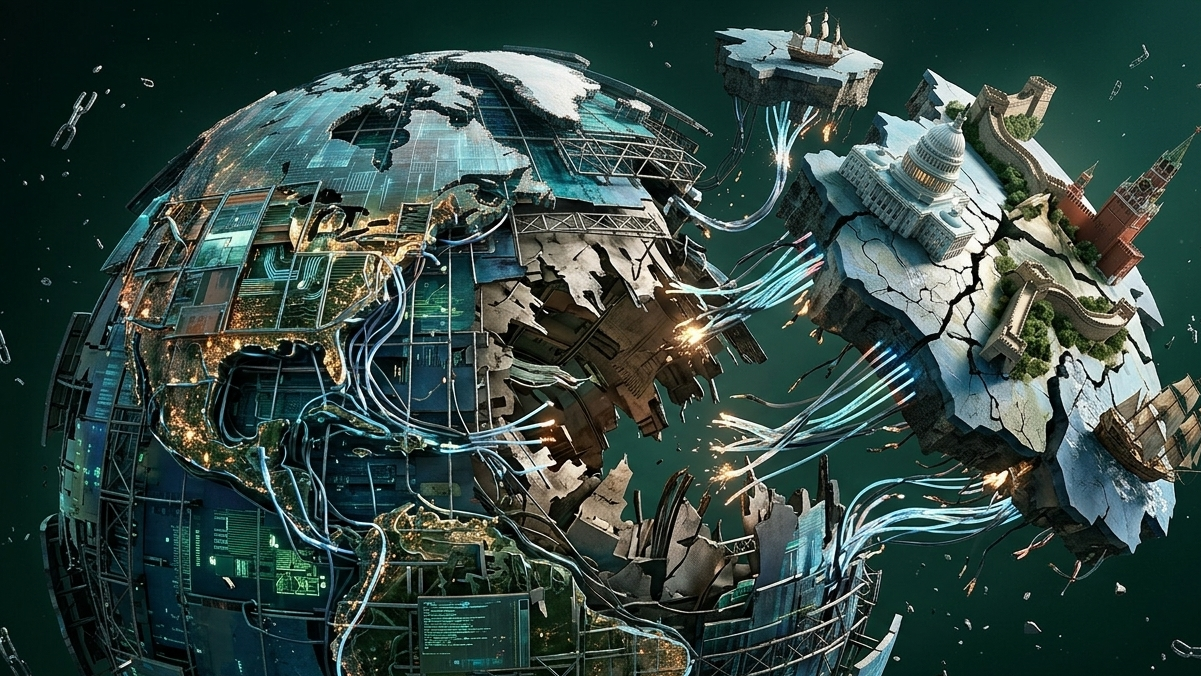
A world marked by American-Chinese rivalry and local armed conflicts has shattered our sense of security and weakened the foundations of our thinking. People speak of a globalization crisis — but what does that actually mean? Will foreign policy overturn the global economic order, or force us into an intellectual revolution?
In public debate, the claim that globalization is ending appears more and more often. The same authors, however, write these revelations on devices bearing American logos, produced in Asia, made with African minerals, and delivered by a European merchant fleet. Something is changing. But what?
The answer depends on the definition we adopt. If we treat globalization broadly, as a range of phenomena running from economics and technology to politics, then the world has been moving toward its current condition since the first half of the 19th century.
During that time, the United States flourished and the colonial empires finally collapsed. China, in turn, traveled from political humiliation at the hands of Europeans, through communism and poverty, to the role of a power offering an alternative to the United States.
During that same period, two world wars took place. Industrial, moral, and social revolutions passed like lightning. We moved from balloon flights to entirely realistic concepts for conquering space. Is another global rivalry really supposed to end the migration of specialists, foreign investment, outsourcing, and international exchange once and for all? Globalization is the official name for human greed equipped with concrete tools.
Where, then, does this fear come from? The crisis of globalism has two dimensions. The first is measurable and less significant: Americans have genuinely lost their monopoly over world power and now have to share influence, which in fact has already happened.
The age of interventionism, protectionism, rebuilding productive capacity, and renewed concern for one’s own security will come as a shock to Europe. In fact, this is already happening, though at a snail’s pace.
Shortening and duplicating supply chains, maintaining reserves, moving production closer to one’s borders, paying more for energy, and spending more on defense all represent the cost of security. We will pay for it through lower efficiency, slower growth, and a decline in wealth. We will simply be poorer.
The cultural shock, however, will be much greater. Until now, the debate has treated globalization too strongly as an economic mechanism and too weakly as an ideological and anthropological project: in other words, as a particular vision of the human being, society, history, and political order.
Here, the most important distinction matters. Globalization is a real process: flows of capital, goods, people, information, norms, and lifestyles. Globalism is an ideology claiming that ever-greater integration of the world is not only inevitable. It is also fundamentally good, progressive, and leads humanity to a higher stage of development. That second idea really is in crisis today.
After the fall of communism, Poland developed a particular synthesis of several ideas: economic and political liberalism, cosmopolitanism, supranational institutionalism, technocracy, and individualism.
We embraced globalism with particular zeal because it was not merely an abstract doctrine. In practice, it meant leaving the Soviet sphere of influence, gaining access to the West, modernizing, becoming wealthier, and traveling freely.
It therefore became easy to mistake the success of Polish integration for proof that the Western model was not only beneficial for us, but also universal for the whole world.
Globalization was never only trade in containers. It promised to create a world in which the market, law, technology, and individual rights would gradually replace geopolitics, religion, borders, and collective identities.
In the 1990s, Francis Fukuyama’s thesis about the end of history was often simplified into a belief that states would democratize, the middle class would expand, trade would soften conflicts, Russia would liberalize as it grew richer and would enter the European system, wars between states would become anachronistic, and nations would remain as folklore and administration while losing real importance. That assumption turned out to be wrong.
Exchange between nations is not ending. Trade between continents is not ending either. What is ending, rather, is the belief that the whole world is moving toward one Western model of modernity. For years, many assumed that society after society would adopt the market economy, liberal democracy, individualism, and increasingly weaker borders.
Today, however, we see something different. China is building a modernity based on technology and a strong state. Russia is building one on imperial nationalism. India is building one on civilizational pride. Islamic states are trying to modernize without fully adopting Western culture. What emerges, then, is not one shared world, but several great spaces. They will trade with one another, but they will not necessarily share the same values.
In this reality, liberalism will have to accept that nations will not disappear. Instead of trying to replace them, it should learn to act through states, communities, and a national sense of responsibility. The most important question is no longer: liberalism or nationalism? The real question is: what kind of liberalism, and what kind of patriotism, do we need?
A democratic patriotism is possible: one that combines a strong state with individual rights. But authoritarian nationalism is possible too, one for which strength and uniformity matter more than freedom. Europe faces a similar dilemma. Either it remains mainly a common market, or it begins to behave like a political power that protects its own borders, technologies, and industry.
For Poland, this problem is especially complex. Globalization and integration with the West brought us modernization, development, freedom of travel, and the security connected with membership in the European Union and the North Atlantic Treaty Organization.
At the same time, Polish history reminds us that organizing around the nation was not merely symbolic for us. It was a tool of survival during the partitions, occupation, and Soviet domination.
That is why Poland should not choose between nationalism and unconditional globalism. In the coming years, some kind of Polish synthesis will have to emerge between these extremes.
The globalization crisis does not ask whether Poland should retreat from the world or dissolve into it. It asks whether we can remain open without becoming naive, modern without becoming rootless, and patriotic without surrendering to the politics of resentment.
Read this article in Polish: Globalizacja w kryzysie. Co naprawdę się kończy?


Analyzes, describes, and comments on contemporary politics. Particularly interested in international relations, history, literature, new technologies, and the Polish stock market. He's also a decent beekeeper.



Zmień tryb na ciemny