Humanism
What Happens When Winning Stops Being Proof of Worth?
11 October 2026





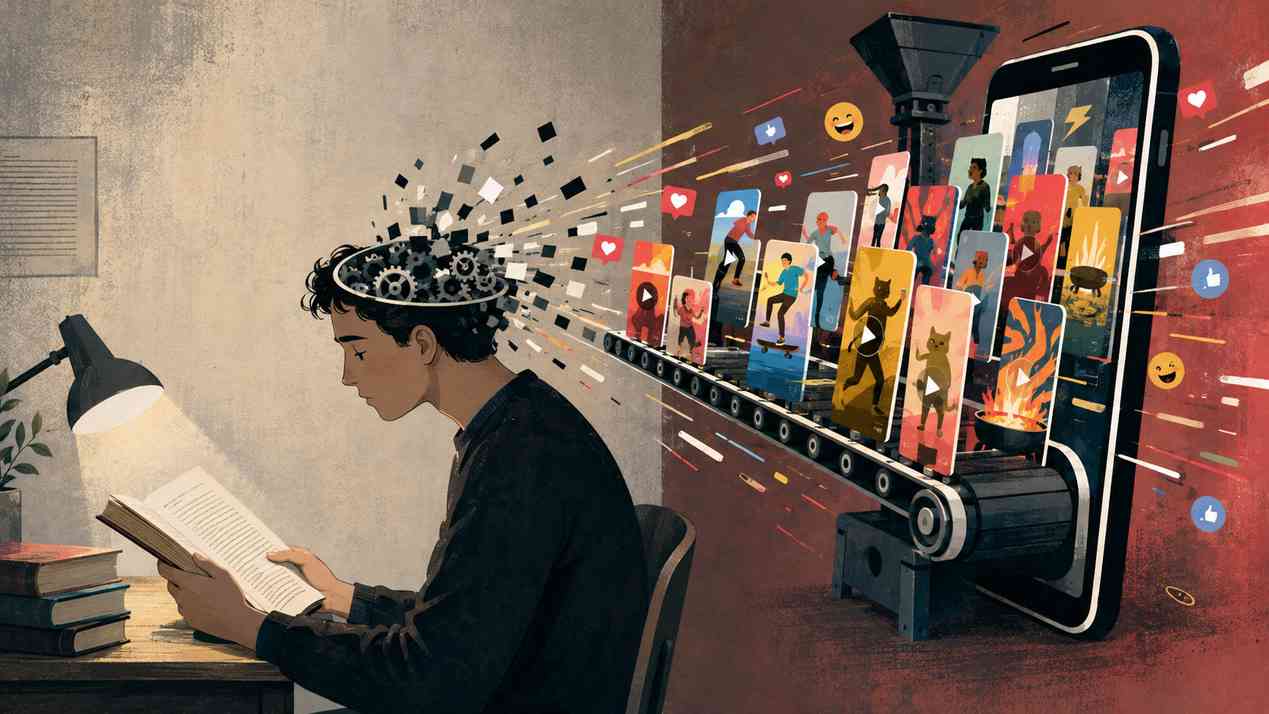
A few seconds of video, a swipe of a finger, and the cycle continues for minutes, sometimes hours. The problem may appear later, when we need to read several pages, listen to a lesson, or focus on a single task. A growing number of studies link intensive use of TikTok, Reels, and Shorts with weaker concentration.
They sat down to read, lost the thread after a few minutes, reached for their phone, and never returned to the text. Not because the reading was too difficult or because they consciously decided to give up. They described a moment when their concentration simply disappeared. Without any deliberate decision, almost automatically.
This was the experience of students who used short videos intensively, described in the 2024 study by Haliti-Sylaj and Sadiku.
When researchers compared their results with those of people who used short videos more moderately, the difference turned out to be statistically significant. The study does not answer the question of whether short videos themselves weaken concentration, but it fits into a broader pattern appearing in further scientific research conducted in different countries and among different age groups.
In 2025, Keith Robert Head collected the results of empirical studies conducted between 2019 and 2025 that examined the relationship between the use of short-video platforms and the ability to concentrate.
The platforms analysed included TikTok, Instagram Reels, YouTube Shorts, and Chinese equivalents of these services.
The picture that emerged from this review was relatively consistent. Intensive use of short videos was associated with a weaker ability to maintain attention over longer periods and poorer academic performance. Neuroimaging studies also revealed measurable differences related to the structure of white matter in the brain, which is involved, among other things, in behavioural control.
Head emphasized that his review was narrative rather than a meta-analysis, and that the relationship described was a correlation, not proven causation. Nevertheless, the collected data were consistent enough to deserve serious attention.
In the same review, he described a mechanism that has quickly become a reference point in discussions about education: the brain’s reward system, stimulated by each successive short video, begins to expect stimulation every 15 to 60 seconds. Tasks that do not provide such immediate rewards – such as reading a chapter of a novel – become increasingly difficult to tolerate.
One of the more methodologically rigorous studies in this field was conducted by researchers from Zhejiang University. The results were published in 2024 in Frontiers in Human Neuroscience. Yan, Su, Xue, Hu, and Zhou examined 48 participants who wore EEG caps while completing the Attention Network Test.
The test measures three components of attention: alerting, orienting, and executive control. The last of these is responsible for the ability to resist distractions and maintain focus on a chosen task. It involves, among other areas, the prefrontal cortex and the anterior cingulate cortex.
The researchers found a significant negative correlation between the tendency toward short-video addiction and the strength of theta waves in frontal brain regions during tasks requiring executive control. People with higher levels of short-video dependence showed weaker activity in areas of the brain involved in selecting information and maintaining a direction of thought. Importantly, this was not a result based only on participants’ self-reports. Brain activity was monitored while they performed a task requiring concentration.
However, the limits of this study are clear: the sample consisted of 48 adult university students, not teenagers. The human prefrontal cortex continues developing until roughly the middle of the third decade of life. Do similar effects appear in 12-year-olds? This study could not answer that question.
Platforms such as TikTok do not leave anything to chance. Put simply, they are tools optimized around one key variable: how long a user watches each successive video. Data from Statista, based on an analysis of more than 700,000 videos and 61,000 accounts, show this mechanism precisely: clips shorter than 60 seconds are watched until the end by 80 percent of viewers. Videos lasting 90 seconds lose half of their audience before the final second.
The distribution algorithm is built around precisely this measure. Content that holds attention until the final frame is shown to more users. Less engaging clips are gradually reduced in visibility during the next cycle. The effect reinforces itself: the less time users are willing to wait for a new stimulus, the more efficiently they avoid content that requires patience – and the higher completion rates the next short videos achieve in their feed. The platform does not simply shorten attention. It systematically rewards the absence of patience.
Haliti-Sylaj and Sadiku (2024), mentioned earlier, examined 150 students by comparing frequent Reels users with people who used them moderately. The first group showed noticeably greater difficulties maintaining attention for longer periods. This was not only a matter of subjective perception. The difference appeared in their actual behaviour during reading tasks assigned as part of the study.

A reading comprehension lesson assumes that a student can follow a developing argument across several pages. The curriculum assumes that patience with longer narratives is already a skill students possess. An exam assumes that a written answer consisting of several paragraphs is a task a 15-year-old can complete.
Xie and colleagues (2023), in a study of 1,047 Chinese university students published in Frontiers in Psychology, showed that short-video addiction is linked with increased procrastination – both directly and indirectly, through reduced concentration ability. Students did not avoid reading because they considered it unimportant. The sequence looked different: They started reading, lost focus after a few minutes, felt frustrated, reached for their phone, and did not return to the point where they had stopped.
The problem lies deeper than motivation alone. It concerns the tool itself. A brain accustomed to receiving stimuli every few seconds encounters a task that requires concentration for several dozen minutes – and is no longer prepared to perform it.
The attractive media claim that TikTok has a clearly destructive effect on concentration is, however, questioned by serious researchers – not only by representatives of similar platforms.
Amy Orben from the MRC Cognition and Brain Sciences Unit at the University of Cambridge and Andrew Przybylski from the Oxford Internet Institute have spent years examining whether the panic surrounding screens is actually supported by data. Their 2019 analysis published in Nature Human Behaviour, which included more than 355,000 participants, showed that the negative relationship between digital technology use and adolescent well-being is statistically real, but very small – accounting for no more than 0.4 percent of the variation in well-being.
For comparison, the authors referred to the effect of wearing glasses. Their argument was not that screens are harmless. Rather, they suggested that public debate systematically exaggerates small effects and overlooks the fact that poorer outcomes among teenagers usually result from several factors combined: too little sleep, too little physical activity, poor diet, and only then screen time.
Head responds to this point in his review: the pattern appearing in research does not concern every user or every amount of use. It concerns intensity of use and, importantly, situations in which short videos replace other activities. Students who spend three hours a day on TikTok but also read, play chess, or practise an instrument do not appear in studies in the same way as those for whom the platform has become their main way of spending free time.
There are far fewer studies on interventions than on the phenomenon itself, but they do exist.
Regular mindfulness exercises carried out over 8 weeks improve measurable indicators of self-regulation and concentration among teenagers, as shown by the results of several controlled trials. Reading aloud with a teacher, with phones put away, more effectively rebuilds the habit of focused engagement with text than silent individual reading. The presence of another person reduces the temptation to reach for a phone. Gradually extending assigned reading materials, combined with an open conversation about the fact that this is an exercise in concentration rather than a test of knowledge, produces measurable effects over the course of a semester.
None of these methods is a miracle cure. They are rather a form of rehabilitation: a gradual process of restoring a skill that everyday media habits may have weakened. The deeper question is different: Is the education system ready to acknowledge that the conditions in which students absorb knowledge outside school have changed so significantly that teaching reading itself now requires teaching concentration first?
In Poland, this reflection is still missing from available data. The Educational Research Institute has information about reading habits, but it does not combine it with declared time spent using social media. The Central Examination Board analyses reading comprehension results, but without a variable describing students’ digital habits. This gap is particularly revealing because we are studying the consequences without searching for their causes.
TikTok is not the first technology accused of permanently shortening young people’s attention spans. Television was. Video games were. In most cases, the predicted cognitive catastrophe did not occur, and the brain proved more flexible and resilient than critics assumed.
This time, however, the focus of the concern is different. A platform designed to reduce the time needed to capture attention – and doing so increasingly effectively with every new generation of content – is reaching children whose prefrontal cortexes will continue developing for many years. The Zhejiang University study captured its findings among adult students.
Whether, and to what extent, the same mechanism affects 12-year-olds remains unanswered. No existing study has resolved this question because the answer would require observations conducted over a decade. For now, we have a growing body of correlational data, 1 EEG-based study, and a pattern consistent enough to take seriously.
The question of whether schools will respond in time – before exam results respond for them – remains open.
Read this article in Polish: TikTok, rolki, reelsy. Co krótkie filmy robią z koncentracją?


Content marketing specialist with his heart in journalism and English translations. An active writer for 20 years. Majored in economy. He has authored several non-fiction books, one of which won an award at the Ladek Mountain Festival. Sports, hard rock, and Italian cuisine afficionado.



Zmień tryb na ciemny