Culture
A Life Spent Becoming Someone Else’s Ideal
12 October 2026





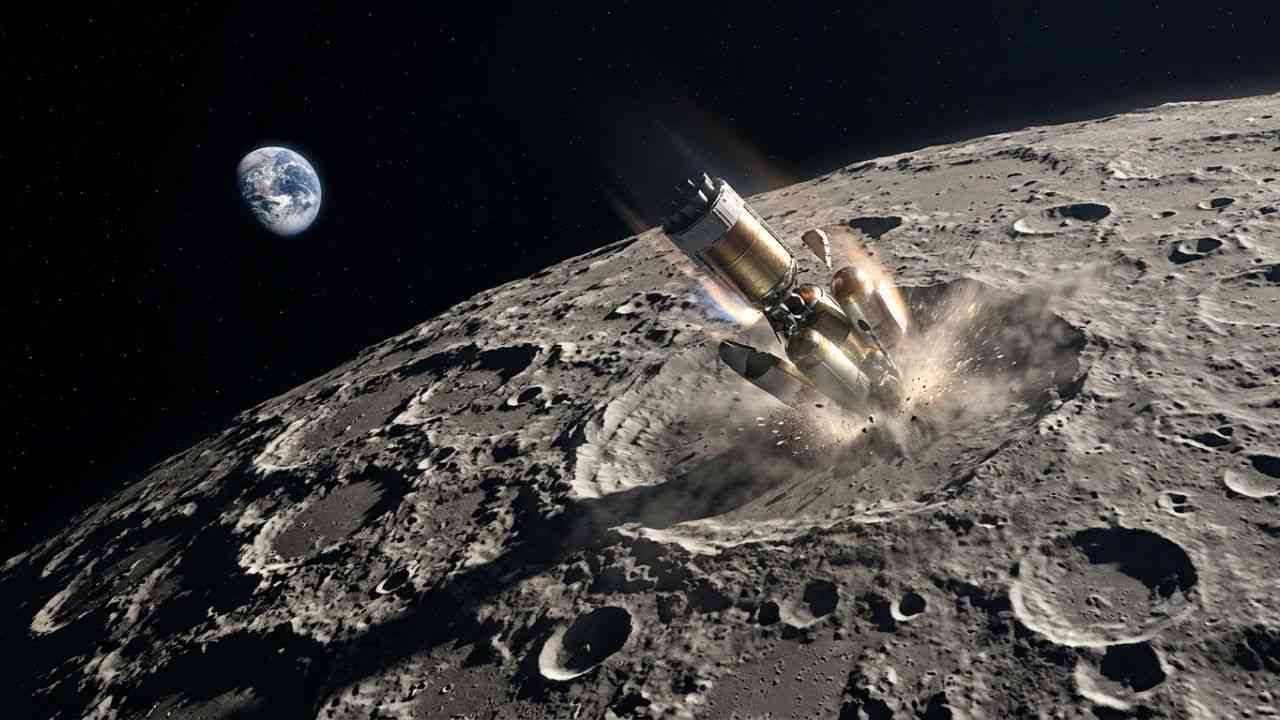
In 2 months, an abandoned SpaceX rocket stage will strike the Moon and probably carve out a new crater. This time, there will be no casualties. But the next piece of space junk left adrift may hit not an empty landscape, but a probe, a station, or a place where people are present.
On August 5, 2026, at 8:35 a.m. Polish time, the upper stage of a Falcon 9 rocket is expected to collide with the Moon. Although this is not the entire rocket, but an abandoned upper section, we are still speaking about an object whose size has been compared to a 5-story building. It will strike the lunar surface at about 2.43 km/s, roughly seven times the speed of sound in Earth’s atmosphere. It will be one of the more striking space events of 2026.
The collision will most likely occur near the Einstein crater, close to the boundary between the Moon’s near and far sides. This is an area marked by many traces of ancient impacts. The exact impact point remains uncertain. Sunlight acts on the abandoned rocket stage. Its pressure is very weak, but over many months it can slightly alter the object’s trajectory. That is difficult to calculate precisely because the rocket fragment is tumbling through space. Depending on its orientation, it reflects light differently, and therefore responds to that light in slightly different ways.
As we can read on the Project Pluto website, the second stage of the Falcon 9 orbits Earth every 26 days. When it is at perigee — the point closest to our planet — it is “only” 220,000 kilometers away. Later, however, it moves much farther out. In this way, its elongated orbit crosses the Moon’s orbit.
The Moon’s orbit and the orbit of this object basically cross.
— wrote astronomer Bill Gray on his project’s website.
In early August, however, the two objects will be in almost the same place at almost the same time. This will not be the 1st time a rocket stage has struck the surface of the Moon. Similar events have happened before, sometimes deliberately, as during the Apollo program, and sometimes accidentally. In 2022, a rocket stage associated with the Chang’e 5-T1 mission crashed on the far side of the Moon.
That collision left an unusual mark: a double crater on the Moon. After the August impact, a new crater will probably form as well, though it is not yet clear whether it will have an equally unusual shape. The effects of the impact may be photographed by the Lunar Reconnaissance Orbiter, NASA’s probe that has documented the lunar surface from orbit for years. Project Pluto notes that the odds are good that LRO will be able to image the crater caused by the Falcon 9 upper stage.
The rocket’s collision with the Moon will not pose a threat. There will be no people at the impact site, and no structures that could be damaged by falling rocket debris. The object’s mass is small compared with the scale of the Moon, and the impact location is very far from other active space missions.
The danger lies elsewhere. It concerns our children and grandchildren, the generations that will come after us. We are moving ever more boldly into the space around the Moon, but we still too often leave cosmic debris behind. Today, such a fragment may simply strike an empty region of the Moon. In the future, when more satellites, probes, stations, and perhaps bases operate around Earth and the Moon, similar space junk may become a real danger to infrastructure, missions, and people.
Spent rocket stages can, in many cases, be directed so that after completing their missions they enter orbit around the Sun and no longer threaten either Earth or the Moon for a long time. Sometimes this requires only a small additional maneuver. Project Pluto gives examples of later upper stages that were placed on paths leading into solar orbit, rather than being left in Earth-Moon space.
This collision therefore shows not so much a cosmic catastrophe as a lack of planning — one that will become harder to ignore as flights to the Moon develop. The Moon may be vast and empty today, but the era of treating space junk as someone else’s future problem is coming to an end.
Read this article in Polish: Rakieta SpaceX uderzy w Księżyc. To dopiero początek problemu


A graduate of journalism and social communication at the University of Rzeszów. She has been working in the media since 2019. She has collaborated with newsrooms and copywriting agencies. She has a strong background in psychology, especially cognitive psychology. She is also interested in social issues. She specializes in scientific discoveries and research that have a direct impact on human life.



Zmień tryb na ciemny