Science
Before There Are Planets, There Is Dust
16 October 2026





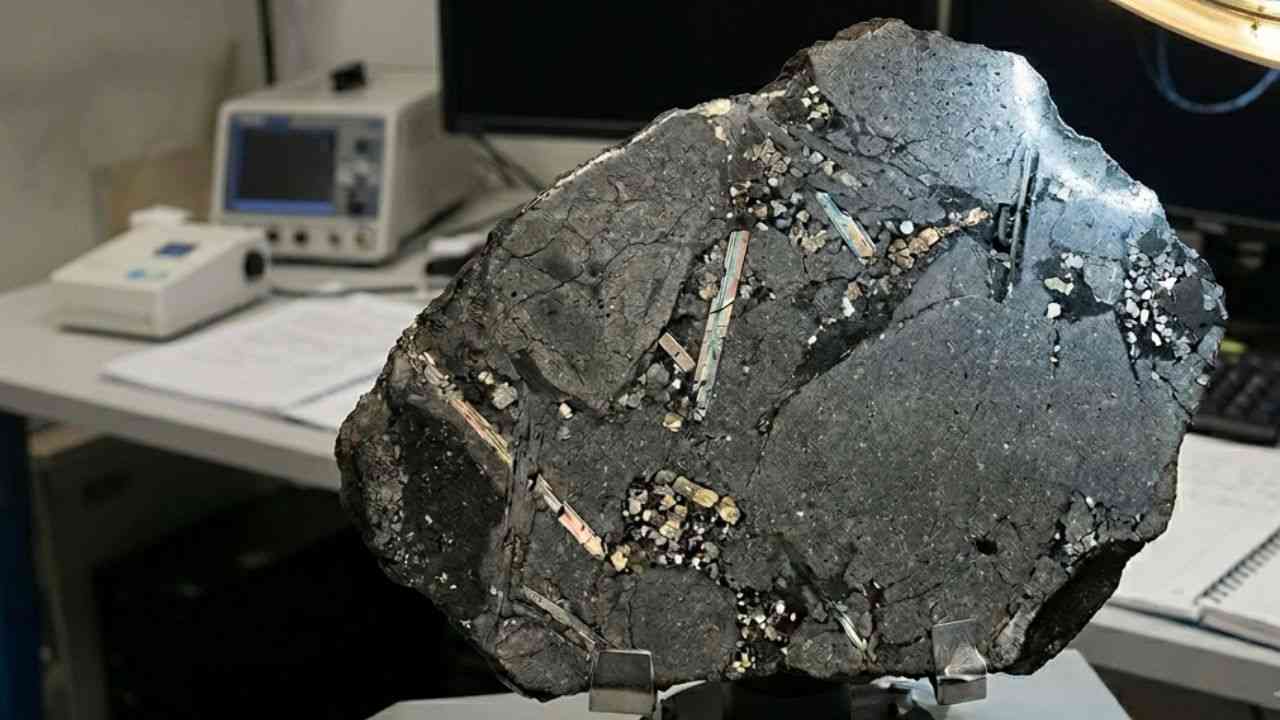
More than four billion years ago, another mysterious object may have existed in space. It resembled the Moon in size and, according to researchers, may once have orbited the Sun. Although it disappeared long ago, scientists have found a trace of this lost protoplanet in fragments that eventually reached Earth.
About four and a half billion years ago, the solar system was still a brutal and unstable place. Planets were only beginning to form, and whole worlds could vanish after a single cosmic collision. A new study by scientists including researchers from the New Mexico Institute of Mining and Technology and the University of Colorado Boulder suggests that one more large object existed in that chaos. In their view, it may have been a young, lost protoplanet whose catastrophe left behind only fragments. After billions of years, one of those fragments fell to Earth as a meteorite.
The meteorite in question is NWA 12774, found in the Sahara in 2019. It was no ordinary piece of space rock. This object from the solar system belongs to the angrites, an exceptionally rare group of very old stony meteorites.
Among all meteorites known on Earth so far, angrites make up only a tiny fraction. University of Colorado Boulder reports that out of more than 80,000 meteorites discovered on Earth, only 68 belong to this group. Angrites rank among the oldest known volcanic rocks in the solar system and formed within just a few million years of the solar system’s beginning, about 4.56 billion years ago.
According to researchers, angrites preserve remnants of a larger body that broke apart after a catastrophe. Scientists subjected one such fragment, the meteorite NWA 12774, to detailed analysis.
The article published in Earth and Planetary Science Letters reports that this discovery contains clinopyroxene crystals. This mineral, in this particular form, develops under very high pressure. For researchers, that served as an important clue: the rock could not have formed inside a small cosmic fragment. It must have come from the interior of a much larger celestial body. CU Boulder notes that NWA 12774’s clinopyroxene contained unusually high levels of aluminum, a chemical sign of formation under enormous pressure.
Calculations suggest that the parent body may have had a radius from about 1,000 to 3,300 kilometers. The crystals also survived in almost ideal condition, which suggests that they did not come from the deepest interior, but from a shallower part of a vast magma reservoir. Under that scenario, the ancient object may have had a radius of about 1,800 kilometers. That nearly matches the Moon’s radius, which is why scientists compare the lost body to our natural satellite.
Unfortunately, scientists do not yet know how this potential protoplanet suffered total destruction. They have several theories. One points to the gravity of young Jupiter, which may have helped tear apart a forming planet. Researchers still do not know whether the ancient world broke apart in one catastrophic impact or in a series of cosmic collisions.
No continents, craters, or moons remain from that vanished world. Only a stone survived — a fragment found in the desert after billions of years. And in that stone, the lost protoplanet left one of the few clues that it ever existed at all.
Read this article in Polish: Na Saharze znaleźli meteoryt. W środku był ślad zaginionego świata


A graduate of journalism and social communication at the University of Rzeszów. She has been working in the media since 2019. She has collaborated with newsrooms and copywriting agencies. She has a strong background in psychology, especially cognitive psychology. She is also interested in social issues. She specializes in scientific discoveries and research that have a direct impact on human life.


Zmień tryb na ciemny